Political ClimatePolitical Climate in Guilford, KS
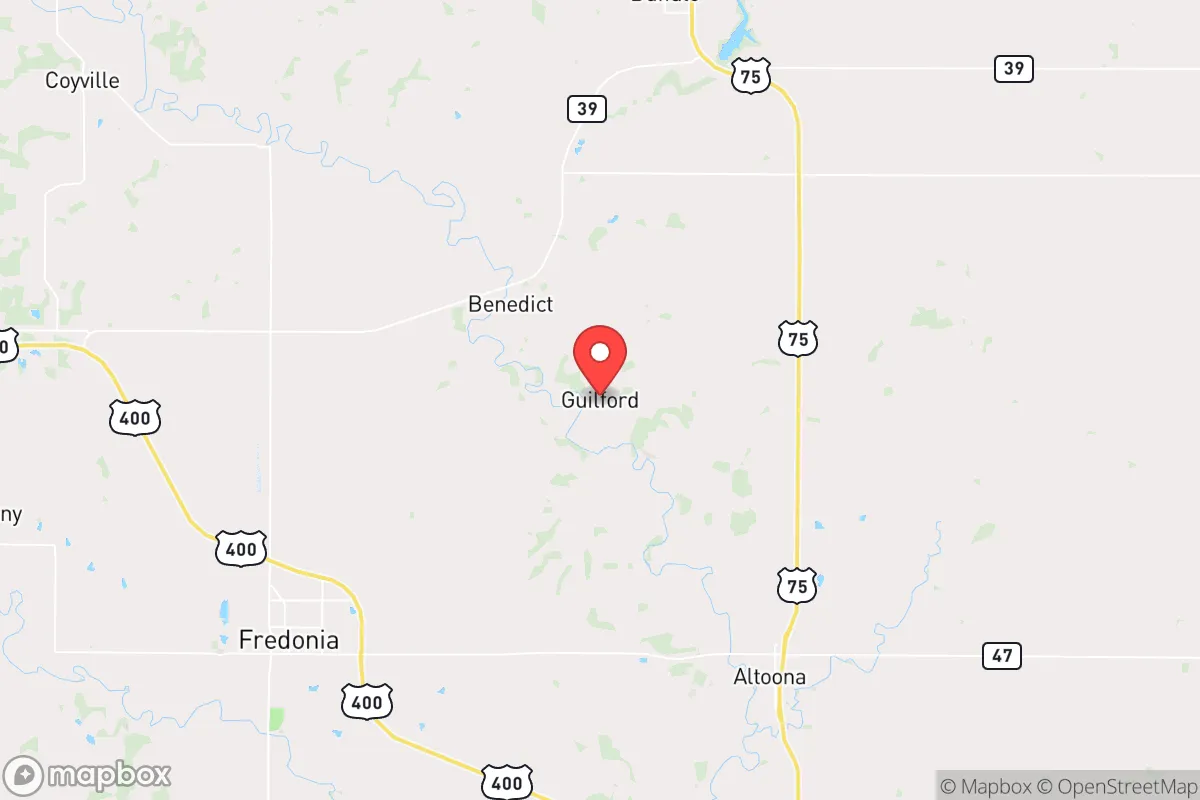
District shown is the primary district for this city’s centroid. Cities may span multiple districts.
Local Political AnalysisPolitical Analysis of Guilford, KS
Guilford, Kansas, leans solidly Republican, with a Cook Partisan Voting Index (PVI) of R+10, making it slightly more conservative than the state of Kansas as a whole, which sits at R+9. This isn't a new development; the area has been a Republican stronghold for generations, but the margin has tightened a bit in recent cycles as the suburbs around Wichita have shifted. You won't find many competitive local races here—primaries are where the real decisions get made. The political trajectory is stable, with no signs of a dramatic flip, though the growing influence of moderate Republicans and a small but vocal independent streak keeps things from being a total lockstep.
How it compares
Compared to the rest of Kansas, Guilford is a few points redder, but the difference is subtle in practice. The state as a whole has a mix of deep-red rural areas and more moderate suburbs, while Guilford sits squarely in the conservative rural camp. Nearby cities like Wichita (roughly 30 miles east) are more politically diverse, with a stronger Democratic presence in the urban core and a more competitive overall environment. In contrast, towns like Harper or Anthony to the south lean even further right, often pushing R+12 or R+13. Guilford sits in the middle of that spectrum—conservative, but not the most conservative in the region. The R+10 rating reflects a consistent Republican advantage of about 10 points in presidential elections, which is a bit more than the state's 9-point lean, but not dramatically so.
What this means for residents
For conservative residents, Guilford is a comfortable place where their views align with the majority of their neighbors and local elected officials. School board meetings, county commission decisions, and even zoning debates tend to reflect a small-government, low-tax philosophy. For liberal residents, the reality is more about finding your niche. You won't be alone—there are pockets of progressive thought, especially among younger families and some of the newer transplants from Wichita—but you'll likely be in the minority in most public forums. The practical impact is that local policy tends to favor gun rights, agricultural interests, and limited regulation. Socially, it's a place where church attendance is high and community events often have a conservative flavor. Neither side faces outright hostility, but the political climate is unmistakably right-leaning, and that shapes everything from the local news coverage to the candidates who bother to run.
Culturally, Guilford is more traditional and rural than the state average, with a stronger emphasis on agricultural values and a slower pace of life. Policy-wise, the area has been slower to adopt some of the more progressive state-level trends, like expanded Medicaid or marijuana decriminalization, even when those measures have broader support in Kansas. The local school board, for instance, has been cautious about curriculum changes that might be seen as too progressive. For a conservative, this feels like common sense; for a liberal, it can feel like a drag on progress. Either way, the political climate here is stable, predictable, and deeply rooted in the community's history—and that's not likely to change anytime soon.

State Political ClimatePolitical Climate in Kansas
State Political AnalysisPolitical Environment in the State
Kansas is a solidly Republican state with a Cook PVI of R+9, meaning it typically votes about nine points more Republican than the nation as a whole. Over the past 20 years, the state has shifted rightward in presidential elections—George W. Bush won it by 25 points in 2004, while Donald Trump carried it by 15 in 2016 and 14 in 2020—but that trend has moderated slightly as the Kansas City suburbs have drifted left. The dominant political coalition is a mix of rural conservatives, Wichita-area business Republicans, and a growing populist wing that has reshaped the state GOP from within. For a relocator, the practical reality is that Kansas is a reliably red state where conservative policy wins most battles, but the margins are close enough in some regions that Democrats hold real power in a few cities and counties.
Urban vs. rural divide
The political map of Kansas is a textbook study in the urban-rural split. The state's two major metros—the Kansas City area (Johnson, Wyandotte, and Douglas counties) and Wichita (Sedgwick County)—are the blue dots in a sea of red. Johnson County, the wealthiest and most populous county, has been trending Democratic for a decade: it voted for Hillary Clinton in 2016 and Joe Biden in 2020, and it now sends a mix of moderate Republicans and Democrats to the legislature. Lawrence, home to the University of Kansas in Douglas County, is the state's most reliably liberal city, often voting 70%+ Democratic. Wichita itself is more competitive—Sedgwick County went for Trump by about 5 points in 2020—but the city's core leans left while the surrounding suburbs and exurbs are deeply conservative. Outside these islands, the rest of Kansas is overwhelmingly Republican. Counties like Thomas (Colby), Grant (Ulysses), and Harper (Anthony) routinely vote 80-85% Republican. The divide isn't just about population density; it's also cultural. Western Kansas, dominated by agriculture and energy, votes like the High Plains of neighboring Colorado or Nebraska, while the eastern third of the state, anchored by the Kansas City suburbs and Topeka, is more moderate and economically diversified.
Policy environment
Kansas has a conservative policy environment shaped by decades of Republican control of the legislature and governorship. The state income tax is a flat rate of 5.7% as of 2026, down from a progressive top rate of 6.45% in 2020, following a series of cuts that began with the controversial Brownback tax experiment (2012-2017). Property taxes are locally set and relatively high for the region, averaging about 1.3% of home value, which funds schools and local services. The state has a right-to-work law, no statewide mask or vaccine mandates (those were banned by the legislature in 2023), and a constitutional amendment passed in 2024 that requires a two-thirds legislative supermajority to raise any tax. On education, Kansas funds its K-12 system through a formula that has been the subject of repeated lawsuits; the state Supreme Court has forced the legislature to increase funding several times since 2010. School choice is expanding: the 2024 legislature created education savings accounts (ESAs) worth roughly $5,000 per student for low- and middle-income families. On healthcare, Kansas did not expand Medicaid under the Affordable Care Act, leaving roughly 150,000 low-income adults in the coverage gap. Election laws have tightened: the 2021 Voting Access Act requires a photo ID for all ballots (including mail-in), limits drop boxes to one per county, and shortens the mail ballot return window. Abortion is legal up to 22 weeks, protected by a 2019 Kansas Supreme Court ruling and affirmed by voters who rejected a constitutional amendment in 2022 that would have removed that protection.
Recent policy direction
The last five years have seen Kansas move decisively in a conservative direction on most fronts, with some notable exceptions. On gun rights, Kansas is a permitless carry state (since 2015) and has a "stand your ground" law; the 2024 legislature passed a bill prohibiting local governments from enforcing federal gun regulations that conflict with state law. On parental rights and education, the 2023 "Parents' Bill of Rights" requires schools to notify parents of any curriculum involving sexuality and to obtain parental consent before a student can change their name or pronouns in school records. On speech and privacy, the state passed a law in 2024 banning TikTok on government devices and requiring social media platforms to verify the age of Kansas users. On medical and bodily autonomy, the 2022 abortion amendment vote was a landmark: despite the state's red lean, voters rejected the amendment 59-41%, preserving the existing legal framework. On property rights, Kansas has a strong eminent domain law that limits takings for private economic development, and the 2023 legislature banned local governments from enacting rent control. On taxation, the trend is toward lower and flatter rates: the 2024 tax cut package reduced the top income rate from 5.7% to 5.7% (it was already flat) and accelerated the phase-out of the state's estate tax. On voting and ballot access, the 2021 law made absentee voting harder but did not eliminate it; early in-person voting remains available in most counties. The overall direction is toward smaller government, lower taxes, and more local control, with the abortion vote serving as a reminder that Kansas voters will push back on social issues they see as too extreme.
Civil unrest & political movements
Kansas is not a state known for frequent civil unrest, but there have been notable flashpoints. The 2022 abortion amendment campaign saw massive grassroots organizing on both sides, with pro-choice groups outspending and out-organizing anti-abortion forces in a state that hadn't seen that level of single-issue mobilization in decades. Immigration politics are less heated than in border states, but there have been local controversies: in 2023, the city of Dodge City debated a "sanctuary city" ordinance that failed, while the legislature passed a law requiring local law enforcement to cooperate with federal immigration authorities. Election integrity has been a recurring theme: the 2020 and 2022 cycles saw Republican-led audits in a few counties (notably Sedgwick and Johnson), but no widespread fraud was found, and the state's voting system is generally considered secure. There is no serious secession or nullification movement in Kansas, though rural counties have occasionally floated the idea of joining a "Greater Nebraska" or forming a new state from western Kansas—these are fringe proposals with no legislative traction. What a new resident would notice most is the political polarization in everyday life: in Johnson County, you'll see Biden-Harris yard signs and "In This House We Believe" signs; in rural areas, you'll see Trump flags and "Don't Tread on Me" plates. The two Kansases coexist but don't mix much socially or politically.
Projection
Over the next 5-10 years, Kansas is likely to remain solidly Republican but with a slowly shrinking margin. The key demographic trend is the continued growth of Johnson County, which is becoming more diverse, more educated, and more Democratic with each election cycle. If Johnson County continues its leftward drift at the current pace, it could flip the state's presidential vote from R+14 to single digits by 2032—but that's a long way from competitive. Meanwhile, rural counties are depopulating, which reduces their electoral weight. The state's political future will be shaped by two forces: the suburbanization of the Kansas City metro and the aging of the rural base. For a relocator, this means the state will likely stay conservative on taxes, guns, and education, but may moderate on social issues like abortion and marijuana (medical cannabis has broad support but hasn't passed the legislature). The 2024 ESA expansion and the 2022 abortion vote suggest a pragmatic conservatism that is open to school choice and personal liberty but skeptical of government overreach. Expect more tax cuts, more school choice, and continued fights over Medicaid expansion and local control.
For a new resident, the bottom line is straightforward: if you're conservative, you'll find Kansas welcoming and aligned with your values on most issues. If you're liberal, you'll find your political home in Lawrence, parts of Kansas City, or pockets of Wichita, but you'll be in the minority statewide. The practical implications are that state government will continue to be Republican-controlled, taxes will stay low or go lower, and social policy will tilt conservative—but with enough moderation on specific issues (abortion, school funding) to avoid the most extreme outcomes. Your day-to-day experience will depend heavily on which Kansas you choose: the urban, diverse, left-leaning corridor along I-35 from Kansas City to Lawrence, or the rural, conservative, agricultural expanse that covers the other 95% of the state's land area. Pick your county carefully, and you'll find a community that fits.
* Values derived from national, state, county, city and local statistics and may differ in a specific area. Last updated: 2026-09-27T19:25:33.000Z
Narrative content on this page is AI-generated and may contain mistakes. Verify any details that matter before acting on them.
ReloMaps may earn a commission from affiliate links at no extra cost to you.

