Demographics of Guilford, KS
Affluence Level in Guilford, KS
A middle-class area roughly in line with national averages across income, home values, education, and employment.
People of Guilford, KS
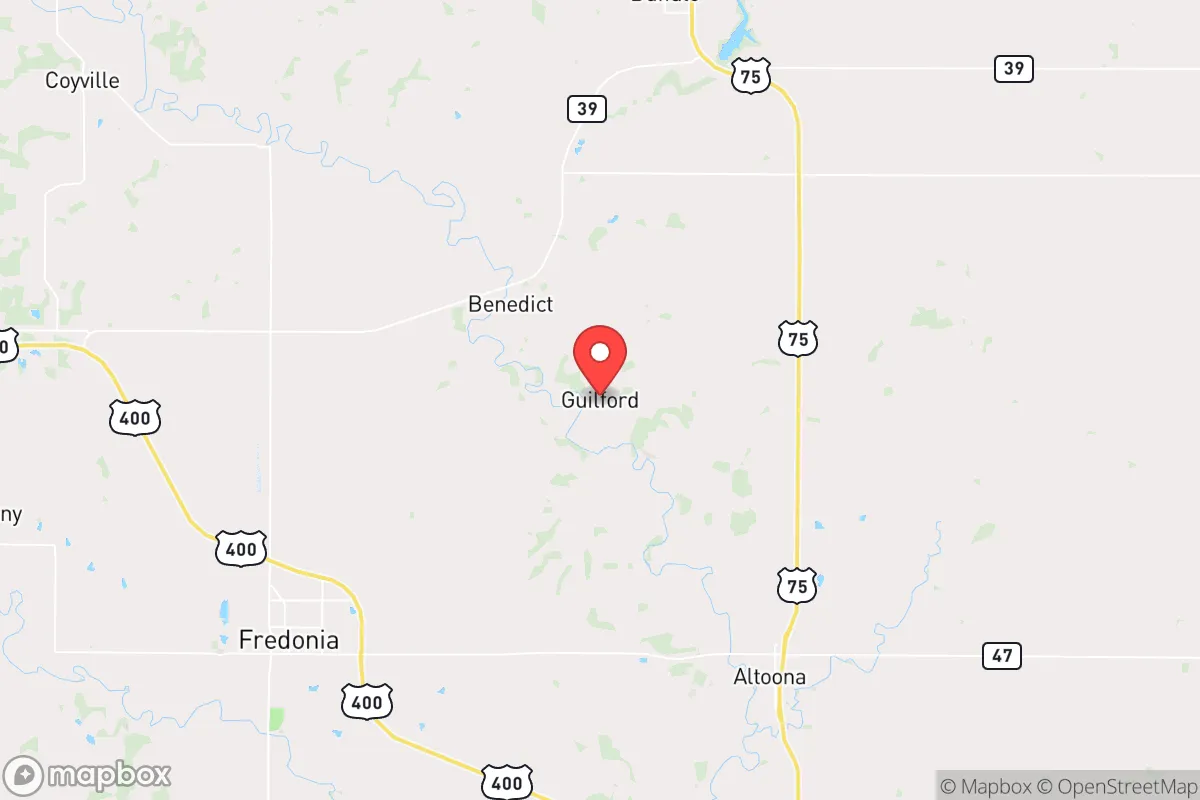
Guilford, Kansas, is a tiny, deeply rural community of 65 residents, where the population is overwhelmingly white (86.2%) and nearly entirely native-born, with 0.0% foreign-born residents. The city’s character is defined by its agricultural roots, low density, and a notably low college attainment rate of just 1.8%, reflecting a workforce historically tied to farming and manual labor. Distinctive markers include a strong sense of local heritage and a population that has remained remarkably homogenous and stable for generations.
How the city was settled and grew
Guilford’s human history begins with its founding in the late 19th century as a railroad stop and agricultural service center in Woodson County. The original population was drawn by the promise of fertile prairie land for homesteading, with the first settlers being predominantly white farmers of German and English descent who arrived via the expanding rail network. These early families built the core of the community around the railroad depot, an area now referred to as Old Town Guilford, where the original grain elevators and a handful of homes still stand. A second wave of settlement occurred in the early 1900s, when tenant farmers and sharecroppers, also white and largely from the Midwest, moved in to work the expanding wheat and cattle operations. They established a small residential cluster along what is now Main Street, building simple wood-frame houses and a single general store. No significant immigrant or minority populations settled in Guilford during this period; the town remained a homogenous, agrarian enclave through the mid-20th century, with its peak population never exceeding a few hundred.
Modern era (post-1965)
After 1965, Guilford experienced no major demographic shifts. The post-Hart-Cellar immigration waves that transformed many American towns bypassed Guilford entirely, as the area offered no industrial or service-sector jobs to attract foreign-born populations. Instead, the modern era has been defined by steady out-migration. Younger generations left for larger cities like Chanute or Iola, seeking education and employment, while the remaining residents aged in place. The East Side neighborhood, a small collection of homes near the old schoolhouse, saw many houses vacated as families moved away. The West End, a handful of properties along the county road, became home to a few retired farmers and long-term residents. The 0.0% figures for Hispanic, Black, Asian, and Indian populations in the data reflect a community that has not diversified at all in the modern era. The only notable change has been a slight increase in the number of second-home buyers or retirees from outside the county purchasing inexpensive properties, but these newcomers are also overwhelmingly white and native-born.
The future
The population of Guilford is heading toward further contraction and aging. With a current population of just 65 and a very low birth rate, the town is unlikely to see any significant growth. The lack of employment opportunities, combined with the absence of any new housing development or commercial investment, means that young adults will continue to leave. The Schoolhouse District, centered on the now-closed Guilford school building, has seen its few remaining homes occupied by older residents, and this pattern is expected to continue. The population will likely become even less diverse, remaining entirely white and native-born, as there are no economic or social pull factors for new immigrant or minority communities. Over the next 10-20 years, Guilford will likely shrink to a hamlet of fewer than 50 residents, with a cultural identity that remains rooted in its agricultural past but with fewer people to sustain local institutions like the church or the volunteer fire department.
Guilford is becoming a quieter, older, and smaller version of its already tiny self. For someone moving in now, this is a place where you will find deep community ties among a handful of families, but very few services, no diversity, and a population that is not expected to grow or change. It is best suited for those seeking extreme rural isolation and a low cost of living, with the understanding that the community’s future is one of gradual decline rather than renewal.

* Values derived from national, state, county, city and local statistics and may differ in a specific area. Last updated: 2026-09-27T19:25:33.000Z
Narrative content on this page is AI-generated and may contain mistakes. Verify any details that matter before acting on them.
ReloMaps may earn a commission from affiliate links at no extra cost to you.

