Photo: Wikipedia
Demographics of Gold Beach, OR
Affluence Level in Gold Beach, OR
A middle-class area roughly in line with national averages across income, home values, education, and employment.
People of Gold Beach, OR
Gold Beach, Oregon, is a small coastal town of 2,455 residents where the population is overwhelmingly white (80.0%) but has a notable Hispanic minority (10.6%) that is reshaping the local workforce and community life. With a foreign-born share of just 0.9%, this is a deeply native-born community, yet its identity is less about ethnic diversity and more about a working-class, resource-extraction heritage meeting a newer wave of remote workers and retirees. The town’s character is defined by the Rogue River, commercial fishing, and a quiet independence that reflects its rugged isolation from the rest of Oregon.
How the city was settled and grew
Gold Beach’s human history begins not with the city itself, but with the Tututni people, who inhabited the Rogue River mouth for millennia before white settlement. The first permanent American settlers arrived in the 1850s, drawn by gold placer mining along the river — the source of the town’s name. The original mining camp clustered around what is now the Wedderburn district on the river’s north bank, where the first general store and ferry landing were established. The town’s growth was slow and tied to extraction: timber, commercial salmon fishing, and small-scale farming on the fertile river flats.
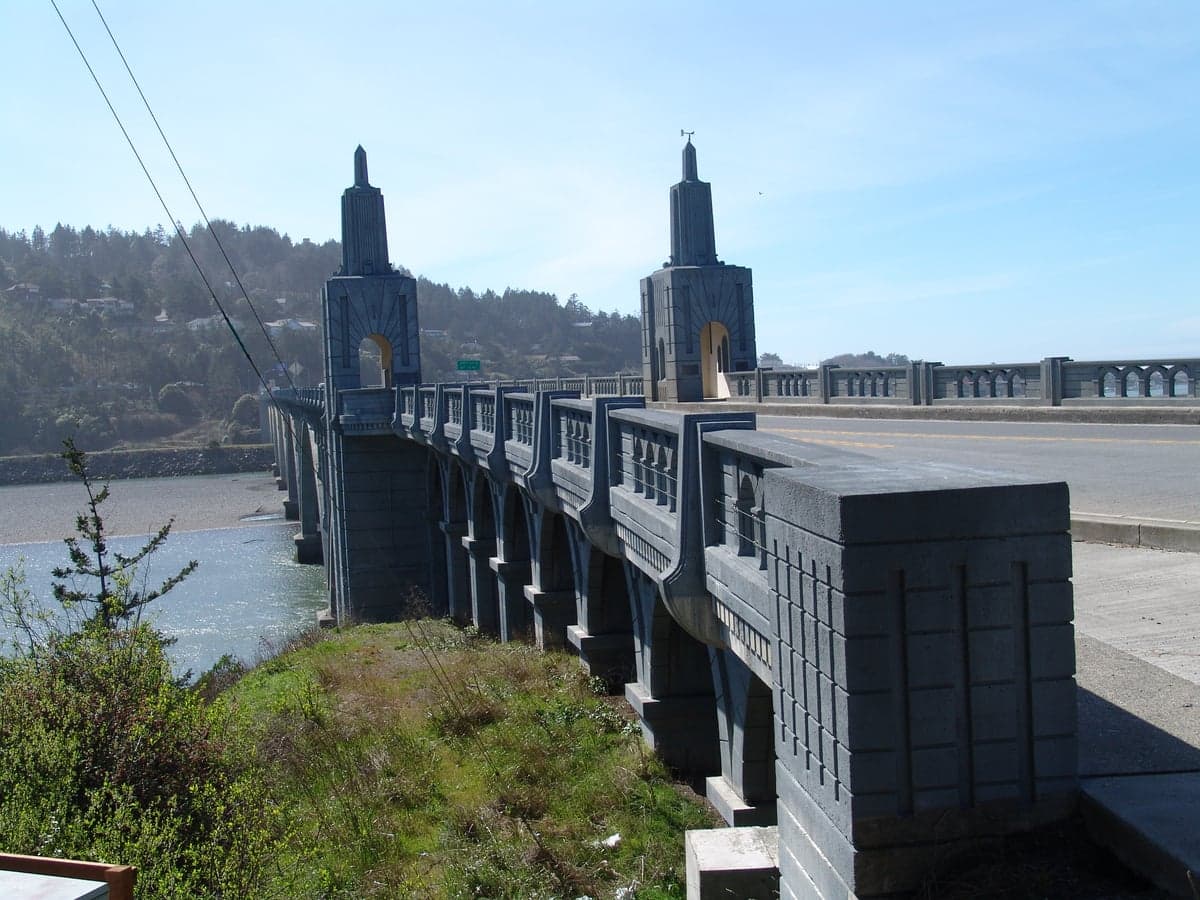
The most significant early population wave came with the construction of the Rogue River Bridge in 1932, which connected the town to the Oregon Coast Highway and ended its reliance on ferries. This opened the Harbor district — the flat land near the river mouth — to commercial development, attracting fishermen, cannery workers, and loggers who built modest homes on pilings and fill. The Jerry’s Flat area, slightly inland, became the working-class residential heart of the town, settled by the families of mill workers and river guides. By 1950, Gold Beach was a classic Pacific Northwest resource town: overwhelmingly white, male-dominated, and organized around the seasonal rhythms of fishing and logging.
Modern era (post-1965)
The post-1965 era brought two distinct demographic shifts. First, the decline of the timber industry in the 1980s and 1990s pushed out many working-age families, causing population stagnation. Second, the rise of jet boat tourism on the Rogue River and the growth of the South Beach neighborhood — a strip of motels, RV parks, and vacation rentals along the ocean — created a seasonal service economy that attracted a new, more transient workforce. This is where the Hispanic population (10.6%) concentrated, primarily in service roles in hospitality, landscaping, and commercial fishing support. Unlike many Oregon towns, Gold Beach’s Hispanic community is not a recent arrival; many families have been here for two or three generations, working in the fish processing plants that anchor the Port of Gold Beach district.
Meanwhile, the North Bank area, across the river, saw a quieter transformation. Retirees and remote workers from California and the Willamette Valley bought riverfront and hillside parcels, building newer homes that contrast sharply with the older, more modest housing stock in Jerry’s Flat. This has created a subtle economic divide: the North Bank and South Beach skew older, whiter, and more affluent, while the Harbor and Jerry’s Flat remain the working-class core. The college-educated share (20.1%) is concentrated almost entirely in these newer arrivals, not in the native-born population.
The future
Gold Beach’s population is aging and slowly diversifying. The white share (80.0%) is declining as older residents pass away and younger families move out for better job markets, while the Hispanic share (10.6%) is stable or slightly growing through natural increase. The town is not attracting significant new immigration — the 0.9% foreign-born figure is among the lowest in Oregon — so future diversity will come from domestic migration, not international arrivals. The most likely demographic trend over the next 10-20 years is continued slow growth, driven by remote workers and retirees seeking coastal affordability, with new housing concentrated in the Huntley Park area and the hills above the North Bank.
This will likely widen the cultural gap between the old resource-economy families and the new professional arrivals. The town’s identity is already shifting from a working fishing village to a tourism-and-retirement destination, and that trajectory will continue. The East/Southeast Asian population (0.3%) and Black population (0.2%) are negligible and unlikely to grow significantly given the lack of major employers or urban amenities.
For someone moving to Gold Beach today, the bottom line is this: you are entering a community that is still predominantly white and native-born, with a stable Hispanic minority that is integrated into the local economy, and a growing cohort of newcomers who are reshaping the housing market and civic life. The town is becoming more affluent and more oriented toward tourism and remote work, but it remains a place where the river, the ocean, and the resource economy still define daily life. If you are comfortable with a small, isolated community where everyone knows your business, Gold Beach offers a distinct, if narrowing, way of life.

* Values derived from national, state, county, city and local statistics and may differ in a specific area. Last updated: 2026-10-29T04:45:54.000Z
Narrative content on this page is AI-generated and may contain mistakes. Verify any details that matter before acting on them.
ReloMaps may earn a commission from affiliate links at no extra cost to you.

