Photo: Wikipedia
Political ClimatePolitical Climate in Muscogee County
Showing district-level results — no local-only data available.
Local Political AnalysisPolitical Analysis of Muscogee County
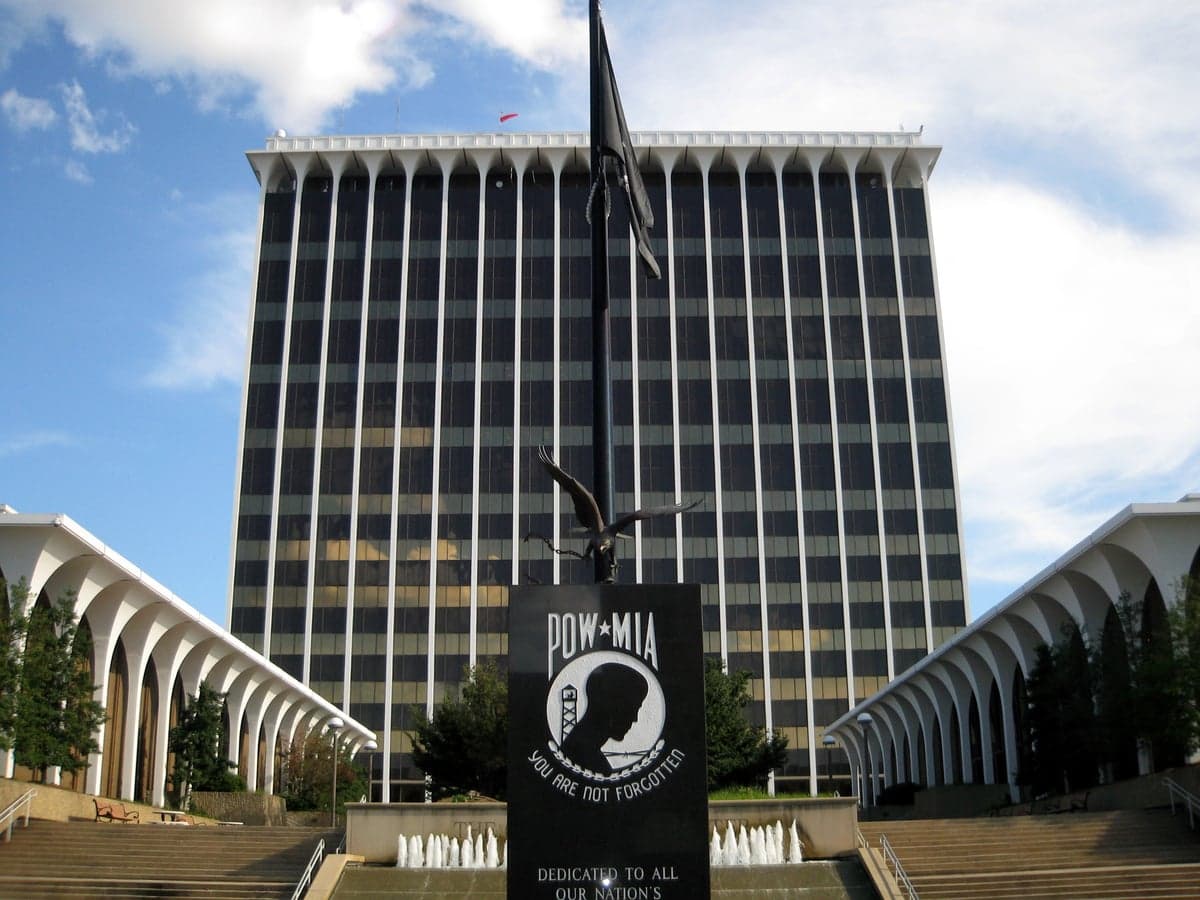
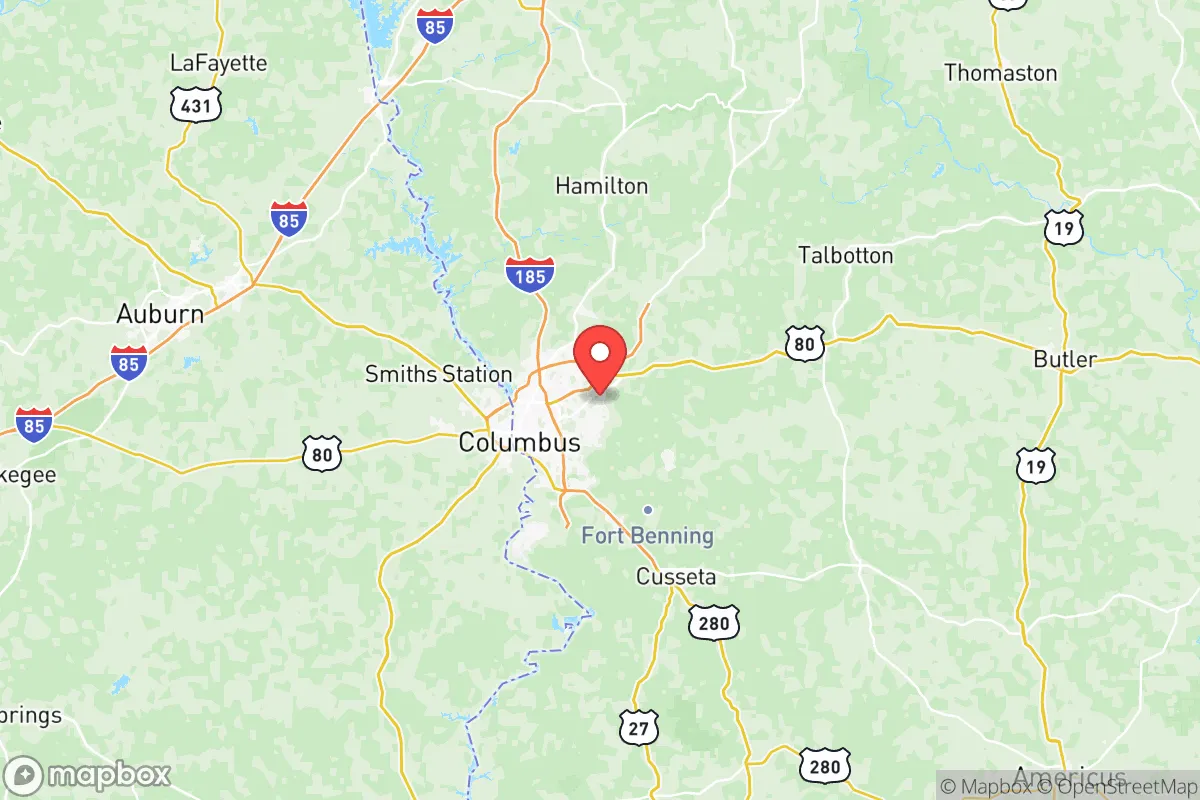
Muscogee County, anchored by Columbus, is a reliable Democratic stronghold in west Georgia, with a Cook PVI of D+4 that reflects a consistent 4-point Democratic lean relative to the national average. This isn't a recent shift—the county has voted Democratic in every presidential election since 1992, though the margins have tightened as the broader state has moved rightward. In 2020, Joe Biden won the county by about 15 points, down from Hillary Clinton's 18-point margin in 2016, signaling a slow but real drift toward competitiveness. The real story, though, is the stark divide within the county itself: the city of Columbus, especially its urban core and historically Black neighborhoods like Midtown and the area around Fort Moore (formerly Fort Benning), votes overwhelmingly blue, while the more rural, northern and eastern fringes—places like Bibb City, the Green Island Hills area, and the unincorporated communities near Upatoi Creek—lean just as heavily red. The swing precincts are mostly in the suburban middle-ring neighborhoods around the Columbus Airport and along the Manchester Expressway corridor, where ticket-splitting is common and local races can flip on turnout.
How it compares to Georgia as a whole
Georgia statewide has no official Cook PVI, but it's widely considered a toss-up or lean-Republican after 2024, where Trump won by roughly 2 points. That makes Muscogee County a clear outlier—one of the few deep-blue anchors in a state that's become a national battleground. Compared to metro Atlanta counties like Fulton or DeKalb, Muscogee is less overwhelmingly Democratic (those are D+30 or more), but it's far more Democratic than the surrounding rural counties like Harris, Talbot, or Chattahoochee, which vote Republican by 20-40 points. In practical terms, Muscogee is a blue island in a red sea: it provides the Democratic votes that keep statewide races competitive, but its influence is diluted by the massive Republican margins in the exurbs and small towns just a 20-minute drive away. The county's political trajectory mirrors Georgia's slow rightward shift, but at a slower pace—the Democratic margin here has only eroded by about 3 points since 2012, while the state as a whole has moved about 5 points redder over the same period.
What this means for residents
For liberal residents, Muscogee County offers a comfortable political home base within a conservative state. Local government in Columbus is reliably Democratic—the mayor, city council, and school board are all majority-Democrat—so progressive policies on housing, public transit, and police reform get a fair hearing. But you can't ignore the state-level reality: the Georgia General Assembly, controlled by Republicans, frequently preempts local ordinances on issues like gun laws, immigration, and property taxes. For conservative residents, the county can feel like a lonely outpost, but it's not hostile. The local Republican Party is active, and conservative candidates regularly win seats on the county commission and school board in the northern precincts. The real friction point is cultural: Columbus is a military town (Fort Moore is the county's largest employer), and that brings a mix of socially conservative veterans and more moderate, pragmatic officers, which keeps the political temperature lower than in, say, Atlanta or Savannah. You'll find as many "Don't Tread on Me" flags as "Black Lives Matter" signs in the same strip mall parking lot, and most people just get along.
One cultural distinction that shapes daily life: the county's strong military presence means a high turnover of residents from all over the country, which dilutes the deep partisan tribalism you see in more static communities. A soldier from California and one from Texas might share a beer at the same bar on Victory Drive, and that cross-pollination keeps the political rhetoric more pragmatic than ideological. The local news is dominated by base expansion, school funding, and infrastructure—not culture war flashpoints. For both conservatives and liberals, the takeaway is that Muscogee County is a place where your vote matters locally but gets swallowed up statewide, and where the political climate is more about getting things done than making a statement. If you're moving here, expect to live in a blue bubble with red neighbors, and plan to engage with local issues directly—because that's where the real power lies.

State Political ClimatePolitical Climate in Georgia
State Political AnalysisPolitical Environment in the State
Georgia has transformed from a reliably Republican stronghold into the nation’s most competitive swing state, with a partisan lean that now sits at a razor-thin margin. The state’s 16 electoral votes flipped blue for Joe Biden in 2020 by just 11,779 votes, and both Senate seats followed in 2021, powered by a coalition of suburban moderates, Black voters in metro Atlanta, and a rapidly diversifying electorate. Over the past 20 years, the GOP’s dominance has eroded from double-digit margins to a dead heat, driven by explosive growth in the Atlanta suburbs and a countervailing surge of rural Trump support.
Urban vs. rural divide
The political map of Georgia is a story of two Georgias. Metro Atlanta’s core counties—Fulton, DeKalb, Cobb, Gwinnett—are now solidly Democratic, with Gwinnett flipping blue in 2016 and Cobb following in 2020. These suburbs, once GOP bastions, have been reshaped by an influx of tech workers, immigrants, and young families drawn to jobs at Alpharetta and Sandy Springs. Meanwhile, the state’s rural and exurban areas—places like Rome in the northwest, Valdosta in the south, and Augusta’s outer ring—vote overwhelmingly Republican, often by 70-80% margins. The divide is stark: Fulton County alone cast more votes for Biden than the entire southern half of the state combined. The “donut” effect is real—the Atlanta core is deep blue, the immediate suburbs are purple trending blue, and the outer exurbs and small towns are deep red. Savannah (Chatham County) and Athens (Clarke County) are the only other reliably blue metros, while Columbus and Macon remain competitive but lean Republican in statewide races.
Policy environment
Georgia’s policy environment is a patchwork of conservative state-level control and local autonomy. The state has a flat income tax rate of 5.49% (set to drop to 4.99% by 2029), a low corporate tax rate, and a homestead exemption that keeps property taxes moderate. The legislature is firmly Republican, with a 33-23 Senate majority and a 102-78 House majority after the 2024 elections. Education policy is a flashpoint: the state has a universal school voucher program (the Georgia Promise Scholarship Act, passed in 2024) that allows $6,500 per student for private school or homeschooling, but it’s means-tested for families earning under 400% of the federal poverty line. The state also has a “Parents’ Bill of Rights” (SB 88, 2022) that requires schools to notify parents of any curriculum changes and allows them to opt their children out of materials they find objectionable. Healthcare is a mixed bag: Georgia did not expand Medicaid under the ACA, leaving roughly 300,000 residents in the coverage gap, but the state has a limited “Georgia Pathways” work requirement program. Election laws tightened after 2020 with SB 202 (2021), which added voter ID requirements for absentee ballots, limited drop boxes, and made it a crime to hand out food or water to voters in line. The state also has a “stand your ground” self-defense law and constitutional carry (permitless carry, effective 2022).
Recent policy direction
The last five years have seen Georgia lurch rightward on cultural and liberty issues, even as its electoral map tightens. On gun and self-defense law, the state passed constitutional carry (SB 319, 2022), allowing anyone 21 or older to carry a concealed firearm without a permit. On parental and education rights, the “Protect Students First Act” (SB 88, 2022) banned teaching of “divisive concepts” related to race and sex in public schools, and the “Georgia Promise Scholarship Act” (2024) created the voucher program. On speech and privacy, the state passed a “Heartbeat Bill” (HB 481, 2019) banning abortion after six weeks, which was later superseded by a near-total ban (SB 140, 2024) with exceptions only for rape, incest, and life of the mother. On medical and bodily autonomy, the state has banned gender-affirming care for minors (SB 140, 2023) and restricted puberty blockers and hormone therapy. On property rights, Georgia is a “right-to-farm” state with strong protections for agricultural operations against nuisance lawsuits. On taxation, the state is phasing down its income tax to a flat 4.99% by 2029, and has eliminated the state sales tax on groceries. On voting and ballot access, SB 202 (2021) remains the most consequential law, with critics arguing it suppresses turnout and supporters saying it restores confidence. The state also passed a law (HB 974, 2023) that allows the State Election Board to take over local election boards in counties with “performance issues,” a move that has sparked controversy in Democratic-leaning counties like Fulton and DeKalb.
Civil unrest & political movements
Georgia has been a focal point for political activism on both sides. The 2020 election aftermath saw massive protests in Atlanta over police brutality (the “Cop City” protests at the proposed police training center in DeKalb County) and the “Stop the Steal” movement, which culminated in a January 2021 rally at the state capitol. The “Stop Cop City” movement has been one of the most sustained activist campaigns in the state, with environmental and racial justice groups opposing the $90 million training facility. Immigration politics are heated: Georgia has a “sanctuary city” ban (HB 87, 2011) that prohibits local governments from adopting policies that limit cooperation with federal immigration enforcement, and the state has seen high-profile raids at poultry plants in Gainesville and Dalton. Election integrity remains a live issue: the State Election Board’s 2023 takeover of the Fulton County elections board was challenged in court, and the 2024 election saw record turnout despite the new restrictions. The state has also seen a rise in “election integrity” activist groups on the right, while left-leaning groups like Fair Fight (founded by Stacey Abrams) continue to mobilize voters. A new resident would notice the political polarization in everyday life: yard signs, bumper stickers, and even church affiliations can signal political allegiance, especially in the suburbs.
Projection
Over the next 5-10 years, Georgia is likely to remain a toss-up state, but the demographic trends favor a slow shift toward the center-left. The Atlanta metro is projected to add 1.5 million people by 2030, with most growth in the diverse, college-educated suburbs of Gwinnett, Cobb, and Forsyth counties. These voters tend to be fiscally moderate and socially liberal, which could push the state toward a more “purple” policy mix—think expanded Medicaid, more school choice, and a softening of the abortion ban. However, the rural and exurban vote is not shrinking; it’s just being diluted. The state’s Republican legislature is likely to continue passing conservative cultural legislation (on transgender issues, education, and immigration) to energize the base, but the governor’s race and Senate races will remain competitive. The wild card is the 2026 gubernatorial election: if a Democrat wins, expect a rapid shift in policy direction, including Medicaid expansion and a rollback of the abortion ban. If a Republican holds the seat, the current trajectory of incremental conservative policy changes will continue. For a relocator, the practical takeaway is that Georgia’s political future is uncertain but dynamic—the state is a laboratory for the national political battle, and your vote will matter more here than in almost any other state.
For a new resident, the bottom line is that Georgia offers a low-tax, business-friendly environment with a conservative cultural tilt at the state level, but with deep blue pockets in the cities where progressive policies dominate locally. If you’re a conservative, you’ll find a state government that generally aligns with your values on guns, taxes, and education, but you’ll also live in a state where the political conversation is constantly shifting. If you’re a liberal, you’ll find a vibrant, activist community in Atlanta and the college towns, but you’ll face a state government that is actively hostile to many of your priorities. The practical reality is that Georgia is a place where your local government—city council, county commission, school board—has more direct impact on your daily life than the state capitol, and those local races are often decided by a few hundred votes. Choose your county carefully, and get ready to vote in every election.
* Values derived from national, state, county, city and local statistics and may differ in a specific area. Last updated: 2026-08-04T04:25:05.000Z
Narrative content on this page is AI-generated and may contain mistakes. Verify any details that matter before acting on them.
ReloMaps may earn a commission from affiliate links at no extra cost to you.

