
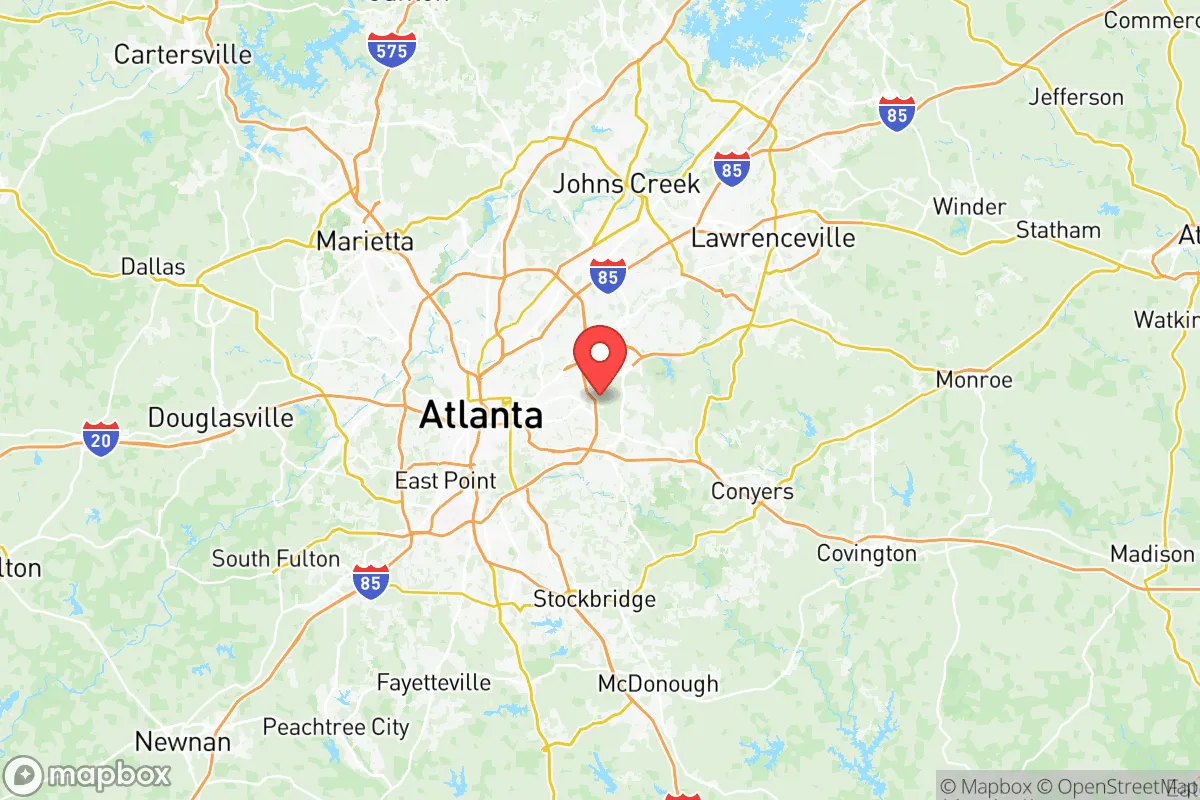
Photo: Wikipedia
Political ClimatePolitical Climate in Dekalb County
Showing district-level results — no local-only data available.
Local Political AnalysisPolitical Analysis of Dekalb County
Look, I’ve lived in DeKalb County long enough to watch it shift from a moderate, business-friendly place into one of the most reliably blue jurisdictions in the entire South. The Cook PVI sits at D+27, which means Democrats win here by an average of 27 points more than they do nationally. That’s not a lean—that’s a landslide. And it’s a far cry from the rest of Georgia, which sits at Cook PVI EVEN—a true battleground state that flipped blue in 2020 but still has enough red in the exurbs and rural areas to keep things competitive. In DeKalb, you’re not just voting blue; you’re voting deep blue, and the trajectory has been that way for a generation.
How it compares
If you drive across DeKalb, you’ll see the political divide play out in real neighborhoods. The core of the county—places like Decatur, Avondale Estates, and the Candler Park area near Atlanta—are as progressive as anywhere in the country. You’ll see yard signs for candidates who want to defund the police, raise property taxes for social programs, and push zoning changes that let developers build high-density apartments in single-family neighborhoods. Meanwhile, head east to Stone Mountain or south to Ellenwood, and you’ll find precincts that still vote Republican—sometimes by 10 or 15 points. Those are the folks who remember when DeKalb was a place where local government stayed out of your business. Now, the county commission and school board are dominated by progressive Democrats who’ve passed things like a $15 minimum wage for county contractors, sanctuary city policies limiting cooperation with ICE, and a controversial “equity” ordinance that gives preferential treatment in contracting based on race and gender. Compare that to the state level, where Republicans still control the legislature and governor’s mansion—and you get a constant tug-of-war. The state has preempted DeKalb on things like gun carry laws, mask mandates, and even property tax caps. So residents here live under two very different governments: a local one that leans hard left, and a state one that checks those impulses.
What this means for residents
For a conservative or even a moderate, living in DeKalb means you’re constantly fighting against government overreach. The county has tried to mandate paid sick leave for all private employers—struck down by the state. It’s pushed for rent control and eviction moratoriums that make it harder for landlords to operate. The school board has implemented critical race theory-inspired curriculum and banned police officers from schools, even as crime in some parts of the county has ticked up. Property taxes are among the highest in Georgia, and they keep rising because the county keeps spending. If you value personal freedom—like the right to keep your guns, run a small business without endless red tape, or send your kid to a school that focuses on academics over activism—you’ll feel the squeeze here. The long-term trend is concerning: as more people move from Atlanta proper into DeKalb for cheaper housing, they bring the same progressive voting habits. The swing precincts in Tucker and Dunwoody are slowly turning blue. I don’t see it reversing anytime soon.
Culturally, DeKalb is a mixed bag. You’ve got the historic African-American communities in Lithonia and Redan that have deep roots and a more traditional, church-going conservatism on social issues—but they vote straight-ticket Democratic because of national politics. Then you’ve got the influx of young professionals and transplants who see government as a tool for social engineering. The policy distinctions are real: DeKalb was one of the first counties in Georgia to declare itself a “Second Amendment Sanctuary” back in 2013, but that was before the current board took over. Now, they’re more likely to pass resolutions opposing state gun laws than enforcing them. If you’re thinking of moving here, just know you’re signing up for a place where your vote for local office won’t count for much if you lean right—and your personal freedoms will be under constant debate.

State Political ClimatePolitical Climate in Georgia
State Political AnalysisPolitical Environment in the State
Georgia is a true battleground state, with a Cook PVI of EVEN, meaning it is perfectly split between the two major parties after a dramatic 20-year shift. Once a reliably Republican stronghold in the South, Georgia has become the nation’s most watched political prize, driven by explosive growth in the Atlanta metro area and a countervailing surge of conservative energy in the exurbs and rural counties. The state’s political soul is now fought over between the deep-red small towns and the increasingly blue, diverse suburbs of Atlanta, creating a volatile and high-stakes environment for anyone considering a move here.
Urban vs. rural divide
The political map of Georgia is a story of two Georgias. The Atlanta metro core—including Fulton, DeKalb, Cobb, and Gwinnett counties—has become a Democratic stronghold, powered by a coalition of young professionals, African American voters, and transplants from blue states. In 2020, Joe Biden won Fulton County by over 400,000 votes alone, a margin that erased Republican leads across the rest of the state. Meanwhile, the rural and small-town counties in South Georgia, like Colquitt, Tift, and Brooks, vote Republican by 70-80% margins. The real battleground is the exurban ring: counties like Forsyth, Cherokee, and Paulding, which are growing fast and remain reliably red, but are seeing demographic pressure from Atlanta’s sprawl. A notable flashpoint is the city of Savannah (Chatham County), which has trended blue, while the surrounding coastal counties like Bryan and Effingham remain deeply conservative. The political divide is not just geographic—it’s cultural, with Atlanta’s progressive urbanism clashing directly with the traditional, agrarian values of the rest of the state.
Policy environment
Georgia’s state-level policy environment is a mixed bag for conservatives. On the positive side, the state has a flat income tax rate of 5.49% (down from 6% in 2022), with a path to a lower rate if revenue targets are met. There is no state estate tax, and property taxes are relatively low, especially in rural counties. The regulatory climate is business-friendly, with a right-to-work law and a low corporate tax rate. However, the education landscape is contentious. Governor Brian Kemp signed the Georgia Promise Scholarship Act in 2024, creating a $6,500 education savings account for students in low-performing schools—a win for school choice advocates. But the state’s public school system remains heavily union-influenced in metro Atlanta, and curriculum battles over Critical Race Theory and gender ideology have been fierce. On healthcare, Georgia did not expand Medicaid, a point of pride for fiscal conservatives, but the state’s Certificate of Need (CON) laws still restrict competition in healthcare, keeping costs high. Election integrity is a major issue: the 2021 Election Integrity Act (SB 202) tightened voter ID requirements for absentee ballots, limited drop boxes, and banned mobile voting centers. This law has been praised by conservatives as necessary for security and condemned by progressives as voter suppression—a flashpoint that will define the state’s politics for years.
Trajectory & freedom
Georgia’s trajectory on personal freedom is a tug-of-war. On the positive side, the state has seen a significant expansion of gun rights. In 2022, Governor Kemp signed a permitless carry law (HB 218), allowing any legal gun owner to carry a concealed firearm without a license. This was a major victory for Second Amendment advocates. Parental rights also saw a win with the passage of the “Parents’ Bill of Rights” (HB 1178) in 2022, which requires schools to notify parents of any medical or counseling services provided to their children and prohibits instruction on gender identity in elementary grades. However, the state’s medical autonomy is under threat. While Georgia has a limited medical cannabis program, it remains one of the strictest in the nation, and recreational marijuana is illegal. More concerning for freedom-minded residents is the state’s aggressive use of eminent domain for private development projects, particularly in the Atlanta area. Property rights are also being tested by the growth of homeowners’ associations (HOAs) in new subdivisions, which impose restrictive covenants that limit personal expression. The biggest threat to freedom, however, is the cultural shift in metro Atlanta, where local governments are increasingly adopting progressive policies on housing, zoning, and policing that can feel like government overreach to newcomers from more libertarian states.
Civil unrest & political movements
Georgia has been a hotbed of political activism on both sides. The 2020 election cycle saw massive protests in Atlanta following the death of George Floyd, with the city experiencing significant property damage and a spike in crime that has yet to fully subside. The “Stop Cop City” movement, which opposes the construction of a police training facility in Atlanta’s South River Forest, has become a national flashpoint for left-wing activism, with violent clashes and arson attacks. On the right, the Georgia Republican Party has been energized by grassroots groups like the Georgia Freedom Caucus and the Georgia Gun Rights Coalition, which have pushed for more aggressive legislation on election integrity and gun rights. Immigration politics are also volatile: while Georgia is not a sanctuary state, the city of Atlanta and several metro counties have adopted “welcoming city” policies that limit cooperation with ICE. This has led to a backlash in rural areas, where sheriffs have publicly declared their intent to fully enforce federal immigration law. The 2024 election cycle saw a surge in “election integrity” volunteers on the right, with groups like True the Vote training poll watchers and challenging voter rolls. A new resident should expect to see political signs, bumper stickers, and yard flags everywhere, especially in the exurbs, where the culture war is fought daily.
Projection
Over the next 5-10 years, Georgia is likely to become even more competitive, with the Atlanta metro’s growth continuing to pull the state leftward, while the exurbs and rural areas dig in deeper. The state’s population is projected to grow by another 1.5 million people by 2030, with most of that growth in the Atlanta region. This will likely make statewide elections a coin flip, with the outcome determined by turnout in a handful of swing counties like Cobb, Gwinnett, and Forsyth. For a conservative moving in now, the expectation should be that the state’s political environment will remain highly polarized, with no clear majority for either party. The good news is that the state’s constitutional structure—with a Republican-controlled legislature and a Republican governor—provides a buffer against the most progressive impulses of the Atlanta metro. However, if Democrats ever win the governorship and both chambers of the legislature, the state could see a rapid shift toward California-style policies on taxes, regulation, and social issues. The key variable is in-migration: if the new arrivals are mostly from blue states, the state’s political center of gravity will shift left. If they are from red states or are conservative-leaning, the balance could hold.
For a new resident, the bottom line is that Georgia offers a low-tax, business-friendly environment with strong gun rights and a growing school choice program, but it comes with a high level of political volatility. You will need to be politically engaged to protect your freedoms, especially at the local level, where school boards and county commissions are the front lines of the culture war. If you are moving to the exurbs of Forsyth or Cherokee County, you will find a conservative community that largely shares your values. If you are moving to Atlanta proper or its inner suburbs, you will be living in a blue enclave where progressive policies are the norm. Choose your county carefully, and be prepared for the fight.
* Values derived from national, state, county, city and local statistics and may differ in a specific area. Last updated: 2026-05-12T09:42:34.000Z
Narrative content on this page is AI-generated and may contain mistakes. Verify any details that matter before acting on them.
ReloMaps may earn a commission from affiliate links at no extra cost to you.

