
Photo: Wikipedia
Demographics of Dekalb County
Affluence Level in Dekalb County
A middle-class area roughly in line with national averages across income, home values, education, and employment.
People of Dekalb County
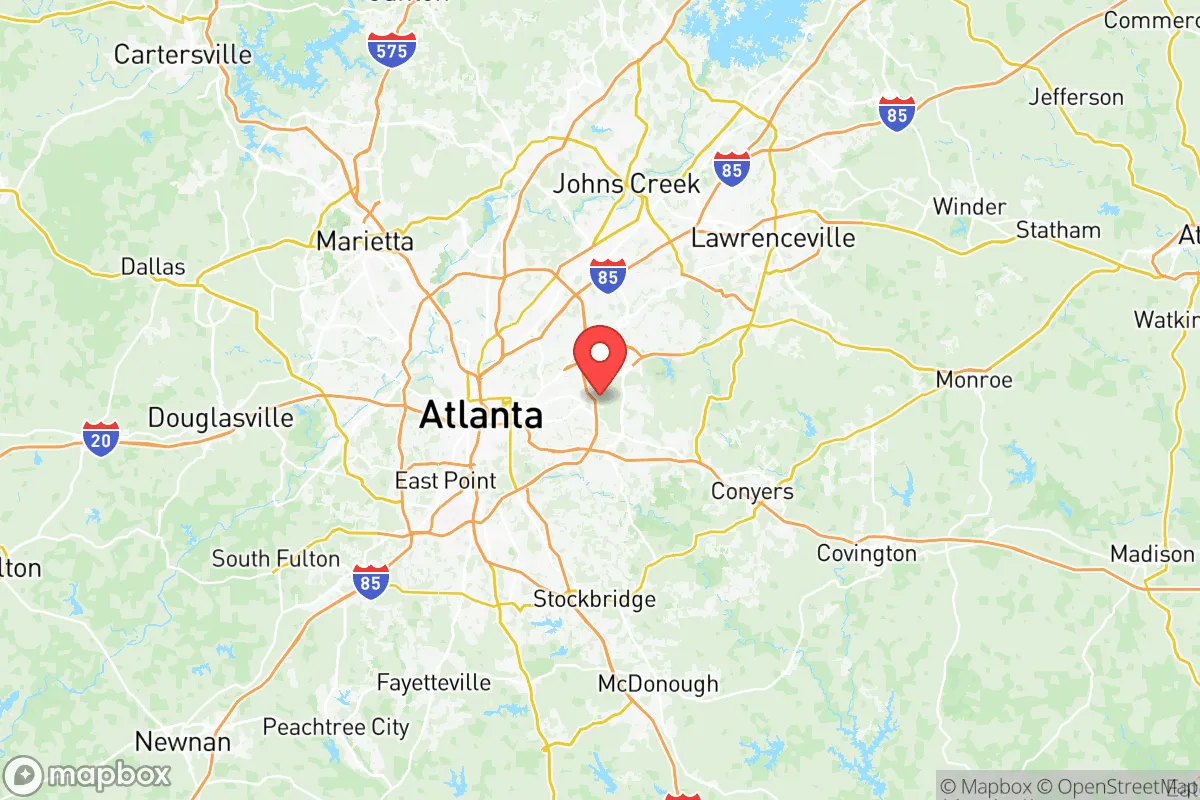
DeKalb County, Georgia, is a majority-Black, densely populated suburban core of metro Atlanta, home to 762,105 residents as of 2025. Its population is 51.1% Black or African American, 28.1% white, 10.4% Hispanic, 3.3% East and Southeast Asian, and 2.8% Indian subcontinent, with 46.7% of adults holding a college degree. The county’s identity is shaped by its role as a historic center of Black political and economic power in the South, a destination for post-1965 immigrant communities, and a rapidly diversifying suburban landscape that still retains pockets of its old white, rural, and Jewish heritage.
Settlement & growth (pre-1960)
Before European settlement, the area now known as DeKalb County was part of the ancestral homeland of the Creek and Cherokee nations. The Creek controlled the southern portion, while the Cherokee held the northern hills. Both nations were forcibly removed during the 1830s Trail of Tears, opening the land to white settlers from the Upper South. The county was created in 1822 from parts of Henry, Gwinnett, and Fayette counties, named after a Revolutionary War hero, and its early economy was built on cotton plantations worked by enslaved Black laborers.
The first major white wave came from Virginia, North Carolina, and South Carolina in the 1820s–1840s, drawn by cheap land grants in the Georgia Land Lotteries. These settlers were predominantly of English and Scots-Irish stock, and they established small farming communities that later became the towns of Decatur (the county seat, founded 1823), Stone Mountain (a granite-quarrying village), and Lithonia (a railroad depot for cotton and timber). By 1860, enslaved Black people made up roughly 40% of the county’s population, concentrated on plantations around Scottdale and Clarkston.
After the Civil War and Reconstruction, many freed Black families remained as sharecroppers and tenant farmers, forming the foundation of DeKalb’s Black rural communities. The county remained overwhelmingly white and agricultural through the early 1900s, but the 1910s–1930s brought a new wave: Jewish immigrants from Eastern Europe, who settled in Avondale Estates and Decatur, establishing small businesses and synagogues. The 1940s–1950s saw the first major suburban boom, as white families from Atlanta moved east to escape the city’s growing Black population, aided by the construction of the Stone Mountain Freeway and the expansion of Emory University. By 1960, DeKalb was 85% white, with a small but growing Black middle class concentrated in Candler-McAfee and Panthersville.
Modern era (post-1965)
The 1965 Hart-Cellar Act and the Civil Rights Movement transformed DeKalb County’s population. The most dramatic shift was the Great Migration of Black Americans from the rural South and the urban North into Atlanta’s expanding suburbs. Between 1970 and 2000, DeKalb’s Black population surged from 15% to over 50%, driven by white flight to outer counties and the construction of affordable housing in Stonecrest and Redan. By 2025, Black residents make up 51.1% of the population, making DeKalb one of the most heavily Black suburban counties in the United States. This community is diverse within itself, including descendants of the original freedmen, second- and third-generation migrants from Chicago and Detroit, and recent immigrants from Nigeria, Ghana, and Ethiopia.
The post-1965 immigration wave also reshaped the county. The Hispanic population, now 10.4%, began arriving in the 1980s, primarily from Mexico and Central America, drawn by construction and service jobs in the booming Atlanta metro. They concentrated in Chamblee and Doraville, where Buford Highway became a corridor of Latin American restaurants, bodegas, and churches. The East and Southeast Asian community (3.3%) arrived in two phases: first, Chinese and Taiwanese professionals in the 1980s–1990s, settling near Emory University and the Centers for Disease Control in Druid Hills; second, Vietnamese and Korean refugees and their families, who established a commercial hub in Clairmont Heights and North Decatur. The Indian subcontinent population (2.8%) grew rapidly after 2000, driven by H-1B visa holders in tech and healthcare, with a visible concentration in Johns Creek (which was part of DeKalb until 2017) and Dunwoody.
Domestic migration has also been significant. Since 2010, DeKalb has attracted young white professionals and empty-nesters from the Northeast and West Coast, drawn by its proximity to Atlanta’s job centers, its historic housing stock, and its liberal politics. This has gentrified neighborhoods like Decatur’s Oakhurst and Avondale Estates, pushing up home prices and displacing some long-term Black residents. The county’s foreign-born share is 8.8%, lower than neighboring Gwinnett (24%) but higher than the national average, reflecting a population that is still majority native-born.
The future
DeKalb County’s population is likely to continue diversifying, but not homogenizing. The Black majority is projected to shrink slightly as white and Hispanic in-migration continues, while the Asian and Indian communities are expected to grow, particularly in the northern parts of the county. The county is tribalizing into distinct enclaves: Black middle-class suburbs like Stonecrest and Lithonia remain heavily Black; Hispanic Chamblee and Doraville are becoming more pan-Latino; and white gentrifiers cluster in Decatur and Avondale Estates. The Indian and East Asian communities are more dispersed but concentrated in the higher-income northern tier.
Immigrant communities are growing but plateauing in some areas. The Hispanic population is stabilizing as immigration from Mexico slows, while the Indian community continues to expand through tech-sector recruitment. Assimilation is uneven: second-generation Hispanic and Asian residents are moving to outer suburbs like Gwinnett and Forsyth, while the Black population remains more rooted. The county’s cultural identity is becoming more cosmopolitan, but its political character—solidly Democratic, with a strong Black political establishment—is unlikely to change in the next decade.
DeKalb County is becoming a multiethnic, majority-minority suburban powerhouse, where Black political and cultural influence remains central but is increasingly shared with Hispanic, Asian, and white newcomers. For a conservative-leaning individual or family moving in now, the county offers a dense, diverse, and liberal environment with strong public schools in the north and west, but also higher taxes and crime concerns in some southern areas. The population is heading toward a more fragmented but stable mosaic, not a melting pot, and newcomers should expect to find their own niche rather than a single unified community.

* Values derived from national, state, county, city and local statistics and may differ in a specific area. Last updated: 2026-05-12T09:42:34.000Z
Narrative content on this page is AI-generated and may contain mistakes. Verify any details that matter before acting on them.
ReloMaps may earn a commission from affiliate links at no extra cost to you.

