
Photo: Wikipedia
Political ClimatePolitical Climate in Bibb County
Showing district-level results — no local-only data available.
Local Political AnalysisPolitical Analysis of Bibb County
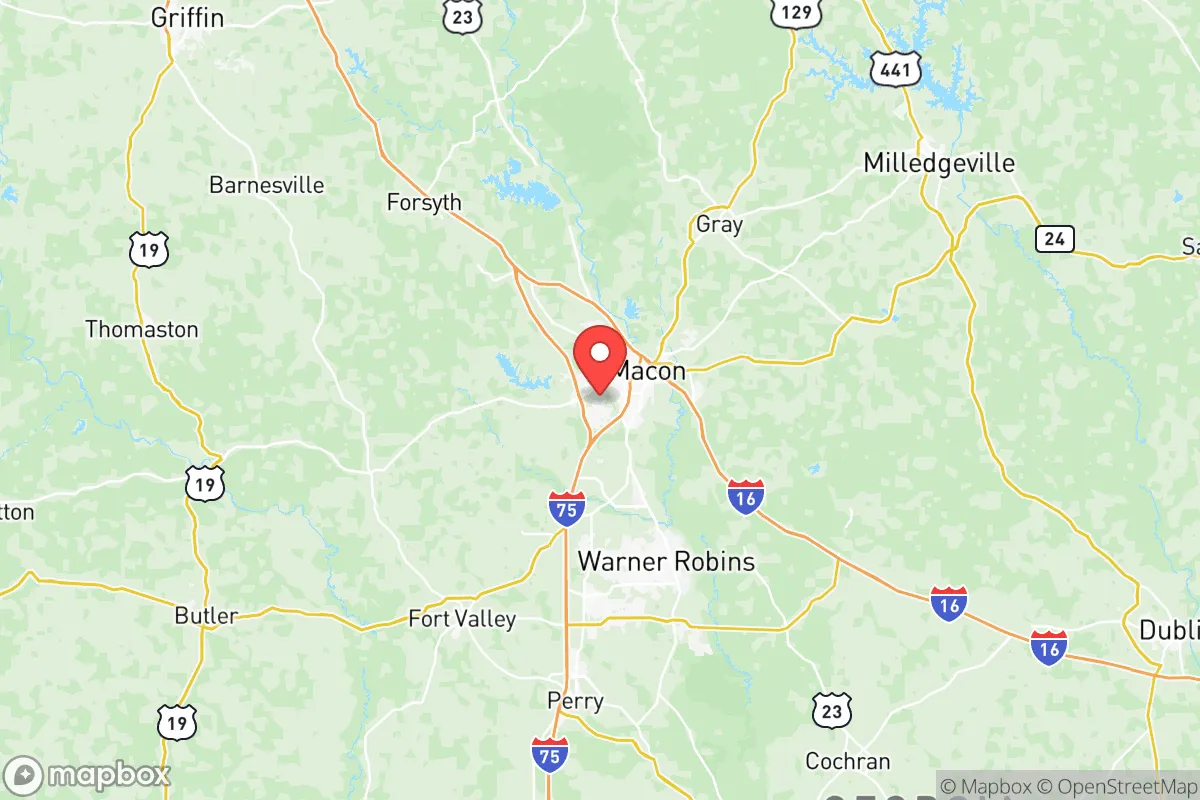
Bibb County, anchored by the city of Macon, has a Cook Partisan Voting Index of D+4, meaning it leans about four points more Democratic than the national average. That said, this isn't a deep-blue stronghold — it's a classic Southern swing county where the margins have tightened in recent cycles. In 2020, Joe Biden carried Bibb by roughly 10 points, but down-ballot races often see Republicans win here, especially in the more rural and suburban pockets outside Macon's urban core. The county's trajectory is slowly shifting leftward as Macon's core becomes more diverse and younger, but the surrounding unincorporated areas and towns like Payne and Lizella still vote reliably red, keeping the overall picture competitive.
How it compares
Georgia as a whole is a true battleground state, with a Cook PVI of R+3 in 2024, though it flipped for Biden in 2020 and has been hotly contested ever since. Bibb County's D+4 lean makes it significantly more Democratic than the state average, but it's not as blue as metro Atlanta's core counties like DeKalb or Fulton. Instead, Bibb sits in a middle ground — think of it as a smaller-scale version of Cobb or Gwinnett counties before they fully shifted blue. The political geography inside Bibb tells the story: Macon's historic neighborhoods like Ingleside and Vineville lean heavily Democratic, while the more suburban areas around Bass Road and the county's southern edge near Byron and Centerville (which actually spill into Houston County) trend Republican. The swing precincts are in the middle-class neighborhoods around Eisenhower Parkway and the northwestern part of the county, where ticket-splitting is still common — a voter might back a Democrat for president but a Republican for sheriff or county commission.
What this means for residents
For conservative residents, Bibb County is far from hostile territory. Republicans hold several county commission seats, and the sheriff's office has been held by a Republican for years. You'll find plenty of conservative churches, gun-friendly attitudes, and a strong local GOP presence in Lizella and the rural stretches. For liberal residents, Macon itself offers a reliably progressive voting base, a growing arts scene, and local activism around issues like historic preservation and public transit. The practical upshot is that neither side feels completely shut out — local governance tends toward moderation, with both parties needing to negotiate on budgets, zoning, and school funding. The county's political center of gravity means that extreme policy shifts are rare; instead, you get incremental changes that reflect the county's mixed electorate.
Culturally, Bibb County stands apart from deep-red rural Georgia and deep-blue Atlanta alike. Macon's identity as the "Heart of Georgia" is real — there's a pragmatic, live-and-let-live vibe that tempers the partisan noise you see on national news. The county's policy debates tend to focus on local bread-and-butter issues: downtown revitalization, school district performance, and infrastructure. One notable distinction is that Bibb County voters have consistently supported local education funding measures, including a 2023 ESPLOST renewal, even as statewide education politics grow more polarized. For anyone moving here, the takeaway is simple: Bibb County is a place where your vote matters, but your neighbor's vote probably matters just as much — and that's by design.

State Political ClimatePolitical Climate in Georgia
State Political AnalysisPolitical Environment in the State
Georgia has transformed from a reliably Republican stronghold into the nation’s most competitive swing state, with a partisan lean that now sits roughly evenly split after decades of GOP dominance. The state’s political trajectory over the last 10-20 years has been dramatic: as recently as 2012, Mitt Romney carried Georgia by nearly 8 points, but by 2020, Joe Biden won it by a razor-thin 0.23% margin, and Donald Trump reclaimed it in 2024 by a similarly narrow 1.2% margin. This shift is driven by explosive growth in the Atlanta metro area, particularly among suburban voters and new arrivals, while the rest of the state remains deeply conservative. For a relocator, this means living in a state where your political experience will vary dramatically depending on whether you settle in the capital region or in a smaller town like Gainesville or Valdosta.
Urban vs. rural divide
The political map of Georgia is a textbook case of the urban-rural split, with the Atlanta metro area acting as the state’s Democratic engine. Fulton County (Atlanta) and DeKalb County (Decatur) are among the most reliably Democratic jurisdictions in the South, delivering margins of 70-80% for Democratic candidates. The suburban ring—places like Cobb County (Marietta), Gwinnett County (Lawrenceville), and Henry County (McDonough)—has flipped from red to purple or blue over the past decade, driven by an influx of diverse, college-educated professionals. Meanwhile, the rest of the state is overwhelmingly Republican. Rural south Georgia, including towns like Thomasville and Waycross, votes 70-80% Republican, as does much of north Georgia, including Dalton and Rome. The key battlegrounds are the exurban and micropolitan areas: Augusta, Savannah, Columbus, and Macon all lean Democratic but have enough conservative suburbs to keep them competitive. The result is a state where statewide elections are decided by a few thousand votes in the Atlanta suburbs, while the rest of the map is a sea of red.
Policy environment
Georgia’s policy environment reflects its divided politics, producing a mix of conservative governance with occasional moderate compromises. The state has a flat income tax rate of 5.49%, which is scheduled to drop to 4.99% by 2029 under legislation passed in 2022. Property taxes are relatively low, with a median effective rate of 0.87%, though they vary by county. The regulatory posture is business-friendly, with Georgia consistently ranked among the top states for doing business, and it is a right-to-work state. Education policy is a flashpoint: the state has expanded school choice through the Georgia Promise Scholarship Act (2024), which provides state funds for private school tuition, while also maintaining a robust HOPE scholarship program for in-state college students. Healthcare policy is more mixed—Georgia did not expand Medicaid under the Affordable Care Act, leaving a coverage gap for low-income adults, but it has a limited Medicaid waiver program (Pathways to Coverage) that requires work or community engagement. Election laws have been a national focus: the Election Integrity Act of 2021 (SB 202) added voter ID requirements for absentee ballots, limited drop boxes, and restricted third-party ballot collection, drawing both praise and criticism. For a relocator, the practical takeaway is that Georgia offers low taxes and business-friendly rules, but public services like healthcare access and transit are less robust than in blue states.
Recent policy direction
Georgia’s recent legislative sessions have pushed the state in a distinctly conservative direction on several fronts, while leaving some areas unchanged. On gun and self-defense law, Georgia is a permitless carry state (HB 218, 2022), meaning anyone 21 or older who can legally possess a firearm may carry it openly or concealed without a permit. On parental and education rights, the state passed the Parents’ Bill of Rights (SB 449, 2022), which affirms parents’ rights to direct their children’s education and access school materials, and the Protect Students First Act (2022), which restricts the teaching of divisive concepts related to race. On speech and privacy, Georgia has no broad shield law for journalists, and the state’s anti-SLAPP statute is weak, though the state Supreme Court has recognized some protections. On medical and bodily autonomy, Georgia’s Living Infants Fairness and Equality (LIFE) Act (HB 481, 2019) bans abortion after a fetal heartbeat is detected (around six weeks), with exceptions for rape, incest, and medical emergencies. On property rights, Georgia is a strong property rights state, with limits on eminent domain and no state-level rent control. On taxation, the trend is toward lower rates: the flat income tax is being phased down, and the state has suspended the gas tax periodically. On voting and ballot access, SB 202 tightened rules, but early voting hours were expanded and weekend voting was codified. For a relocator, the direction is clear: Georgia is becoming more conservative on social and cultural issues while maintaining a pro-business, low-tax economic posture.
Civil unrest & political movements
Georgia has been a focal point for political movements on both sides, with visible flashpoints that a new resident would notice. The Atlanta area saw significant protests in 2020 following the murder of George Floyd, with demonstrations in downtown Atlanta and along the BeltLine, as well as the occupation of the Wendy’s on University Avenue where Rayshard Brooks was killed. These protests were largely peaceful but included some property damage and arson, leading to a heightened police presence and ongoing debates about public safety. On the right, the Georgia Republican Party has been energized by election integrity concerns, with grassroots groups like the Georgia Election Integrity Coalition monitoring polling places and pushing for stricter laws. Immigration politics are a growing issue, particularly in north Georgia’s Dalton area, where the carpet industry relies heavily on immigrant labor; the state has passed laws like HB 87 (2011) requiring employers to use E-Verify, but enforcement is uneven. There is no sanctuary city policy in Georgia—state law prohibits such designations—and the Sheriff’s Cooperation Act (SB 160, 2024) requires local law enforcement to cooperate with federal immigration authorities. Election integrity remains a live controversy: the 2020 and 2024 elections saw dueling lawsuits and recounts, and the State Election Board has been a battleground between Republican and Democratic appointees. For a new resident, the political climate is palpable in Atlanta, where yard signs and bumper stickers are common, but less visible in smaller towns where politics is more private.
Projection
Over the next 5-10 years, Georgia is likely to remain a competitive swing state, but demographic trends suggest a slow, steady shift toward the Democratic column. The Atlanta metro area continues to grow rapidly, attracting young, diverse, and college-educated residents from other states, while rural areas are losing population. This means that Gwinnett, Cobb, and Henry counties will become more Democratic, while the GOP’s base in south and north Georgia will shrink in relative terms. However, the Republican Party is making inroads with Hispanic and Asian voters, particularly in the suburbs, which could offset some of the Democratic gains. The state’s policy direction will likely remain a tug-of-war: when Republicans control the legislature and governor’s office (as they do now), expect continued conservative moves on abortion, gun rights, and education; when Democrats win, expect reversals on those fronts and expansions of Medicaid and voting access. For a relocator moving in now, the expectation should be that Georgia will be a purple state for the foreseeable future, with close elections and divided government as the norm. The practical implication is that your daily life will be shaped more by your local county government than by state politics—blue counties will have different policies on transit, schools, and policing than red ones.
For a new resident, the bottom line is that Georgia offers a low-tax, business-friendly environment with a growing economy, but the political climate is intensely competitive and can feel polarized, especially in the Atlanta area. If you’re conservative, you’ll find a state government that largely shares your values on guns, taxes, and education, but you’ll need to navigate blue-leaning local governments in the metro area. If you’re liberal, you’ll find a vibrant political community in Atlanta and its suburbs, but state-level policies on abortion, voting, and immigration will be frustrating. The key is to choose your location carefully: Marietta and Lawrenceville are purple suburbs with good schools and diverse populations, while Gainesville and Valdosta are solidly conservative and more affordable. Georgia is a state where your political experience is largely a function of your zip code, and that’s unlikely to change anytime soon.
* Values derived from national, state, county, city and local statistics and may differ in a specific area. Last updated: 2026-08-08T19:25:03.000Z
Narrative content on this page is AI-generated and may contain mistakes. Verify any details that matter before acting on them.
ReloMaps may earn a commission from affiliate links at no extra cost to you.

