
Photo: Wikipedia
Strategic Assessment of Bibb County
Workable tactical position. Some exposure to population density or targets, but generally defensible in a crisis.
What does the Strategic Assessment tell us?
Our Strategic Assessment grades tactical survivability of an area. Major population centers, military targets, fallout zones, natural disasters, and border exposure all drive risk — lower exposure means a more defensible position in a crisis.
This is heavily inspired by Joel Skousen's Strategic Relocation book. Highly recommended you checkout the book ($)What does this tell us?
Our Strategic Assessment grades tactical survivability of an area. Major population centers, military targets, fallout zones, natural disasters, and border exposure all drive risk — lower exposure means a more defensible position in a crisis.
This is heavily inspired by Joel Skousen's Strategic Relocation book. Highly recommended you checkout the book ($)Strategic Pillars

Key Distances
Strategic Assessment Analysis
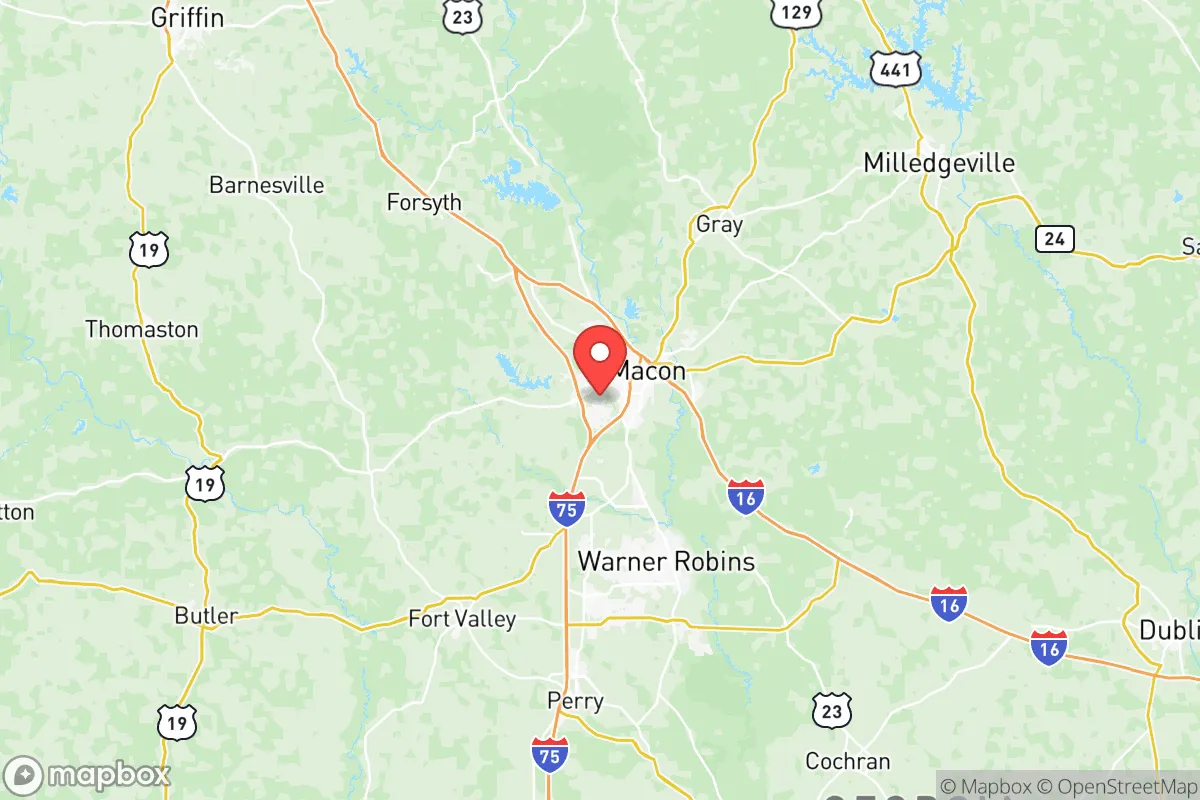
Bibb County, Georgia, anchored by the city of Macon, offers a strategic relocation option for those prioritizing resilience and self-sufficiency without complete isolation from infrastructure. Its position roughly 80 miles south of Atlanta and 100 miles northwest of Savannah places it in a geographic sweet spot—close enough to major supply chains and medical hubs, yet far enough from the immediate fallout zones of large metropolitan targets. The county's location along the Fall Line, where the Piedmont plateau meets the Coastal Plain, provides a mix of rolling hills, clay soils, and access to the Ocmulgee River, creating natural advantages for water security and defensible property selection.
Geographic position and natural advantages for long-term security
Bibb County sits at a natural crossroads, with Interstates 75 and 16 intersecting in Macon, providing redundant evacuation routes and supply access that avoid chokepoints common to larger cities. The Ocmulgee River, which flows through the county's eastern side, offers a reliable surface water source, while the underlying Cretaceous-age aquifer provides groundwater potential for well drilling—a critical factor for off-grid water security. The terrain is gently rolling, with elevations ranging from about 250 to 500 feet, which reduces flood risk compared to coastal Georgia while still offering enough topographic variation for natural drainage and defensible building sites. The county's position along the Fall Line also means fewer hurricane-related storm surge risks than areas closer to the coast, though inland wind damage remains a consideration. For a relocator, the presence of Robins Air Force Base roughly 15 miles south in Warner Robins is a double-edged sword: it provides economic stability and emergency response capability, but also represents a potential military target in a major conflict scenario.
Risks, exposures, and proximity to fallout-relevant landmarks
The most significant risk for Bibb County is its proximity to Robins Air Force Base, a major logistics and maintenance hub for the U.S. Air Force, which could be a primary or secondary target in a large-scale conflict. Additionally, the county lies within roughly 100 miles of the Port of Savannah, one of the busiest container ports on the East Coast, and within 150 miles of the Savannah River Site, a nuclear materials processing facility. These distances mean that while Bibb County is not in a direct blast zone for most plausible scenarios, it could face fallout drift, refugee flow, or supply chain disruption from events at these locations. On the natural disaster front, the area is subject to tornadoes—Georgia averages around 30 tornadoes annually, and Bibb County has experienced EF2 and EF3 events historically. Flooding along the Ocmulgee River and its tributaries is a periodic concern, particularly in low-lying areas near downtown Macon and along the river floodplain. The county's location inland also means it avoids the direct hurricane landfall risks of coastal Georgia, though tropical storm remnants can bring heavy rain and wind.
Practical resilience for a relocator: food, water, energy, and defensibility
For someone serious about self-sufficiency, Bibb County offers several practical advantages. The region's growing season runs roughly from March to November, allowing for substantial food production, and the clay-loam soils—while requiring amendment—are workable for gardens and small-scale farming. Local farmers' markets and agricultural supply stores in Macon and surrounding areas provide seed stock, livestock feed, and equipment without requiring long drives. Water access is the strongest resilience feature: the Ocmulgee River provides a surface water option, and the county's location over the Cretaceous aquifer means many properties can support private wells at depths of 100 to 300 feet, though well yields vary. For energy resilience, the county has good solar exposure—Georgia averages about 218 sunny days per year—and net metering policies allow grid-tied solar systems to offset costs. However, local zoning in Macon's historic districts and some suburban subdivisions may restrict visible solar panels or rainwater catchment systems, so property selection matters. Defensibility is moderate: the rolling terrain and tree cover in rural parts of the county offer natural screening and chokepoints, but the area's road network—particularly the interstate corridors—could become evacuation or refugee routes during a crisis. Properties away from major highways and closer to the county's rural edges, such as areas near Lizella or Bolingbroke, offer better security than those in Macon's urban core.
The overall strategic picture for Bibb County is one of balanced trade-offs. It offers genuine advantages in water access, growing conditions, and infrastructure redundancy that many inland counties lack, while its distance from primary coastal and metropolitan targets reduces—but does not eliminate—exposure to man-made risks. The presence of Robins Air Force Base is the single largest vulnerability, but for a relocator who selects property carefully—away from major highways, with well water and solar potential, and with some defensible terrain—Bibb County provides a workable base for long-term resilience. It is not a remote survivalist retreat, but rather a practical middle-ground option for those who want to maintain access to medical care, supply chains, and community while building genuine self-sufficiency. For a conservative-leaning individual or family looking to relocate with preparedness in mind, Bibb County deserves serious consideration, provided the specific property location accounts for the risks outlined above.

* Values derived from national, state, county, city and local statistics and may differ in a specific area. Last updated: 2026-08-08T19:25:03.000Z
Narrative content on this page is AI-generated and may contain mistakes. Verify any details that matter before acting on them.
ReloMaps may earn a commission from affiliate links at no extra cost to you.

