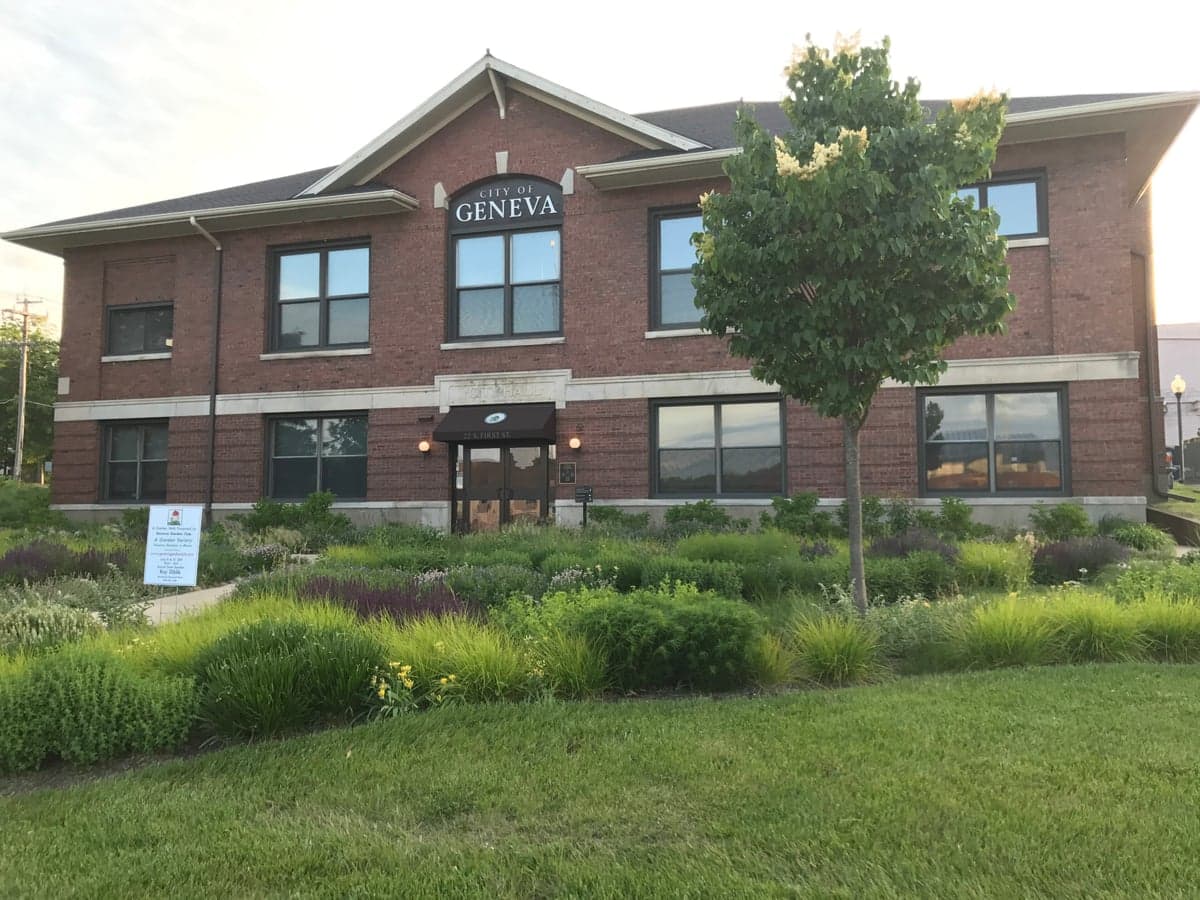
Photo: Wikipedia
Political ClimatePolitical Climate in Geneva, IL
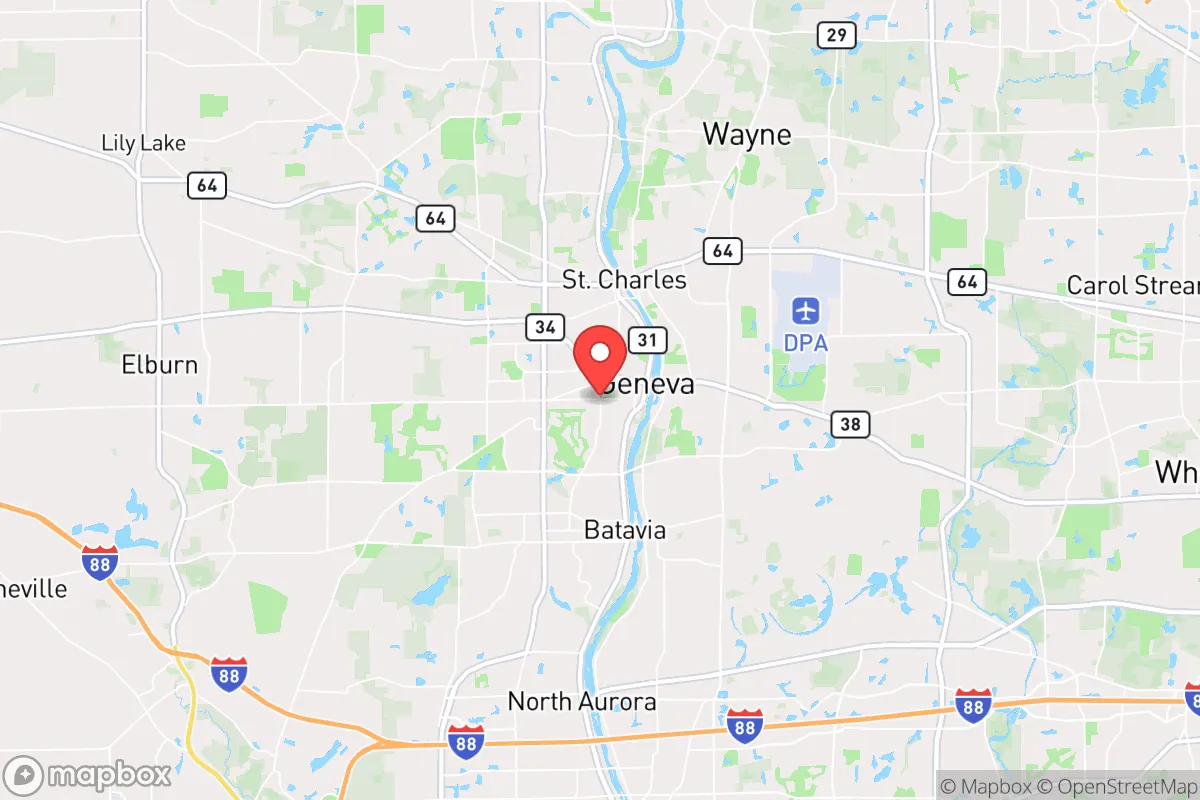
District shown is the primary district for this city’s centroid. Cities may span multiple districts.
Political rankings in Illinois
- Most Conservative Cities in Illinois
- Most Liberal Cities in Illinois
- Best Liberal-Leaning Towns in the Midwest
- Safest Liberal-Leaning Towns in the Midwest
- Safest Conservative-Leaning Towns in the Midwest
- Affordable Small Towns for Conservatives
- Most Affordable Liberal-Leaning Small Towns in the U.S.
- Safest Conservative-Leaning Cities in the U.S.
- Most Conservative Counties in Illinois
- Most Liberal Counties in Illinois
Local Political AnalysisPolitical Analysis of Geneva, IL
Geneva sits in Kane County, a collar county west of Chicago that has drifted from reliably Republican to genuinely competitive, and the city itself now leans modestly Democratic — roughly Cook PVI D+6, a hair less blue than Illinois as a whole at D+7. That one-point gap is the whole story in miniature: Geneva is not Chicago, and it's not downstate Illinois either. It's the kind of place where a Kamala Harris sign and a "We Back the Badge" banner can sit on the same block without anyone keying a car over it.
How it compares to the rest of Illinois
Illinois is one of the most Democratic states in the country, and its D+7 rating is driven overwhelmingly by Chicago and inner-ring suburbs like Oak Park and Evanston. Geneva's D+6 puts it just a notch to the right of that statewide baseline — close enough that statewide Democrats usually carry it, but not by the margins you'd see in, say, neighboring DuPage County towns like Naperville or Downers Grove, which have swung harder toward Democrats since 2016. Drive 25 minutes west to DeKalb County or north into McHenry County and the politics shift noticeably redder. Kane County itself has been a genuine bellwether — it voted for Obama twice, Trump in 2016, Biden in 2020, and Trump again in 2024, making it one of the few counties in America to flip back and forth that many times. Geneva reflects that swingy, ticket-splitting character more than the solid-blue reputation of Illinois overall.
What this means for residents in practice
For conservative residents, Geneva is not hostile territory. Local races for city council and school board (Geneva Community Unit School District 304) are officially nonpartisan, and the tone of local politics tends to be pragmatic — road repairs, the Third Street streetscape, school referenda — rather than culture-war theater. A conservative here can vote Republican up and down the ballot and still find their neighbors agreeable at the Geneva French Market on a Sunday. For liberal residents, the flip side is that Geneva is not a progressive stronghold; you won't find the kind of activist city council you'd get in Evanston, and county-level races are genuinely contested rather than foregone conclusions. Both sides have to actually campaign here, which is arguably the healthiest thing about the place.
The cultural distinction worth knowing: Geneva's politics run through institutions more than ideology. The Kane County Courthouse downtown, the school district, the park district, and the longstanding civic groups shape local decisions far more than national party machinery does. Longtime residents will tell you the town's political temperature rose after 2016 — school board meetings got louder, yard signs multiplied — but the underlying instinct is still moderation and neighborliness. The near-term trajectory looks like more of the same competitive swing; the longer-term question is whether continued growth from Chicago transplants pushes Geneva firmly into Naperville-style blue territory or whether it holds its bellwether identity. Most people who live here seem to prefer the latter.

State Political ClimatePolitical Climate in Illinois
State Political AnalysisPolitical Environment in the State
Illinois is a solidly Democratic state — Cook Partisan Voting Index D+7 — and has been for roughly two decades. Democrats control both chambers of the General Assembly, the governor's office, and every statewide constitutional office; the party holds supermajorities in the House and Senate large enough to override vetoes. The coalition is built on Chicago and its inner-ring suburbs, public-sector unions (the Illinois Federation of Teachers and AFSCME Council 31 are among the state's most influential players), and socially liberal voters in college towns like Champaign and Evanston. The trajectory is unmistakable: George W. Bush carried Illinois in 1988's aftermath era and Republicans last won a statewide federal race in 2010 (Mark Kirk's Senate seat), while the 2014 and 2018 governor's races were the only recent statewide flickers of GOP competitiveness. Since then, the suburban realignment has accelerated — DuPage, Lake, and Will counties, once Republican bellwethers, now vote Democratic in most federal races.
Urban vs. rural divide
The political map is essentially Chicago versus everywhere else, with a handful of swing suburbs in between. Chicago and Cook County deliver roughly 40% of the statewide vote and vote Democratic at 70%+ margins. The collar counties — DuPage, Kane, Lake, McHenry, Will — were Republican-leaning through the 2000s but have shifted Democratic as college-educated suburbanites moved left; DuPage County, home to Naperville and Wheaton, went for Biden in 2020 and Harris in 2024. Downstate, the picture reverses sharply: counties like Effingham, Shelby, and Wayne vote Republican at 75–80% margins, and the further south and west you go, the more reliably red it gets. The result is a state where the Democratic margin in Springfield is decided entirely by how big the Chicago turnout is and how badly Republicans lose the suburbs. Towns like Peoria, Rockford, and Springfield itself are genuinely purple — Democratic-leaning cities surrounded by deep-red rural counties.
Policy environment
Illinois has the highest combined state and local tax burden in the Midwest and among the highest in the nation. The state income tax is a flat 4.95%, and a 2020 constitutional amendment to allow graduated rates failed at the ballot. Property taxes are punishing — Cook County effective rates run around 2%, and in collar-county towns like Naperville and Schaumburg they're not much lower. The state sales tax is 6.25% with local add-ons pushing it past 10% in Chicago. On regulation, Illinois is a strong union state with prevailing-wage requirements on public works and no right-to-work law; the 2019 Workplace Transparency Act and the 2023 Paid Leave for All Workers Act are recent additions. Education policy is heavily state-directed through the Illinois State Board of Education, with the 2017 evidence-based funding formula now the main K-12 lever. Healthcare is expansive — Illinois expanded Medicaid under the ACA and operates a state-based exchange. Election law is notably permissive: same-day registration, no-excuse mail voting, and a 2024 law allowing non-citizens to serve as poll workers (not vote) drew national attention.
Recent policy direction
The last five years have moved Illinois decisively in one direction on most social and regulatory questions. The 2019 Reproductive Health Act codified abortion rights in state law, and the 2023 Illinois Values Act made the state a sanctuary for out-of-state abortion seekers. The 2021 SAFE-T Act abolished cash bail statewide and expanded police accountability measures — a genuine flashpoint for law-and-order voters. Gun law is among the strictest in the country: the 2023 Protect Illinois Communities Act banned assault-style weapons and high-capacity magazines, and the state has a Firearm Owner's Identification (FOID) card requirement and concealed-carry licensing. On parental rights, the 2023 law allowing minors to receive mental health care without parental consent and the state's sex-ed standards have drawn sustained conservative pushback in school board races across the suburbs. On speech and privacy, Illinois has a strong biometric privacy law (BIPA) and a 2024 law regulating AI in employment decisions. On voting, the state is among the most accessible — automatic voter registration, mail voting, and expanded early voting. On property rights, the state's eminent-domain and zoning regimes are locally controlled and vary enormously by municipality.
Civil unrest & political movements
Illinois has a visible, organized political culture on both sides. Chicago saw significant 2020 unrest after the George Floyd killing, and the city's protest scene remains active. On the right, the state has an organized parental-rights movement concentrated in suburban school districts — fights over library books and curriculum in towns like Barrington, Downers Grove, and Lake Zurich have drawn crowds and national coverage. On immigration, Illinois declared itself a sanctuary state under the 2017 TRUST Act and the 2021 Way Forward Act, and Chicago is a certified welcoming city; ICE cooperation is limited, which is a live issue for residents in immigrant-heavy suburbs like Cicero and Berwyn. Election integrity controversies have been more muted than in other states, though the 2024 non-citizen poll-worker law and mail-voting expansion drew Republican lawsuits. Secession talk is essentially nonexistent, but downstate "statehood" or "New Illinois" rhetoric surfaces periodically in rural counties — more venting than movement.
Projection
Over the next 5–10 years, Illinois will likely remain Democratic at the statewide level, with the margin driven by whether Chicago's population decline continues. The state lost population in the 2020 census and has been a net out-migration state, particularly among middle-income families leaving Cook County for Indiana, Wisconsin, and Tennessee. That outflow could modestly tighten statewide margins, but the suburban Democratic shift is structural and unlikely to reverse. Expect continued consolidation on abortion, gun regulation, and labor law, and continued friction in suburban school boards. The fiscal picture — pension obligations, property-tax pressure — will keep driving the tax debate, and a graduated income tax proposal will likely resurface. For a conservative mover, the practical reality is a state where your vote matters less statewide but intensely locally; for a liberal mover, it's a state that will keep delivering on the policy front but with a real cost-of-living and tax bill attached.
Bottom line for a new resident: Illinois is a high-tax, high-regulation, strongly Democratic state where your day-to-day political experience depends almost entirely on which county you land in. If you're conservative, look hard at the collar counties' outer edges or downstate towns like Bloomington-Normal or the Quad Cities, where the culture is more mixed and the tax burden lighter than Cook County. If you're liberal, Chicago and its inner suburbs will feel like home policy-wise, but budget for the property tax. Either way, understand that state-level policy is set in Springfield and will not swing back toward the center in the near term — plan around that, not against it.
* Values derived from national, state, county, city and local statistics and may differ in a specific area. Last updated: 2026-11-28T00:32:19.000Z
Narrative content on this page is AI-generated and may contain mistakes. Verify any details that matter before acting on them.
ReloMaps may earn a commission from affiliate links at no extra cost to you.

