
Photo: Wikipedia
Demographics of Garfield, NJ
Affluence Level in Garfield, NJ
A middle-class area roughly in line with national averages across income, home values, education, and employment.
People of Garfield, NJ
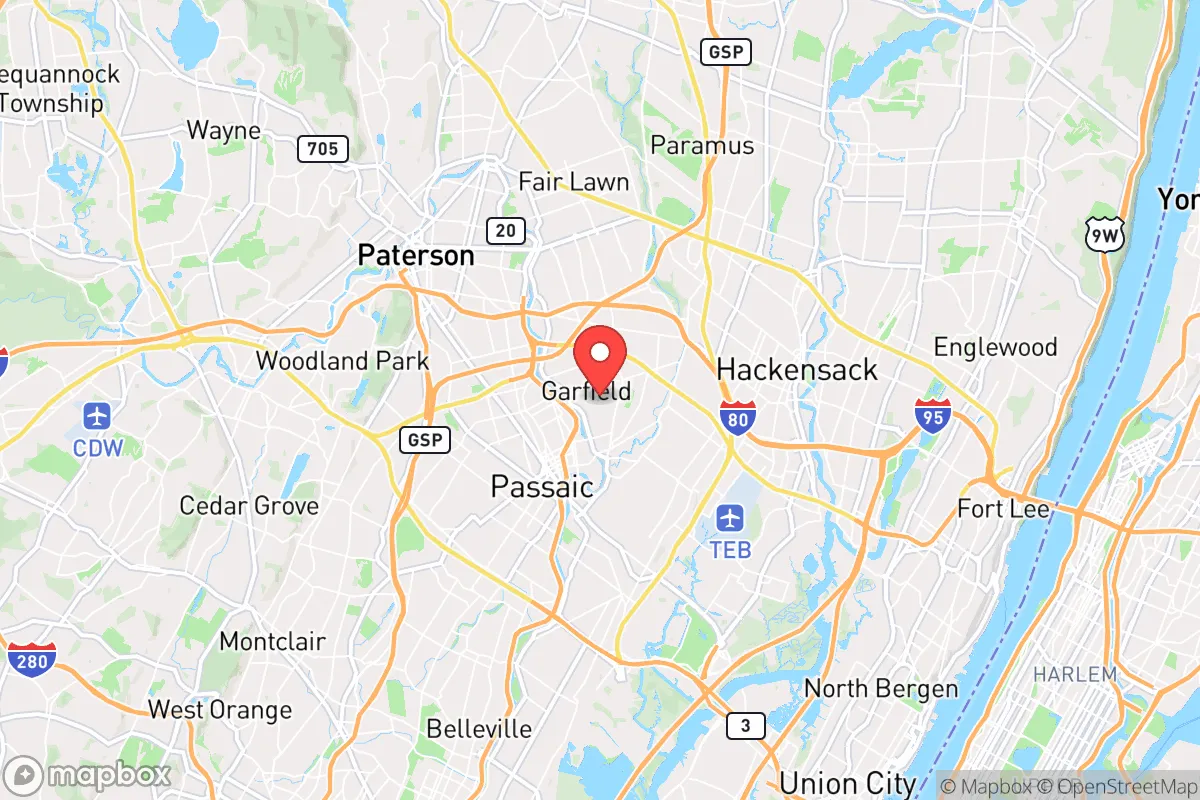
The people of Garfield, New Jersey, today form a dense, working-class city of 32,502 residents where no single ethnic group holds a majority. The city is defined by a near-even split between a shrinking non-Hispanic white population (44.4%) and a growing Hispanic majority (45.4%), with smaller but stable Black (5.1%), East/Southeast Asian (1.9%), and Indian-subcontinent (2.1%) communities. Garfield is notably less affluent than its Bergen County neighbors, with only 24.3% of adults holding a college degree, and its identity is rooted in a century of industrial immigration and recent suburban resettlement. The city feels more like a dense, older Northeast mill town than a typical New Jersey suburb, with a strong blue-collar character and a rapidly diversifying population.
How the city was settled and grew
Garfield was originally farmland within the Dutch-settled region of Bergen County, but its modern history begins in the 1870s with the arrival of the Dundee Water Power and Land Company, which dammed the Passaic River and built mills. The first major wave of immigrants were German and Irish laborers who built the mills and the city’s early infrastructure, settling in the Dundee District along the river. By the 1890s, the city’s textile and paper mills drew a second wave of Polish and Italian immigrants, who established dense ethnic neighborhoods in Central Garfield around Main Avenue and in the Plaza District near the train station. These groups built the city’s Catholic parishes—St. Stanislaus Kostka (Polish) and St. Peter’s (Italian)—which remain neighborhood anchors. A smaller wave of Hungarian and Slovak immigrants arrived in the early 1900s, clustering in the Outwater Lane area near the city’s eastern edge. By 1930, Garfield was a classic industrial immigrant city, with over 40% of its population foreign-born, overwhelmingly from Eastern and Southern Europe.
Modern era (post-1965)
The post-1965 immigration reforms reshaped Garfield’s population dramatically. The first major shift came in the 1970s and 1980s, when Puerto Rican and Dominican families began moving into the aging housing stock of Central Garfield and the River Drive corridor, replacing the departing Italian and Polish populations. This Hispanic influx accelerated through the 1990s and 2000s, with newer arrivals from Peru, Colombia, and Ecuador settling in the Plaza District and along Lanza Avenue. Today, the Hispanic population is the city’s largest single group, concentrated in the southern and central wards. Meanwhile, a smaller but visible Indian-subcontinent community (2.1%) has grown since the 2000s, primarily in the Dundee District and near the Passaic River, drawn by affordable housing and proximity to Indian-owned businesses in neighboring Passaic. The East/Southeast Asian population (1.9%) is more scattered, with Filipino and Vietnamese families living in the Outwater Lane area and the northern end of the city. The non-Hispanic white population, once over 90% in 1970, has fallen to 44.4% as older ethnic European families aged out or moved to less dense suburbs.
The future
Garfield’s population is trending toward a majority-Hispanic city within the next decade, driven by continued immigration from Latin America and higher birth rates among Hispanic families. The non-Hispanic white share is declining steadily, while the Black and Asian populations are growing slowly but remain small. The city is not tribalizing into rigid enclaves—most neighborhoods are mixed, with the strongest Hispanic concentration in the south and central areas and the remaining white population scattered throughout. The Indian-subcontinent community is likely to grow modestly as housing remains cheaper than in nearby Edison or Jersey City, but it will not approach the scale of the Hispanic majority. The city’s low college attainment rate (24.3%) and industrial base suggest it will remain a working-class, immigrant gateway rather than gentrifying rapidly. For a new resident, Garfield offers a dense, walkable, and affordable alternative to pricier Bergen County towns, but with a population that is increasingly Hispanic and less likely to speak English at home.
Garfield is becoming a solidly Hispanic-majority, working-class city with a shrinking white ethnic remnant and small but stable Asian and Black minorities. For a conservative-leaning mover, the city offers low property taxes relative to Bergen County and a strong sense of local community, but the demographic shift means schools and civic life are increasingly oriented toward a Spanish-speaking population. The city is stable, not declining, but it is not a place where the ethnic European character of the early 20th century will return.

* Values derived from national, state, county, city and local statistics and may differ in a specific area. Last updated: 2026-04-29T21:12:44.000Z
Narrative content on this page is AI-generated and may contain mistakes. Verify any details that matter before acting on them.
ReloMaps may earn a commission from affiliate links at no extra cost to you.

