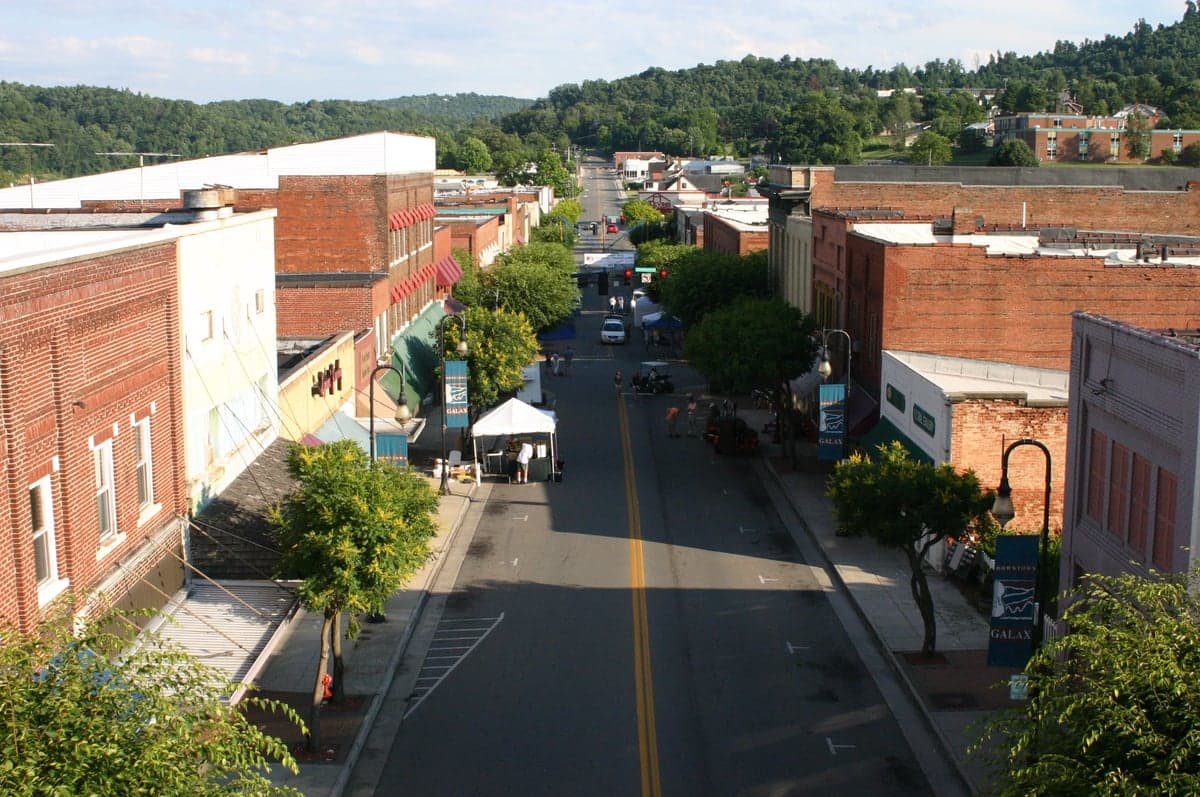
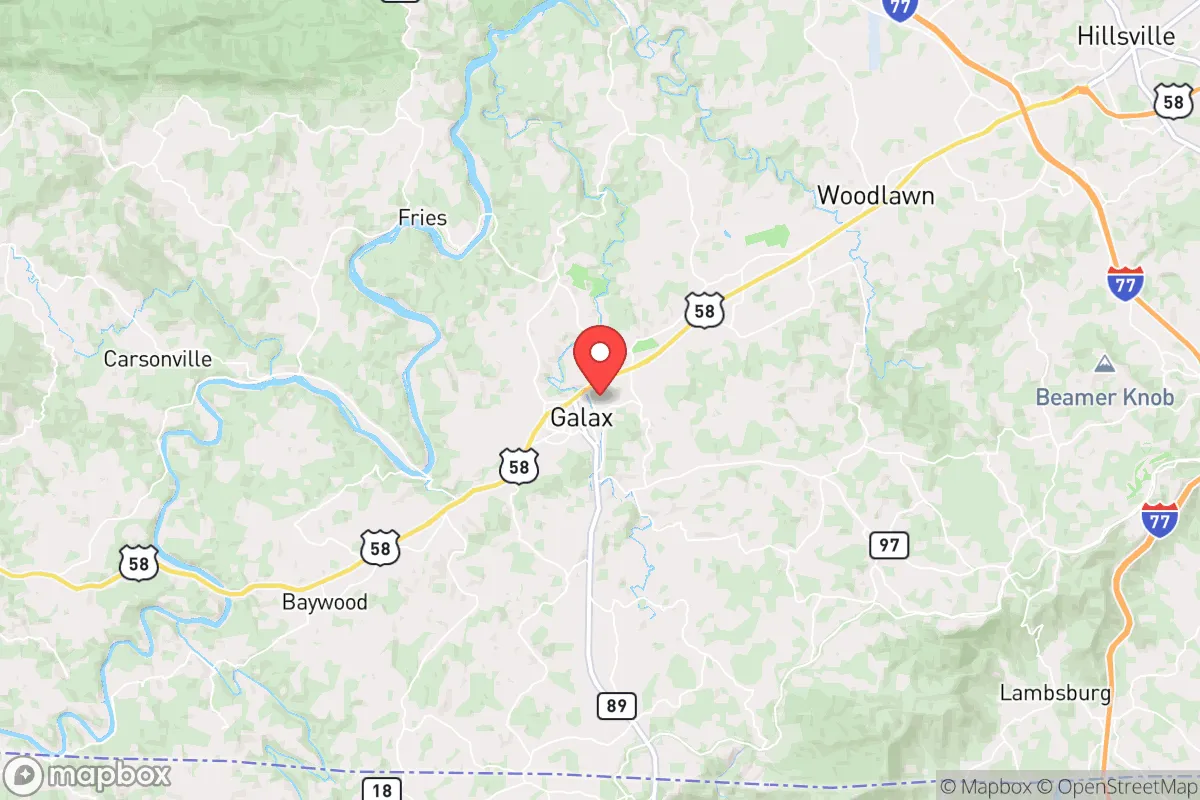

Photo: Wikipedia
Political ClimatePolitical Climate in Galax, VA
District shown is the primary district for this city’s centroid. Cities may span multiple districts.
Local Political AnalysisPolitical Analysis of Galax, VA
Galax, Virginia, sits in a deeply conservative pocket of the state, with a Cook Partisan Voting Index (PVI) of R+22. That’s a stark contrast to the state of Virginia as a whole, which has shifted to a D+4 PVI in recent years. The city and surrounding Carroll County have voted reliably Republican for decades, and the trend has only solidified since the 2010s. If you’re moving here from Northern Virginia or Richmond, you’ll notice the difference immediately—yard signs, church bulletin inserts, and local chatter all tilt heavily red. The area’s political trajectory is steady: no signs of flipping, and if anything, the rural-urban divide in Virginia is widening, making Galax more of a Republican stronghold than it was 20 years ago.
How it compares
Galax’s R+22 rating puts it in a different political universe from Virginia’s statewide D+4 lean. For context, neighboring cities like Wytheville and Mount Airy, North Carolina, share similar conservative profiles, while places like Roanoke (about 90 minutes north) and Blacksburg (home to Virginia Tech) are more moderate or left-leaning. The contrast is especially sharp with Northern Virginia, where counties like Fairfax and Arlington drive the state’s Democratic tilt. In Galax, Republican presidential candidates routinely win by 40 to 50 percentage points, while statewide races for governor or Senate are often closer but still favor the GOP candidate by double digits here. The 2024 election saw Carroll County vote over 75% for the Republican ticket, a pattern that’s held steady since at least 2000. This isn’t a purple area—it’s a deep red one, and the local Democratic Party presence is minimal, with few contested races at the county or city level.
What this means for residents
For conservative residents, Galax offers a comfortable political environment where their views are the norm. Local government, school board decisions, and law enforcement priorities generally align with traditional values. Gun rights are widely supported, taxes are kept low, and social issues are debated from a conservative standpoint. For liberal or moderate residents, life here can feel isolating politically. You’ll likely be in the minority in most social or civic settings, and local elections rarely feature candidates who share your perspective. That said, most people are neighborly and won’t make politics a daily issue—it’s a small town where personal relationships still matter more than party affiliation. The real friction shows up in broader policy debates: state-level decisions on education funding, healthcare expansion, and environmental regulations often feel imposed from Richmond, and local resentment toward the state capital is common across party lines.
Culturally, Galax is distinct from much of Virginia. The city is a hub for old-time and bluegrass music, with the annual Galax Old Fiddlers' Convention drawing thousands of visitors who lean traditionalist in both music and values. There’s a strong sense of self-reliance and local pride that predates modern political divisions. Policy-wise, you’ll find fewer regulations on small businesses, lower property taxes than in Northern Virginia, and a general skepticism of federal or state overreach. For anyone moving here, the key is understanding that Galax’s politics aren’t just about voting patterns—they’re woven into daily life, from church involvement to hunting culture to how people talk about work and family. It’s a place where the political climate is stable, predictable, and deeply rooted in local tradition.

State Political ClimatePolitical Climate in Virginia
State Political AnalysisPolitical Environment in the State
Virginia has shifted from a reliably conservative-leaning swing state to a solidly Democratic-leaning one over the past 20 years, carrying a Cook PVI of D+4. The transformation has been driven almost entirely by explosive population growth in the Washington, D.C. suburbs of Northern Virginia, which now dominate statewide elections and have pulled the state’s policy environment sharply leftward since the mid-2010s. For a conservative relocator, this means living in a state where state-level politics are controlled by a coalition that is often out of step with the values of the state’s rural and exurban regions, while local control and community character vary dramatically depending on which city or county you choose.
Urban vs. rural divide
The political map of Virginia is a textbook case of the urban-rural split. The entire Democratic majority is built on the crescent of Northern Virginia — Arlington, Alexandria, Fairfax County, and Loudoun County — plus the cities of Richmond and Norfolk/Virginia Beach. These areas vote 60-70% Democratic in most elections and produce enough raw votes to overcome the rest of the state. Meanwhile, the vast majority of Virginia’s land area is deeply red. Southwest Virginia (coal country around Bristol and Abingdon), the Shenandoah Valley (Harrisonburg, Staunton, Winchester), and the Southside region along the North Carolina border all vote 65-75% Republican. The key battlegrounds that used to decide Virginia — Chesterfield County and Henrico County outside Richmond, and Prince William County in Northern Virginia — have all moved leftward over the past decade, with Prince William now reliably blue and Chesterfield trending that way. The result is that a Republican candidate for governor or Senate must run up huge margins in the rural west and south while keeping losses in NoVA under 15 points — a math problem that has become nearly impossible as NoVA’s population has exploded.
Policy environment
Virginia’s tax structure is moderate compared to its neighbors. The state income tax is a flat 5.75% on all income over $17,000, and the state sales tax is 5.3% (higher in some localities). Property taxes are set at the county level and vary widely — Loudoun County has relatively high rates to fund its top-tier schools, while Franklin County in the rural south has much lower rates. There is no state-level property tax. Virginia is a Dillon Rule state, meaning localities only have powers explicitly granted by the state legislature, which has been a flashpoint in recent years as the Democratic majority has preempted local ordinances on everything from short-term rentals to firearms. The regulatory environment is business-friendly in the Richmond area and Hampton Roads, but Northern Virginia’s local governments are among the most heavily regulated in the South. Education policy has been a major battleground: the state has seen fierce fights over transgender student policies, critical race theory in K-12 curriculum, and the role of school boards. Virginia is an open primary state — any registered voter can vote in either party’s primary — and has no voter ID law requiring a photo, though voters must show some form of identification. Early voting is available without an excuse, and mail-in voting is widely used.
Recent policy direction
The last five years have seen Virginia lurch leftward on most cultural and regulatory fronts, then partially pull back after the 2021 election of Governor Glenn Youngkin. In 2020 and 2021, the Democratic trifecta passed a wave of progressive legislation: abolition of the death penalty, legalization of marijuana (with retail sales still not operational as of 2026), expansion of voting access through no-excuse absentee voting and same-day registration, and repeal of the state’s right-to-work law for public-sector unions. On gun policy, Democrats passed a package of universal background checks, a red flag law (extreme risk protection orders), and a one-handgun-per-month limit, though the latter was later struck down by a court. Youngkin’s administration has pushed back on some fronts: he signed a parental rights bill requiring schools to notify parents of changes to a child’s health or emotional well-being, and his administration has fought to keep transgender athletes out of girls’ sports. On abortion, Virginia remains an outlier in the South — abortion is legal through the second trimester, and the state has not passed any of the heartbeat bills or near-total bans seen in neighboring states. On property rights, Virginia has seen fights over eminent domain for data center development in Loudoun and Prince William counties, and over solar farm siting in rural areas. On privacy and surveillance, the state passed a consumer data protection law in 2021 but has not restricted law enforcement use of license plate readers or facial recognition in any meaningful way.
Civil unrest & political movements
Virginia has been a national flashpoint for political violence and protest. The 2017 Unite the Right rally in Charlottesville — which turned deadly when a white nationalist drove a car into counter-protesters — remains the most infamous event, and it reshaped the state’s politics by galvanizing suburban voters against the GOP. The 2020 racial justice protests in Richmond saw the toppling of Confederate statues on Monument Avenue and weeks of clashes between protesters and police. On the right, the 2021 parental rights movement — driven by anger over school closures and critical race theory — was the most potent grassroots force in the state, flipping the governor’s mansion and several House of Delegates seats. Loudoun County became the national symbol of this fight after a sexual assault case in a school bathroom became a political firestorm. Immigration politics are less visible in Virginia than in border states, but Prince William County has a long history of sanctuary city debates, and the state has a law requiring local jails to honor ICE detainers. Election integrity has been a persistent issue: the 2020 election saw Trump’s campaign challenge Virginia’s results (though the state was never in doubt), and the 2021 gubernatorial race was marred by a ballot harvesting controversy in which a GOP operative was charged with illegally collecting absentee ballots. The state’s secessionist movement is mostly rhetorical — there have been periodic calls for the rural western counties to break away and form a new state, but nothing has ever come of it.
Projection
Over the next 5-10 years, Virginia will continue to trend blue at the statewide level, driven by relentless population growth in Northern Virginia and the continued urbanization of the Richmond suburbs. The 2025 gubernatorial election will be a test of whether a Republican can still win statewide — Youngkin’s 2021 victory was aided by a uniquely favorable national environment and a backlash to COVID school closures, conditions that may not repeat. The state’s Democratic majority is structurally secure because the population growth is concentrated in the bluest areas. However, the rural-urban cultural divide will widen, and the state will likely see more preemption fights as the legislature tries to impose NoVA-style policies on the rest of the state. On the policy front, expect continued fights over school choice (Youngkin has pushed for lab schools and charter schools), data center regulation (the industry is exploding in Northern Virginia and creating land-use conflicts), and gun policy (the red flag law is likely here to stay, but further restrictions will face court challenges). The marijuana retail market will eventually open, but the timeline is uncertain. For a conservative relocator, the most important trend is that local control is eroding — the state government in Richmond is increasingly willing to override county-level decisions on schools, land use, and public health.
For a new resident, the bottom line is that Virginia offers a dramatically different experience depending on where you land. If you move to Loudoun County or Arlington, you will live in a blue stronghold with high taxes, excellent schools, and a culture that is increasingly indistinguishable from the D.C. suburbs in Maryland. If you move to Franklin County or Augusta County, you will live in a deeply red community with lower taxes, fewer services, and a culture that feels like the rural South. The state government in Richmond will lean left for the foreseeable future, but your day-to-day experience will be shaped far more by your county board and school board than by the governor. The key is to choose your county carefully and understand that Virginia’s political identity is not one thing — it is a collection of regions that are increasingly voting as if they live in different countries.
* Values derived from national, state, county, city and local statistics and may differ in a specific area. Last updated: 2026-10-24T15:29:05.000Z
Narrative content on this page is AI-generated and may contain mistakes. Verify any details that matter before acting on them.
ReloMaps may earn a commission from affiliate links at no extra cost to you.

