Photo: Wikipedia
Demographics of Galax, VA
Affluence Level in Galax, VA
A low-income area with significant economic hardship. Household wealth and educational attainment are well below national averages.
People of Galax, VA
The people of Galax, Virginia, today number 6,698, forming a tight-knit, predominantly white community with a growing Hispanic population that now accounts for 15.8% of residents. The city’s identity is rooted in its Appalachian heritage and the furniture and textile industries that drew workers through the 20th century. With a foreign-born share of just 3.2% and a college attainment rate of 18.3%, Galax remains a working-class, family-oriented city where generational ties run deep and newcomers often arrive through family or employment connections.
How the city was settled and grew
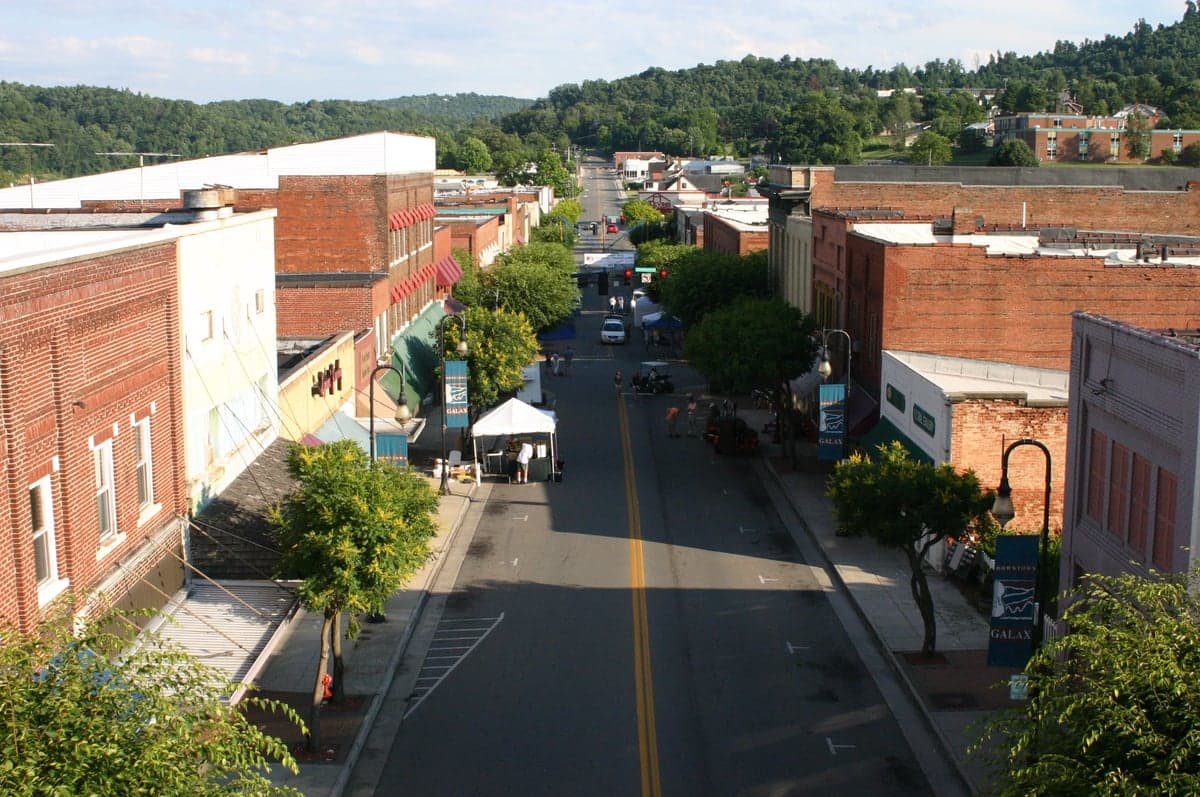
Galax was founded in 1906 as a railroad town, carved out of Carroll and Grayson counties specifically to serve as a commercial hub for the surrounding Blue Ridge region. The city’s name comes from the galax plant, a native evergreen groundcover, reflecting the area’s deep Appalachian roots. The earliest population consisted of Anglo-American settlers from the surrounding counties, drawn by the promise of jobs in the new furniture factories and textile mills that lined the railroad corridor. The Historic Downtown district, centered on Grayson Street, became the commercial and social heart for these early residents, many of whom lived in modest homes within walking distance of the mills. The West End neighborhood, west of Main Street, grew as a working-class area where mill workers and their families settled, building a community of churches, small grocery stores, and social halls. By the 1920s, Galax had established itself as the "Furniture Capital of the Blue Ridge," attracting additional waves of rural Appalachian families seeking steady industrial wages. The East End, along East Stuart Drive, developed later as a mixed residential and commercial corridor, housing both mill workers and the professionals who served the growing town. The city’s population remained overwhelmingly white and native-born through the mid-20th century, with the 1950 census recording less than 1% non-white residents.
Modern era (post-1965)
The post-1965 period brought significant demographic change, though Galax remained far less diverse than Virginia as a whole. The most notable shift has been the growth of the Hispanic population, which rose from negligible levels in 1990 to 15.8% by the 2020s. This wave was driven by employment in the remaining furniture factories, poultry processing plants, and construction trades, with many families arriving from Mexico and Central America. The North Galax area, particularly along North Main Street and the neighborhoods near the old factory sites, became a primary settlement zone for Hispanic families, drawn by affordable housing and proximity to industrial jobs. The Black population, at 4.9%, has remained relatively stable and is concentrated in the South End around South Main Street and the neighborhoods near the former Galax High School site, where a historic Black community has persisted since the early 1900s. East/Southeast Asian residents account for just 0.1% of the population, and Indian-subcontinent residents are statistically absent at 0.0%, reflecting the city’s limited draw for professional immigrants. The white population, at 75.8%, remains the majority but has declined from over 90% in 1980 as the Hispanic share has grown. Suburbanization within the city limits has been minimal; Galax is geographically small at just 8.3 square miles, and most new development has occurred in the Galax Meadows subdivision and along the Pipers Gap Road corridor, where newer single-family homes have attracted younger families and some retirees.
The future
The population of Galax is projected to remain stable or decline slightly over the next 10–20 years, mirroring trends across rural Southwest Virginia. The Hispanic share is likely to continue growing, potentially reaching 20–25% by 2040, as younger Hispanic families have higher birth rates and continued in-migration for industrial and service jobs. The white population will likely continue its gradual decline through out-migration of younger adults seeking opportunities in larger metro areas like the Triad (Greensboro–Winston-Salem) or the Roanoke–Blacksburg corridor. The Black and Asian shares are expected to remain small, as Galax lacks the professional job base or university presence that drives diversity in other Virginia cities. New residential development is likely to concentrate in the Pipers Gap Road and Oldtown areas on the city’s northern and eastern edges, where land is available for single-family subdivisions. The city’s cultural identity is evolving from a strictly Appalachian mill town to a more layered community where Hispanic traditions—seen in new restaurants, tiendas, and church congregations—are becoming part of the local fabric alongside the enduring bluegrass and old-time music heritage that Galax is nationally known for.
For someone moving in now, Galax offers a stable, family-oriented community with a strong sense of place and a gradually diversifying population. The city remains predominantly white and working-class, with a growing Hispanic presence that is reshaping neighborhoods and local culture. New residents should expect a slow pace of change, deep local roots, and a community where church, family, and music remain central to daily life.

* Values derived from national, state, county, city and local statistics and may differ in a specific area. Last updated: 2026-10-24T15:29:05.000Z
Narrative content on this page is AI-generated and may contain mistakes. Verify any details that matter before acting on them.
ReloMaps may earn a commission from affiliate links at no extra cost to you.

