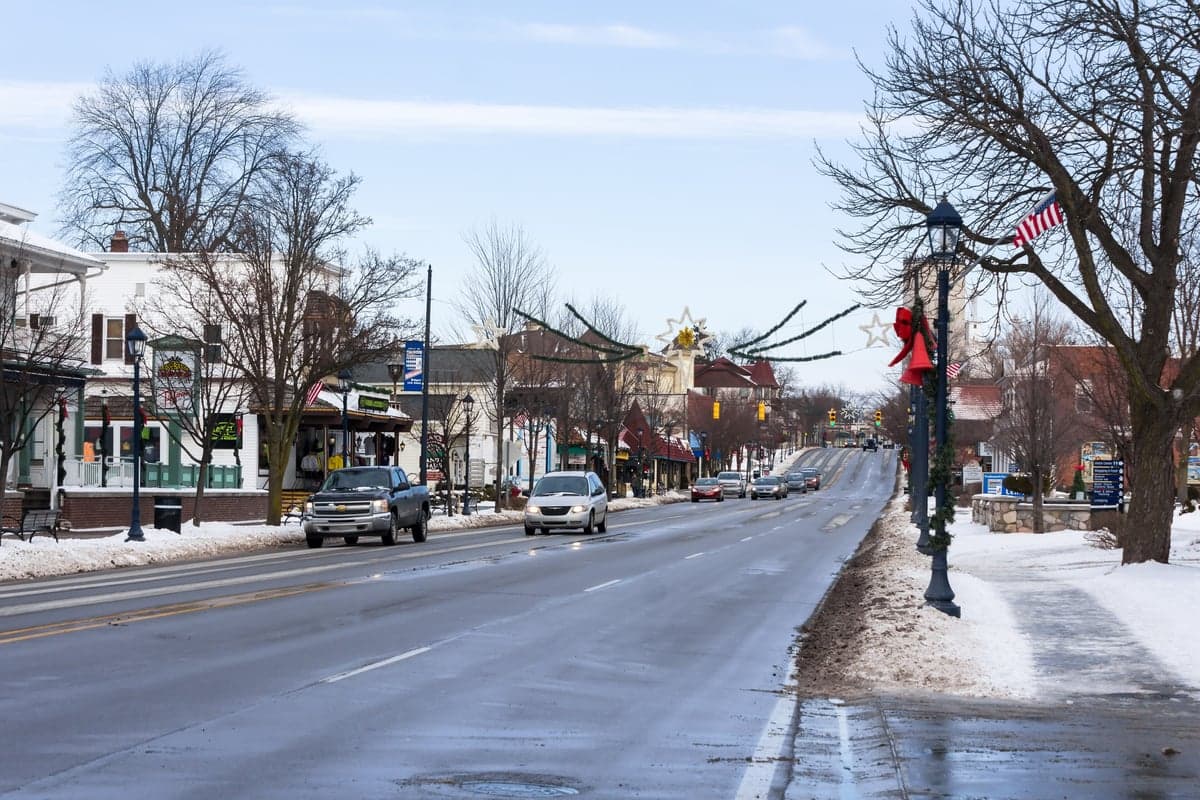
Photo: Wikipedia
Political ClimatePolitical Climate in Frankenmuth, MI
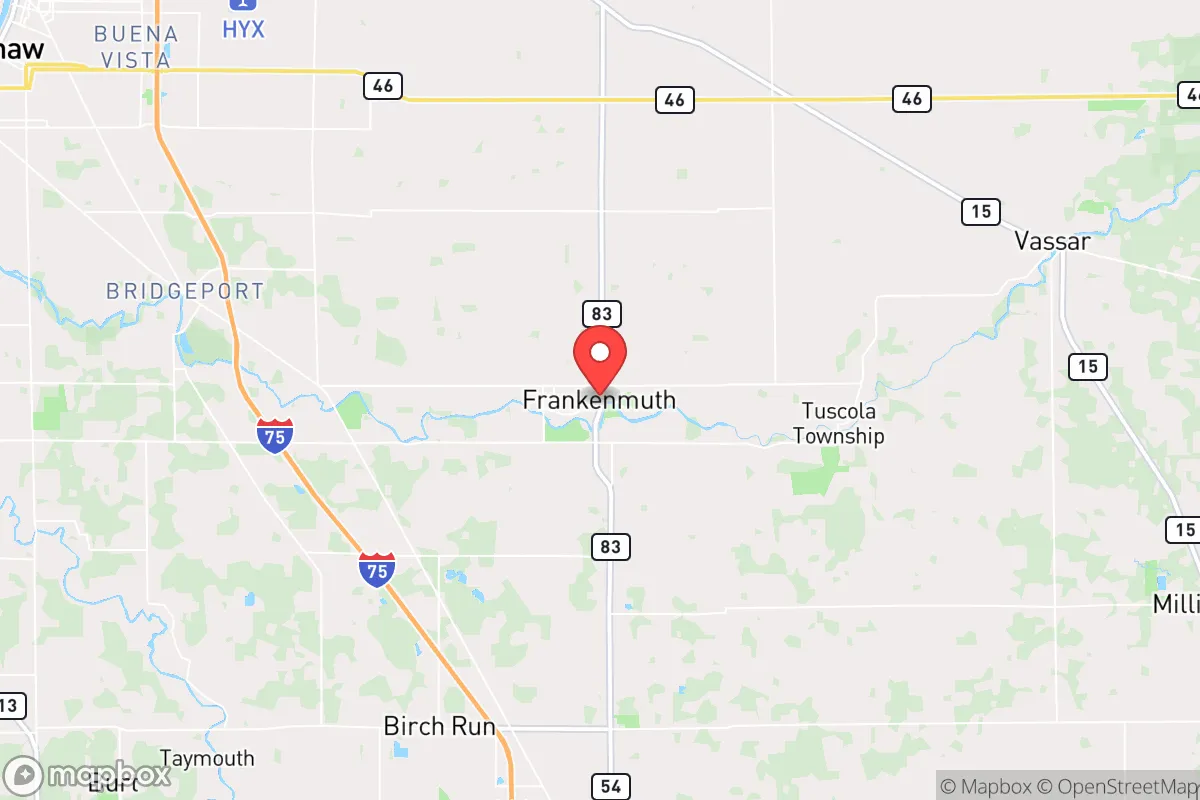
District shown is the primary district for this city’s centroid. Cities may span multiple districts.
Local Political AnalysisPolitical Analysis of Frankenmuth, MI
Frankenmuth, Michigan, sits in a political sweet spot that’s shifted noticeably over the past decade. The city itself leans slightly Republican, with a Cook Partisan Voting Index (PVI) of R+1, meaning it votes about one point more Republican than the national average. But that’s a far cry from the deep-red territory you’ll find just 15 miles west in places like Vassar or Caro, where Republican margins routinely hit double digits. The real story here is how Frankenmuth has drifted rightward since the 2010s, even as Michigan as a whole has become a true swing state with a Cook PVI of EVEN. Back in 2012, the city was a toss-up, but by 2020, Trump carried Saginaw County (which includes Frankenmuth) by about 4 points, while the state overall flipped back to Biden by 2.8 points. That gap—roughly 7 points between local and statewide voting—is the key to understanding the area’s political character today.
How it compares
Frankenmuth’s R+1 lean puts it squarely in the middle of Michigan’s political spectrum, but the comparison gets sharper when you look at nearby towns. Head south to Birch Run or Clio, and you’ll find communities that vote R+10 or more, driven by heavier manufacturing and rural roots. Go north to Saginaw city proper, and you’re in a D+15 stronghold, where union households and a larger Black population push the vote decisively blue. Frankenmuth sits between these poles, reflecting its mix of tourism-driven small business owners, retirees from the auto industry, and a growing number of remote workers who moved here during the pandemic. The city’s politics are less about culture-war flashpoints and more about local economic pragmatism—tax rates, road funding, and school budgets. That’s why you’ll see a Republican mayor (current is Tom Bierlein, elected in 2023) but also a city council that’s often split 4-3 on spending issues. It’s a place where a “Republican” voter might support a local millage for parks, while a “Democrat” might oppose a state-level gun law. The trajectory since 2016 has been a slow, steady rightward drift, but it’s still a far cry from the rural counties to the west.
What this means for residents
For conservative residents, Frankenmuth offers a comfortable environment where their views are the local norm, especially on fiscal issues like low property taxes (the city’s millage rate is about 15 mills, below the state average). You’ll find plenty of “Trump 2024” signs on lawns in the newer subdivisions off M-83, and the local Chamber of Commerce leans pro-business. For liberal residents, the picture is more nuanced. You won’t face hostility, but you’ll be in a clear minority—the Saginaw County Democratic Party has a small presence here, and progressive candidates rarely crack 45% in city elections. That said, the city’s tourism economy (drawing 3 million visitors annually to Bronner’s Christmas Wonderland and Zehnder’s) means there’s a live-and-let-live attitude. You’ll see Pride flags on Main Street during June, but they’re outnumbered by American flags. The practical effect is that local policy stays moderate: the city council voted 5-2 in 2022 to keep a diversity, equity, and inclusion committee, but also rejected a proposal to ban conversion therapy for minors. It’s a place where political battles are fought over sidewalk repairs and zoning for new breweries, not national wedge issues.
Culturally, Frankenmuth’s Bavarian heritage and heavy reliance on tourism create a unique political dynamic. The city’s identity is tied to being a family-friendly destination, which means local leaders avoid polarizing stances that could hurt business. You won’t see the kind of anti-mask protests that flared up in nearby Bay City during COVID, but you also won’t find the progressive activism of Ann Arbor. The biggest policy distinction from the rest of Michigan is the city’s strict sign ordinance—no billboards, no oversized political signs—which keeps the visual landscape clean but also limits the kind of yard-sign warfare you see in other suburbs. Looking ahead, the trend is toward a slow reddening as more retirees from downstate move in, but Frankenmuth’s economic reliance on a diverse visitor base will likely keep it from becoming as conservative as its rural neighbors. For now, it’s a place where you can have a beer at the Frankenmuth Brewery and debate property taxes without anyone getting heated—as long as you don’t bring up the 2020 election results.

State Political ClimatePolitical Climate in Michigan
State Political AnalysisPolitical Environment in the State
Michigan is the ultimate swing state, with a Cook PVI of EVEN that perfectly captures its knife-edge balance. Over the past 20 years, it has lurched from reliably blue (voting for every Democratic presidential candidate from 1992 to 2012) to a true battleground that flipped to Trump in 2016, then back to Biden in 2020 by just 154,000 votes. The dominant coalitions are a shrinking, union-heavy blue wall in the southeast (Detroit, Washtenaw County) versus a growing, exurban and rural red wave in the western and northern Lower Peninsula and the Upper Peninsula. The long arc is a slow rightward drift in the exurbs and small towns, offset by Democratic gains in the affluent suburbs of Grand Rapids and Oakland County, making every election a toss-up.
Urban vs. rural divide
The political map is stark. Wayne County (Detroit) and Washtenaw County (Ann Arbor) are the Democratic strongholds, delivering margins of 60-70% for Democrats. But the real story is the collapse of the old blue wall in the rest of the state. Macomb County, north of Detroit, was the iconic "Reagan Democrat" county that flipped hard to Trump in 2016 and stayed red in 2020. Kent County (Grand Rapids) was historically Republican but has become a competitive toss-up as the city itself has grown younger and more diverse, while the surrounding townships remain deeply conservative. The Upper Peninsula and the northern Lower Peninsula (around Traverse City, Alpena, and the Thumb) are now solidly red, driven by rural resentment of Detroit-centric policies and a strong hunting, fishing, and gun culture. The key swing counties are Ottawa County (west of Grand Rapids, heavily Dutch Reformed and conservative) and Livingston County (exurban Detroit, fast-growing and now reliably red).
Policy environment
Michigan’s policy environment is a mixed bag that reflects its swing-state status. Taxes: the state has a flat 4.25% income tax (reduced from 4.35% in 2023 via a trigger law) and a 6% sales tax. Property taxes are high, averaging about 1.5% of assessed value, but there is a Headlee Amendment that caps annual increases to the rate of inflation. Regulatory posture: Michigan is a right-to-work state for private-sector workers (law passed in 2012, repealed by Democrats in 2023, effective 2024), meaning union membership is no longer mandatory. The state has a constitutional right to hunt and fish (passed in 1996). Education: school choice is robust, with charter schools and inter-district open enrollment, but the state’s education funding formula is heavily tied to local property taxes, creating wide disparities between wealthy suburbs and rural districts. Healthcare: Michigan expanded Medicaid under the Affordable Care Act in 2013, and the state has a strong public health infrastructure. Election laws: Michigan has no-excuse absentee voting (passed by ballot initiative in 2018), same-day voter registration, and automatic voter registration at the DMV. Voter ID is required at the polls, but a signed affidavit can substitute.
Recent policy direction
The last two years under a Democratic trifecta (Governor Gretchen Whitmer, state House, state Senate) have seen a sharp leftward shift on several fronts. Gun and self-defense law: in 2023, Michigan passed universal background checks, safe storage requirements, and a red-flag law (extreme risk protection orders). Open carry is still legal, but concealed carry requires a permit. Parental and education rights: the state repealed its 1931 abortion ban (pre-Roe) and codified abortion rights into law in 2023. A 2023 law also banned conversion therapy for minors. Speech and privacy: Michigan has no specific shield law for journalists, but the state constitution protects free speech. Medical and bodily autonomy: the 2022 ballot initiative (Proposal 3) enshrined a broad right to reproductive freedom, including abortion, contraception, and miscarriage care, in the state constitution. Property rights: the state has a strong Right to Farm Act that protects agricultural operations from nuisance lawsuits, but there is no statewide preemption on local zoning for short-term rentals. Taxation: the 2023 budget included a temporary 0.25% income tax cut, but the overall trajectory is toward higher spending on infrastructure and education. Voting and ballot access: the 2022 ballot initiative (Proposal 2) expanded early voting (nine days), established a permanent absentee voter list, and required drop boxes in every jurisdiction. These changes have made Michigan one of the most accessible states to vote in, but they remain controversial among conservatives who worry about ballot security.
Civil unrest & political movements
Michigan has been a flashpoint for political activism on both sides. The 2020 Whitmer kidnapping plot (involving militia members from the Wolverine Watchmen) and the Operation Gridlock protests at the state capitol (where armed protesters entered the building in April 2020) are still fresh in residents’ minds. The state has a strong MAGA movement in rural areas, with regular rallies in places like Hartland and Muskegon. On the left, the Michigan Democratic Party has been energized by the 2022 ballot initiatives and the 2023 legislative session. Immigration politics: Michigan is not a sanctuary state, but several cities (Detroit, Ann Arbor, Grand Rapids) have declared themselves sanctuary cities. The state has no statewide policy on immigration enforcement. Election integrity: the 2020 election in Michigan was subject to numerous lawsuits and audits, all of which confirmed the results, but distrust remains high among conservatives. The Antrim County clerical error (where a software glitch initially showed a Democratic win in a heavily Republican county) became a national talking point. Secession rhetoric: there have been fringe calls for the Upper Peninsula to secede and join Wisconsin, but these have no serious political traction.
Projection
Over the next 5-10 years, Michigan will remain a toss-up, but the demographic trends favor Democrats in the long run. The Detroit metro area is slowly diversifying and growing, while the rural counties are aging and shrinking. The Grand Rapids area is the wild card: it is growing fast, attracting both conservative Christians and young professionals who lean left. The 2024 election will be a test of whether the Democratic trifecta’s policies (especially the gun laws and abortion rights) mobilize suburban women and young voters, or whether inflation and cultural backlash drive working-class voters back to the GOP. The state’s in-migration is modest (mostly from Illinois and Ohio), and it is not a major destination for remote workers. A new resident moving in now should expect a state that is politically divided down the middle, with every election decided by a few points, and a policy environment that swings sharply with each change in control.
For a conservative-leaning relocator, the bottom line is this: Michigan offers a low cost of living, strong outdoor recreation, and a constitutional right to hunt and fish, but you will be living in a state where the governor and legislature are currently controlled by Democrats who have passed gun restrictions and expanded abortion access. The state’s political future is uncertain, but the rural and exurban areas (like Livingston County, Ottawa County, and the Upper Peninsula) remain deeply conservative and are likely to stay that way. If you value a strong local community and don’t mind the state-level politics swinging back and forth, Michigan is a solid choice. If you want a state that is reliably red and will stay that way, look to Indiana or Ohio instead.
* Values derived from national, state, county, city and local statistics and may differ in a specific area. Last updated: 2026-10-08T15:32:43.000Z
Narrative content on this page is AI-generated and may contain mistakes. Verify any details that matter before acting on them.
ReloMaps may earn a commission from affiliate links at no extra cost to you.

