Photo: Wikipedia
Demographics of Frankenmuth, MI
Affluence Level in Frankenmuth, MI
A middle-class area roughly in line with national averages across income, home values, education, and employment.
People of Frankenmuth, MI
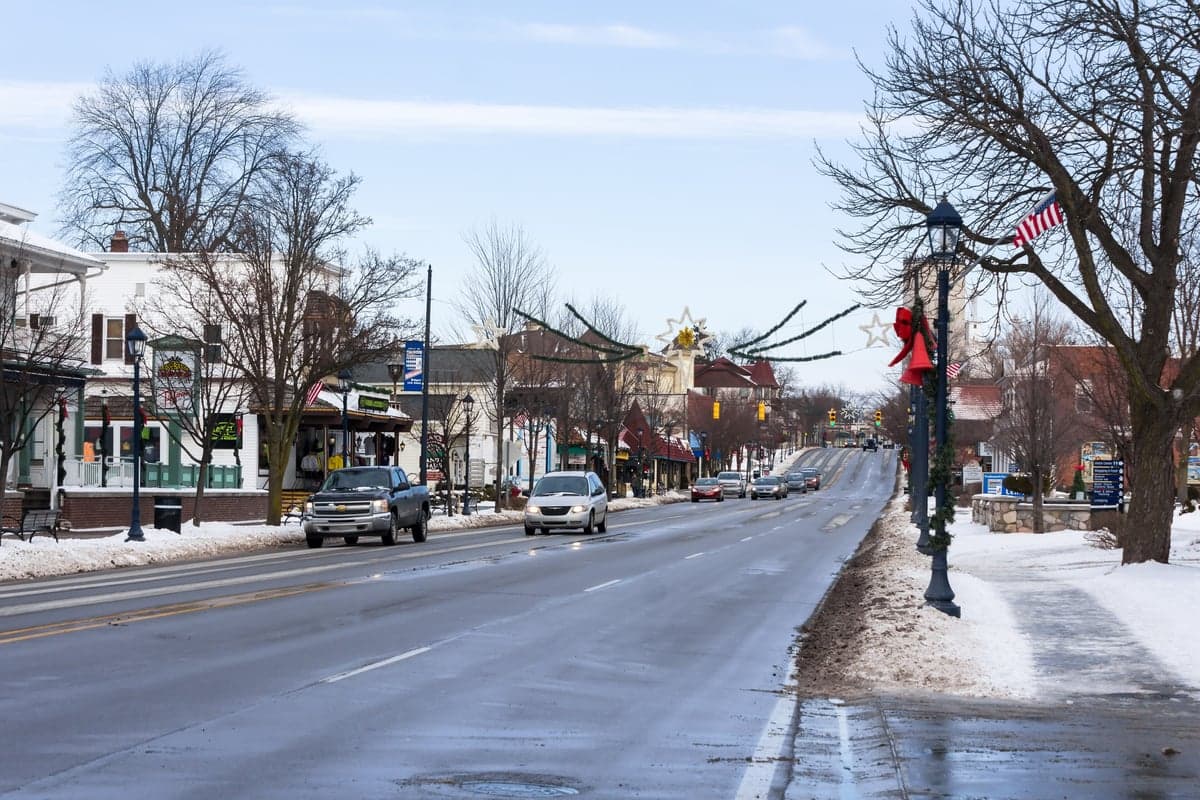
The people of Frankenmuth, Michigan, today number 5,108 and form one of the most culturally homogeneous communities in the state, with 88.9% of residents identifying as white alone. The city’s identity remains deeply shaped by its 19th-century German Lutheran founders, visible in the Bavarian-style architecture, the annual Frankenmuth Oktoberfest, and the prominence of family-owned businesses like Bronner’s Christmas Wonderland. Despite a modest 6.0% Hispanic population and 4.3% Black population, the city is less diverse than Saginaw County as a whole, and its foreign-born share sits at just 2.0%. Nearly half of adults (48.9%) hold a college degree, a figure well above the Michigan average, reflecting a population that is educated, stable, and culturally cohesive.
How the city was settled and grew
Frankenmuth was founded in 1845 by a group of 15 German Lutheran missionaries from the Franconia region of Bavaria, sent by the Lutheran Church–Missouri Synod to minister to the Ojibwe people. The original settlement clustered along the Cass River near what is now Main Street, where the first log church and parsonage were built. The missionaries were soon joined by German farmers and tradesmen, who established the Bavarian Village district—today the historic downtown core—with its half-timbered buildings and beer gardens. A second wave of German immigrants arrived in the 1850s and 1860s, drawn by cheap farmland and the growing timber industry along the river. These families settled in the North Main area, building the iconic St. Lorenz Lutheran Church (now a landmark) and founding the Frankenmuth Brewery in 1862. By 1900, the population was nearly entirely German-born or first-generation German American, and the city remained overwhelmingly white and Lutheran through the mid-20th century. The South Main corridor developed later, after World War II, as returning veterans built ranch-style homes on former farm plots, but the ethnic character stayed unchanged.
Modern era (post-1965)
The 1965 Immigration and Nationality Act had almost no effect on Frankenmuth’s demographics. The city saw no significant influx of Asian, Indian, or Arab populations—the current East/Southeast Asian share is 0.0%, and the Indian-subcontinent share is just 0.8%. Instead, the post-1965 story is one of domestic in-migration from elsewhere in Michigan and the Midwest. The construction of the Frankenmuth High School campus in the 1970s and the expansion of the Bavarian Inn Lodge in the 1980s drew families to the Bavarian Estates subdivision, a planned neighborhood of single-family homes east of Main Street. The Riverbend area, along the Cass River south of town, absorbed a smaller wave of retirees and second-home buyers in the 1990s and 2000s, drawn by riverfront lots and proximity to the city’s tourism economy. The Hispanic population, now 6.0%, began growing in the 2000s, largely through workers in the hospitality and food-processing sectors; these families have concentrated in the West Side neighborhood, west of the river and near the industrial park. The Black population (4.3%) is small and dispersed, with no single neighborhood majority, reflecting the city’s limited racial diversity overall.
The future
Frankenmuth’s population is aging slowly—the median age is 42.5, slightly above the Michigan average—and the city is projected to remain predominantly white for the foreseeable future. The Hispanic share is likely to grow gradually, possibly reaching 8–10% by 2040, driven by continued demand for service workers in the tourism sector. The Black and Indian-subcontinent populations are expected to remain small, as the city lacks the industrial or professional job base that attracts larger minority communities to Saginaw or Flint. New residential development is concentrated in the Heritage Park district, a master-planned community of 200+ homes approved in 2022, which is marketed to young families and remote workers. This development will likely reinforce the city’s college-educated, white-collar character rather than diversify it. Culturally, Frankenmuth is evolving from a purely German-heritage tourist town into a broader “family destination” that still leans conservative—the city voted +38 points for Donald Trump in 2024—but is slowly becoming more accepting of Hispanic residents and non-Lutheran newcomers.
For someone moving in now, Frankenmuth offers a stable, safe, and culturally distinct community where the population is not changing rapidly. The city is becoming slightly more Hispanic and slightly more educated, but the core identity—white, German-rooted, family-oriented, and politically conservative—will remain dominant through the 2030s. New arrivals, especially those in the Heritage Park area, will find a place that values tradition, low crime, and strong schools, but they should expect limited racial or ethnic diversity compared to larger Michigan cities.

* Values derived from national, state, county, city and local statistics and may differ in a specific area. Last updated: 2026-10-08T15:32:43.000Z
Narrative content on this page is AI-generated and may contain mistakes. Verify any details that matter before acting on them.
ReloMaps may earn a commission from affiliate links at no extra cost to you.

