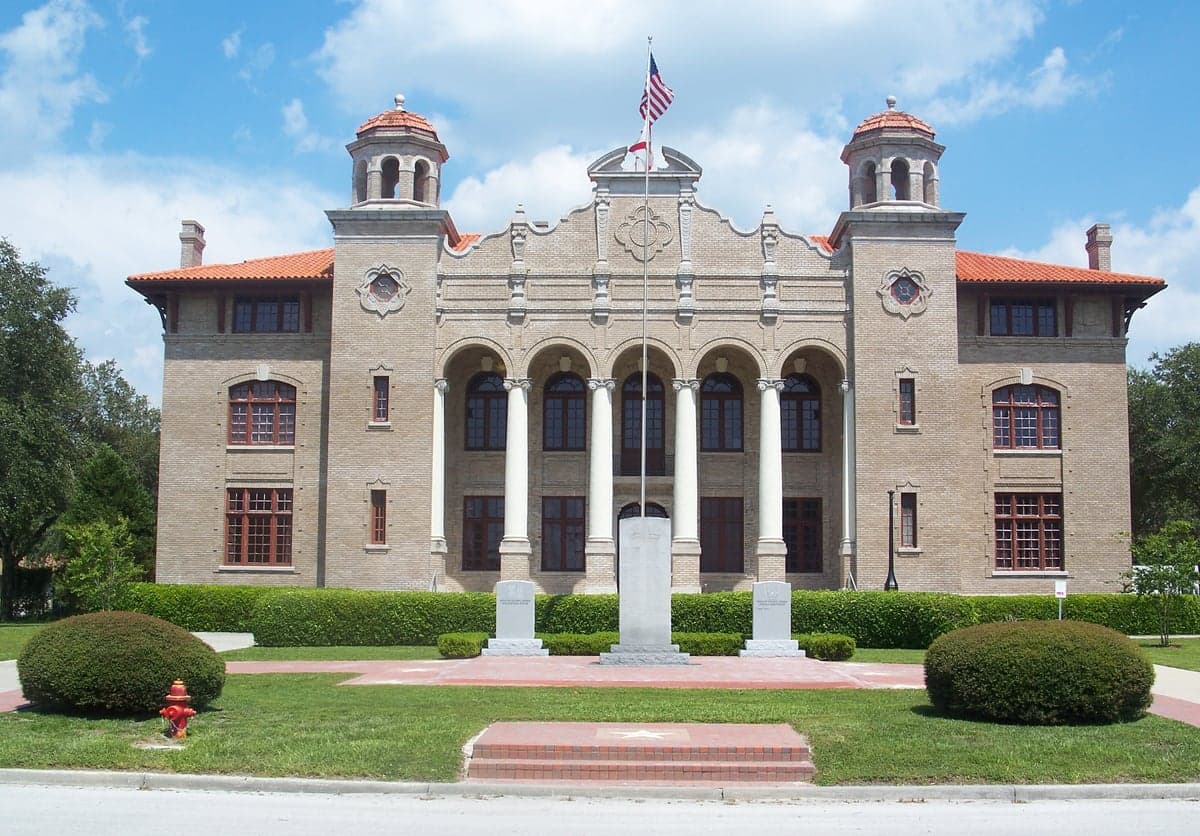
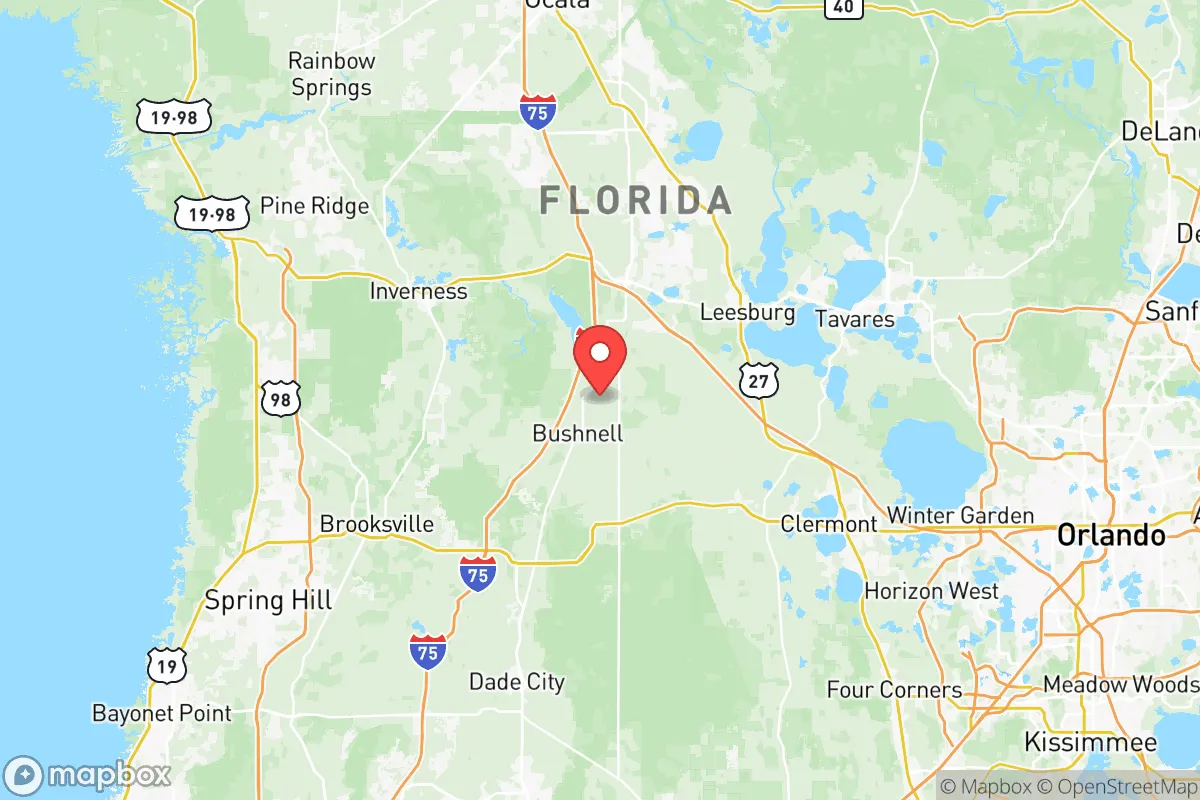
Photo: Wikipedia
Political ClimatePolitical Climate in Sumter County
Showing district-level results — no local-only data available.
Local Political AnalysisPolitical Analysis of Sumter County
Sumter County, Florida, is one of the most reliably Republican counties in the state, with a Cook Partisan Voting Index (PVI) of R+8, making it three points more conservative than Florida’s overall R+5 rating. The county’s politics are overwhelmingly shaped by The Villages, the massive 55+ retirement community that dominates the electorate and delivers lopsided margins for GOP candidates. In the 2024 presidential race, Sumter County gave Donald Trump roughly 68% of the vote, a share that has held steady for the past three cycles. While the county as a whole is deeply red, there are subtle variations between the handful of small towns outside the retirement corridor, and those differences matter for anyone trying to understand the local political landscape.
How it compares
Sumter County’s R+8 PVI places it well to the right of Florida’s statewide R+5, but that gap understates the practical difference. In a typical election, a Republican candidate can expect to win Sumter by 25 to 30 points, while statewide races are often decided by single digits. The Villages precincts in and around Lady Lake and Wildwood are the engine of this margin — these are among the highest-turnout precincts in the state, and they vote Republican at rates exceeding 70%. By contrast, the older, smaller towns like Bushnell and Webster are more mixed. Bushnell, the county seat, has a higher share of working-age families and a small but visible Democratic presence; its precincts sometimes split 55-45 or closer. Coleman, a historically Black community in the northern part of the county, leans reliably Democratic, though its turnout is low relative to The Villages. The swing precincts — if you can call them that — are in the unincorporated areas between Wildwood and the Sumterville crossroads, where independent voters occasionally nudge the margin a few points toward the center. But overall, the county’s trajectory has been steadily rightward since the early 2000s, driven by the influx of conservative retirees from the Midwest and Northeast.
What this means for residents
For conservative residents, Sumter County is a comfortable environment where Republican candidates rarely face serious challenges, and local policy reflects that. The county commission is uniformly Republican, and tax rates are kept low — the county’s millage rate is among the lowest in the state. For liberal residents, the political reality is more isolating. There is no organized Democratic Party infrastructure to speak of outside of Bushnell and Coleman, and progressive candidates rarely appear on the ballot. Socially, it’s common to see Trump flags and conservative bumper stickers everywhere, and liberal residents often keep their politics private to avoid friction. That said, the county is not hostile in a personal sense — most interactions are neighborly regardless of party — but the public sphere is overwhelmingly conservative, and that shapes everything from local news coverage to the issues the county commission prioritizes.
Culturally, Sumter County stands apart from the rest of Florida in a few notable ways. The Villages enforces a strict set of community rules — everything from lawn maintenance to political signage — that would feel out of place in most other parts of the state. Outside the retirement communities, the county retains a rural, agricultural character that is increasingly rare in fast-growing Florida. Gun rights are broadly supported, and the county has a strong Second Amendment sanctuary resolution on the books. On the other hand, there is little appetite for the kind of growth management or environmental regulation that coastal Florida counties debate. If you’re moving here, the political climate is straightforward: it’s deeply conservative, it’s stable, and it’s not changing anytime soon. For someone who fits that mold, it’s a comfortable fit. For someone who doesn’t, it’s a place where you’ll need to find your own community — and it’s worth knowing that going in.

State Political ClimatePolitical Climate in Florida
State Political AnalysisPolitical Environment in the State
Florida is a Republican-leaning state with a Cook PVI of R+5, but it’s far from a monolith. Over the past 20 years, the state has shifted from a classic swing state—famously deciding the 2000 election by 537 votes—to a solidly red stronghold in statewide races, though local pockets of blue remain vibrant. The dominant coalition is a mix of conservative retirees, rural and exurban voters, and a growing number of Hispanic voters in places like Miami-Dade who have moved right, while Democrats hold sway in dense urban cores and among younger, college-educated transplants.
Urban vs. rural divide
The political map of Florida is a tale of three Floridas. The I-4 corridor, stretching from Tampa through Orlando to Daytona Beach, is the state’s perennial battleground, where suburban swing voters in places like Lakeland and Winter Garden have trended red in recent cycles. Meanwhile, the southeast coast—Miami-Dade, Broward, and Palm Beach counties—remains the Democratic stronghold, though Miami-Dade has shifted right dramatically: in 2020, Trump lost it by only 7 points after Hillary Clinton won it by 30 in 2016. The Panhandle and rural north are deeply red, with counties like Liberty and Holmes routinely giving Republicans 80%+ of the vote. The Gulf Coast from Sarasota to Naples is a mix of affluent retirees (red-leaning) and artsy coastal towns (purple to blue). The urban cores of Miami, Orlando, and Tampa are blue, but their suburbs—especially in St. Johns County (Jacksonville exurbs) and Lee County (Fort Myers)—are red and growing fast.
Policy environment
Florida’s policy environment is defined by low taxes and light regulation. There is no state income tax, a major draw for relocators. Property taxes are moderate, with a 3% annual cap on assessed value increases for homesteaded properties (Save Our Homes amendment). Sales tax is 6%, but local options can push it to 7.5-8.5%. The state is a right-to-work state, and its regulatory posture is business-friendly, with minimal zoning restrictions in many rural areas. Education policy has shifted right: the state has one of the nation’s largest school voucher programs (the Family Empowerment Scholarship), and Governor Ron DeSantis signed the Parental Rights in Education Act (HB 1557, often called “Don’t Say Gay”) in 2022, which restricts classroom instruction on sexual orientation and gender identity in early grades. Healthcare policy is mixed: Florida did not expand Medicaid under the ACA, leaving roughly 800,000 residents in the coverage gap, but it has a robust private insurance market. Election laws have tightened: the 2021 SB 90 limited drop boxes, added ID requirements for mail ballots, and restricted third-party ballot collection. The state also has a constitutional carry law (permitless carry) for firearms, signed in 2023, and a “stand your ground” statute that has been on the books since 2005.
Recent policy direction
Over the last five years, Florida has moved decisively right on a broad front. On gun and self-defense law, the 2023 permitless carry law (HB 543) allows most adults to carry concealed firearms without a permit, though open carry remains restricted. On parental and education rights, the state has banned critical race theory in schools (2022), restricted transgender athletes from participating in women’s sports (2021), and passed the Stop WOKE Act (2022), which limits workplace and classroom discussions on race and gender. On speech and privacy, the state has targeted social media platforms with laws (SB 7072, 2021) that allow users to sue for deplatforming, though courts have blocked parts of it. On medical and bodily autonomy, Florida banned abortion after six weeks (HB 5, 2023), with exceptions for rape, incest, and the life of the mother, and it has restricted gender-affirming care for minors (2023). On property rights, the state has strong protections against eminent domain and has preempted local rent control ordinances (2023). On taxation, the state has periodically cut the corporate income tax rate (now 5.5%) and provided temporary gas tax holidays. On voting and ballot access, the 2021 SB 90 law has been followed by a new election police force (Office of Election Crimes and Security) that has prosecuted a handful of cases, mostly for non-citizen voting and double voting.
Civil unrest & political movements
Florida has seen its share of political flashpoints. The 2020 Black Lives Matter protests in Miami, Orlando, and Tampa were large but mostly peaceful, though there were isolated instances of property damage. The state’s immigration politics have been front and center: Governor DeSantis sent migrants to Martha’s Vineyard in 2022, and the state passed the SB 1718 immigration enforcement law in 2023, which requires hospitals to ask about immigration status, bans local governments from providing ID to undocumented immigrants, and expands penalties for human smuggling. There are no sanctuary cities in Florida; the state has banned them since 2019. Election integrity controversies have been a persistent theme: the 2020 election in Florida was widely seen as smooth and secure, but the state has since created a dedicated election police unit, which has been criticized by Democrats as voter intimidation. Secession or nullification rhetoric is rare in Florida, though some rural counties have passed symbolic resolutions asserting local control. The most visible political movement is the DeSantis-aligned conservative activist network, which has pushed for school board takeovers, library book challenges, and anti-vaccine mandates. On the left, the Dream Defenders and Progress Florida organize around criminal justice reform and voting rights, but they have limited legislative success.
Projection
Over the next 5-10 years, Florida is likely to remain Republican-leaning but could see a slight purple shift in certain metros. The state is growing fast—about 1,000 new residents per day—and many are coming from blue states like New York and California. While these transplants are often assumed to be conservative, many are moderate or even liberal, especially younger families moving to Orlando and Tampa. The Hispanic vote, particularly among Cuban-Americans in Miami-Dade and Puerto Ricans in Central Florida, is not monolithic: Cuban-Americans have trended red, but younger Puerto Ricans and Venezuelans are more split. The I-4 corridor will remain the key battleground, and if Democrats can win back suburban women and college-educated voters there, the state could become competitive again. However, the state’s legislative and congressional maps are heavily gerrymandered in favor of Republicans, so even if the statewide vote tightens, the GOP will likely hold the legislature and a majority of House seats. Climate change and insurance costs could become a political issue, especially in coastal areas like Miami Beach and Fort Lauderdale, where flood insurance premiums are skyrocketing. A new resident moving in now should expect a state that is reliably red on most cultural and economic issues, with a growing conservative activist presence in local government, but with enough diversity in the big cities to feel politically comfortable regardless of their lean.
For a new resident, the bottom line is this: Florida offers a low-tax, low-regulation environment with strong protections for gun rights and parental control in education, but it also has a restrictive abortion law, a tight labor market, and a political climate that can feel polarized, especially in the suburbs. If you’re conservative, you’ll find a state government that reflects your values and a growing network of like-minded communities. If you’re liberal, you’ll find vibrant blue cities and a robust activist scene, but you’ll be living under a state government that is actively hostile to many of your policy preferences. Either way, the weather is warm, the economy is growing, and the politics are never boring.
* Values derived from national, state, county, city and local statistics and may differ in a specific area. Last updated: 2026-07-05T11:05:15.000Z
Narrative content on this page is AI-generated and may contain mistakes. Verify any details that matter before acting on them.
ReloMaps may earn a commission from affiliate links at no extra cost to you.

