Photo: Wikipedia
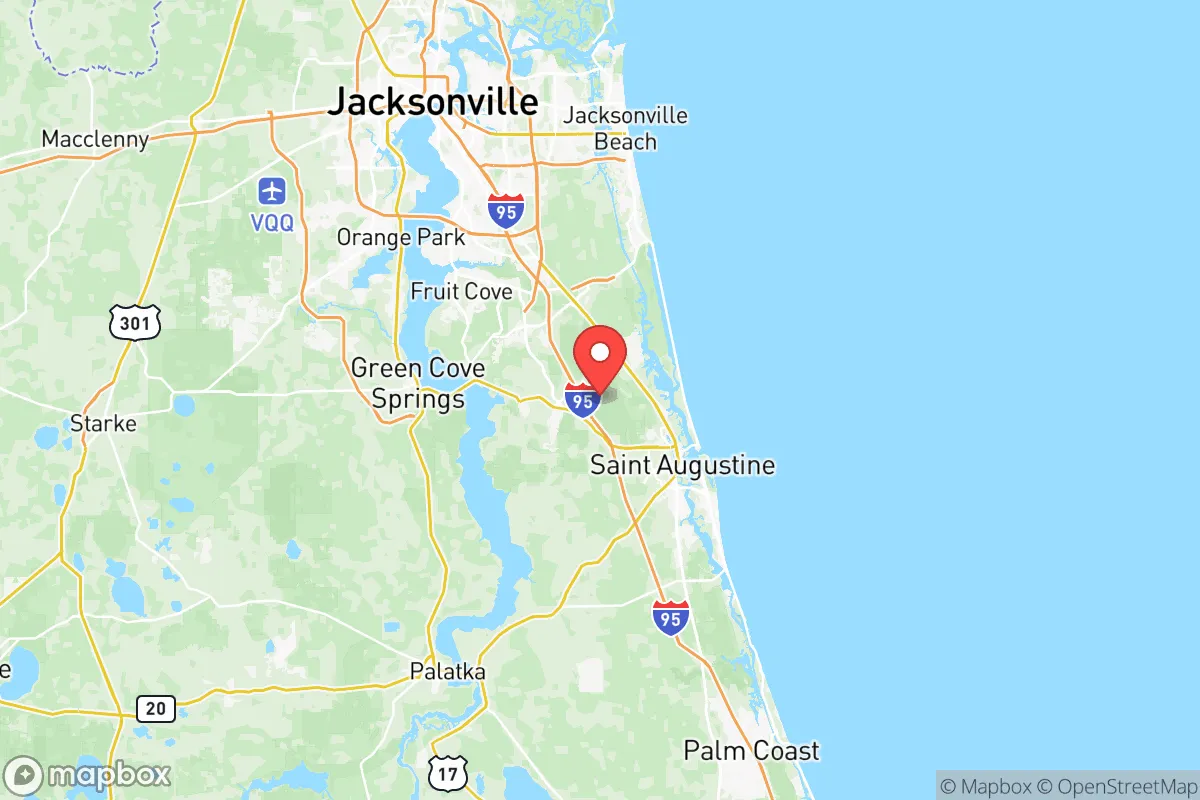
Political ClimatePolitical Climate in St Johns County
Showing district-level results — no local-only data available.
Local Political AnalysisPolitical Analysis of St Johns County
St Johns County has long been a conservative stronghold, and it’s only gotten redder over the years. With a Cook PVI of R+10, it’s a full five points more Republican than the state of Florida as a whole, which sits at R+5. That gap isn’t just a number—it reflects a real cultural and political divide between this county and the rest of the state. If you’re looking for a place where traditional values and limited government are still the norm, this is it.
How it compares
While Florida as a state has been trending purple in recent cycles—thanks to influxes from blue states and growing urban centers like Miami and Orlando—St Johns County has held steady. The county voted for Trump by double digits in both 2020 and 2024, while statewide margins were tighter. That said, there’s some variation within the county itself. The city of St. Augustine, especially its historic downtown and Flagler College area, leans more moderate-to-blue, with precincts near the coast showing closer races. Meanwhile, Ponte Vedra Beach and Nocatee are deep red, driven by families and retirees who moved here specifically for lower taxes and less government interference. The swing precincts are mostly in the World Golf Village area and parts of St. Augustine Shores, where newer transplants from the Northeast have brought more mixed voting patterns. But overall, the county’s Republican base is solid and growing.
What this means for residents
For those of us who’ve lived here a while, the political climate means a few concrete things. First, property taxes remain relatively low compared to other Florida counties, and there’s no talk of a local income tax—something you’d see in more progressive areas. Second, the school board has stayed focused on parental rights and curriculum transparency, resisting the kind of woke indoctrination that’s crept into other districts. Third, gun rights are respected—no local ordinances trying to bypass state preemption laws, which is a growing problem in places like Broward or Orange County. The county commission has also pushed back on state-level mandates that feel like overreach, whether from Tallahassee or Washington. You won’t find mask mandates or vaccine passports here, and that’s by design.
That said, there are warning signs. The rapid growth—St Johns County is one of the fastest-growing in the nation—is bringing in people from California, New York, and Illinois. Some of them bring their old voting habits. If you look at precincts near the new developments in SilverLeaf and RiverTown, you’ll see a slow but steady uptick in Democratic votes. It’s not a crisis yet, but it’s something to watch. The county’s conservative identity isn’t guaranteed forever.
Culturally, St Johns County still feels like old Florida in the best ways. The local government is hands-off, the sheriff’s office is pro-Second Amendment, and the biggest political fights are usually about growth management, not social engineering. Compared to the rest of Florida, where cities like Miami and Tampa are embracing progressive policies on everything from housing to policing, St Johns County remains a place where personal freedom and local control actually mean something. If that changes, it won’t be because the locals wanted it—it’ll be because the newcomers didn’t respect what they found here.

State Political ClimatePolitical Climate in Florida
State Political AnalysisPolitical Environment in the State
Florida is a solidly Republican state with a Cook PVI of R+5, but don’t let that single number fool you—it’s a battleground that’s been shifting rightward over the last decade, driven by a massive influx of conservative-leaning transplants from blue states and a growing Hispanic electorate that’s breaking for the GOP. The dominant coalition is a mix of suburban families, rural voters, and a surprisingly strong Cuban-American and Venezuelan-American base in South Florida, all united around low taxes, parental rights in education, and a general skepticism of federal overreach. Over the past 10-20 years, the state has gone from a classic swing state (think Bush v. Gore recount) to a reliably red one, with Republicans now holding supermajorities in both legislative chambers and the governor’s mansion since 2019.
Urban vs. rural divide
The political map is stark: the I-4 corridor from Tampa to Orlando is the main swing zone, but even that’s trending redder. Miami-Dade County, once a Democratic stronghold, flipped hard—Trump won it in 2020 after Hillary Clinton carried it by 30 points in 2016, driven by Cuban and Venezuelan voters who despise socialism. Jacksonville (Duval County) is now reliably Republican after years of being purple. Meanwhile, Tallahassee (Leon County) and Gainesville (Alachua County) remain deep-blue islands thanks to state government and university populations. The rural Panhandle—places like Panama City and Pensacola—votes like Alabama, while the Naples and Sarasota areas on the Gulf Coast are solidly red, fueled by retirees fleeing high-tax states. The divide isn’t just urban vs. rural; it’s also cultural. The Miami metro is a unique mix of conservative Hispanics and progressive Anglos, while Orlando’s tourism economy pulls in a more transient, left-leaning workforce. But overall, the rural and suburban vote overwhelms the urban cores.
Policy environment
Florida’s policy environment is a conservative’s dream, and it’s been deliberately engineered that way. There’s no state income tax, which is the single biggest draw for movers. Property taxes are moderate, and the state has a constitutional amendment capping annual assessment increases for homesteaded properties. On education, Governor DeSantis pushed through the Parental Rights in Education Act (HB 1557, the “Don’t Say Gay” law) and expanded school choice via the Family Empowerment Scholarship program, which now covers nearly all income levels. Healthcare is a mixed bag: no Medicaid expansion, but the state has a robust private insurance market and a strong push for telehealth deregulation. Election laws were tightened after 2020—the SB 90 law added voter ID requirements, limited drop boxes, and restricted third-party ballot collection. On the regulatory front, Florida preempted local mask and vaccine mandates during COVID, and it’s a “right-to-work” state with weak unions. The Live Local Act (2023) preempts local zoning to fast-track affordable housing, which is a double-edged sword for property rights but keeps housing supply moving.
Trajectory & freedom
Florida is becoming more free in many respects, especially compared to the Northeast or West Coast. The Constitutional Carry law (HB 543, 2023) allows permitless carry of firearms, a major expansion of Second Amendment rights. The Stop WOKE Act (HB 7) restricts critical race theory in schools and workplace training, which supporters say protects free speech from compelled ideology. On medical freedom, the state banned vaccine passports and prohibited employers from mandating COVID shots without broad exemptions. Property rights were strengthened with the Private Property Rights Protection Act (SB 250), which limits local governments’ ability to downzone land without compensation. However, there are concerns: the state’s six-week abortion ban (HB 5, 2023) is a major restriction on bodily autonomy, and the anti-riot law (HB 1) increases penalties for protest-related offenses, which some see as chilling free assembly. The trajectory is toward more individual liberty on guns, speech, and taxes, but with a heavier hand on social issues and public order.
Civil unrest & political movements
Florida has seen its share of flashpoints, but they’re less frequent than in states like Oregon or New York. The 2020 George Floyd protests in Miami, Orlando, and Tampa saw some looting and clashes, but the state’s quick response—DeSantis declared a state of emergency and activated the National Guard—kept things from spiraling. The “Freedom Convoy” movement in 2022 had a small presence, but nothing like Canada. Immigration politics are hot: the state passed SB 1718 (2023), which requires businesses with 25+ employees to use E-Verify, bans local “sanctuary” policies, and makes transporting undocumented immigrants a felony. This has led to protests from immigrant-rights groups, especially in Miami and Immokalee. Election integrity remains a live issue—the Office of Election Crimes and Security was created in 2022 to investigate voter fraud, and several high-profile arrests have been made, though critics call it political theater. You won’t see daily protests, but the cultural tension is real: in St. Augustine and Fort Lauderdale, you’ll find competing rallies on hot-button days. For a new resident, the vibe is generally orderly, but don’t be surprised to see political bumper stickers or yard signs that are more aggressive than in purple states.
Projection
Over the next 5-10 years, Florida will likely get redder, not bluer. The in-migration is overwhelmingly from high-tax, high-regulation states like New York, California, and Illinois—people moving for lower taxes and more personal freedom. These transplants tend to be center-right or libertarian-leaning, not progressive. The Hispanic vote, especially among Cubans, Venezuelans, and Nicaraguans, is solidifying for the GOP, while Puerto Ricans in Orlando remain more Democratic but are less reliable than a decade ago. The biggest wildcard is climate change: rising insurance costs and hurricane risk could slow growth in coastal areas like Miami Beach and Fort Myers, pushing development inland to places like Ocala and Lakeland, which are already trending red. Expect continued legislative battles over school curriculum, transgender rights, and property insurance reform. The state’s political culture will remain one of “leave us alone” conservatism, but with a growing tension between libertarian-leaning newcomers and the more socially conservative native base. If you’re moving in now, you’ll find a state that’s increasingly aligned with your values, but you’ll also see the national media constantly painting it as a cautionary tale—which only reinforces the local resolve.
Bottom line for a new resident: Florida offers a rare combination of low taxes, strong gun rights, parental control in schools, and a government that actively pushes back against federal overreach. You’ll pay no state income tax, your kids’ curriculum won’t be dictated by Washington, and your Second Amendment rights are protected by law. The trade-offs are a hot housing market, brutal summer humidity, and a political climate that can feel like a culture war frontline—but for most conservatives, that’s a price worth paying. If you’re looking for a state that’s trending in the right direction, Florida is it.
* Values derived from national, state, county, city and local statistics and may differ in a specific area. Last updated: 2026-06-05T17:46:50.000Z
Narrative content on this page is AI-generated and may contain mistakes. Verify any details that matter before acting on them.
ReloMaps may earn a commission from affiliate links at no extra cost to you.

