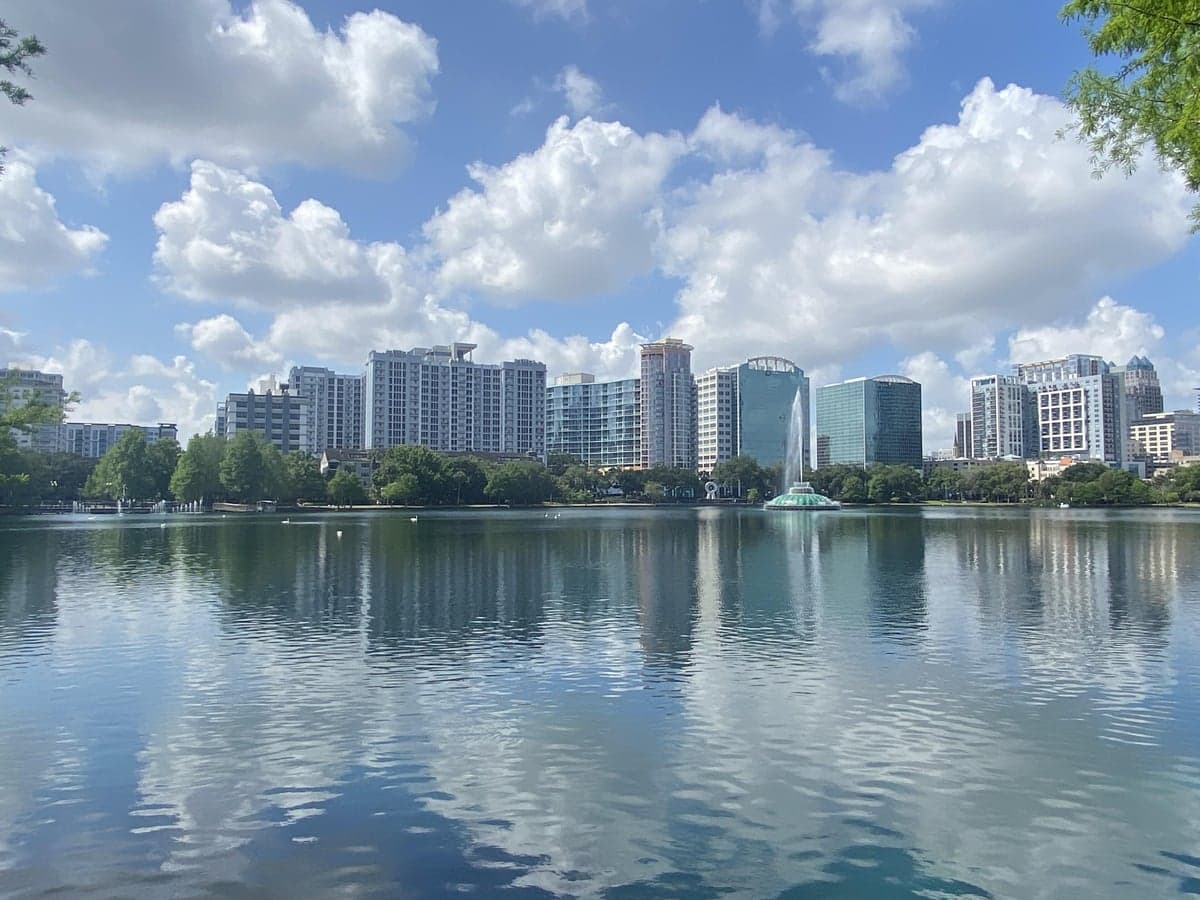
Photo: Wikipedia
Demographics of Orange County
Affluence Level in Orange County
A middle-class area roughly in line with national averages across income, home values, education, and employment.
People of Orange County
Orange County, Florida, is a dense, fast-growing, and culturally layered metropolitan core where no single group holds a majority. With a population of 1,440,471, the county is 36.8% White, 33.2% Hispanic, 19.3% Black, 3.2% East and Southeast Asian, and 2.0% Indian (subcontinent), with 11.6% foreign-born. Its distinctive identity is shaped by a tourism-driven economy, a large Puerto Rican and Afro-Caribbean presence, and a steady influx of domestic migrants from the Northeast and Midwest, creating a place that feels both transient and deeply rooted in family and service-industry life.
Settlement & growth (pre-1960)
Before American settlement, the area now known as Orange County was inhabited by the Timucua people, who lived in small villages along the St. Johns River and its tributaries. Spanish explorers and missionaries made contact in the 1500s, but European disease and conflict largely depopulated the indigenous groups by the 1700s. The region remained a sparsely settled frontier under Spanish and then British rule, with no permanent European settlement taking hold until after Florida became a U.S. territory in 1821.
American settlement began in earnest after the Second Seminole War (1835–1842), when the federal government opened the interior to homesteaders. The first permanent American settlers were primarily Anglo-American farmers from Georgia, South Carolina, and other Deep South states, drawn by cheap land and the promise of citrus and cotton cultivation. They established small agricultural hamlets, the most notable being Fort Gatlin (near modern downtown Orlando) and Maitland, which became early trading posts. The county was officially created in 1824 and named for the orange groves that settlers planted.
The arrival of the South Florida Railroad in 1880 transformed the county. Orlando, then a tiny inland village, became a rail hub and the county seat, attracting merchants, lawyers, and speculators. A wave of Midwestern and Northern migrants arrived in the 1880s and 1890s, drawn by the citrus boom and the mild winter climate. These newcomers were largely of British and German ancestry, and they established the foundations of Orlando's early civic and business elite. The town of Winter Park was founded in 1881 as a winter resort for wealthy Northerners, and its tree-lined streets and Rollins College (founded 1885) reflected the cultural aspirations of this group.
The early 20th century brought a significant African American population. Freed slaves and their descendants moved to Orange County during Reconstruction and the early Jim Crow era, working as farm laborers, domestic servants, and railroad workers. They established distinct communities, most notably the Parramore neighborhood in west Orlando, which became the cultural and commercial heart of Black Orange County. Smaller settlements like Eatonville (incorporated 1887) were founded as all-Black towns, and Eatonville remains one of the oldest African American municipalities in the United States. The Great Migration (1910–1970) brought additional Black families from the Deep South, further solidifying Parramore and Eatonville as anchor communities.
The post-World War II era saw the first major Sun Belt migration. Veterans and their families moved to Orange County for jobs at the new McCoy Air Force Base (later Orlando International Airport) and the burgeoning defense industry. The construction of the Florida Turnpike and Interstate 4 in the 1950s and 1960s opened up suburban land, and developments like Azalea Park and Pine Hills filled with young families from the Northeast and Midwest. By 1960, the county's population had reached 263,540, still predominantly White and native-born, but with a growing Black minority and a small Hispanic presence, mostly Cuban and Puerto Rican.
Modern era (post-1965)
The 1965 Hart-Cellar Act fundamentally reshaped Orange County's demographics. The most dramatic change was the explosion of the Hispanic population, driven overwhelmingly by Puerto Rican migration. Puerto Ricans, who are U.S. citizens, began arriving in large numbers in the 1970s and 1980s, drawn by jobs at Walt Disney World (opened 1971) and the expanding hospitality industry. They concentrated in Buenaventura Lakes and Meadow Woods in south Orange County, as well as in the Azalea Park area. By the 2000s, Puerto Ricans had become the largest Hispanic subgroup, and their influence is visible in the proliferation of bodegas, salsa music, and Spanish-language churches across the county. A smaller but significant Mexican and Central American population also grew, settling in Pine Hills and Orlando's south side.
The Black population also diversified after 1965. While African Americans from the South remain the largest Black subgroup, the county saw a major influx of Haitian and Jamaican immigrants starting in the 1980s. These Afro-Caribbean communities settled in Pine Hills and Orlando's west side, adding a distinct cultural layer with their own churches, restaurants, and festivals. The Black population share grew from roughly 15% in 1970 to 19.3% today, though this growth has been slower than the Hispanic boom.
The East and Southeast Asian community (3.2% of the population) grew primarily after the 1965 Immigration Act and the Vietnam War. Vietnamese refugees arrived in the late 1970s and 1980s, settling in Orlando's Colonialtown neighborhood, which became the heart of a small but vibrant Little Saigon. Filipino immigrants, many working in healthcare and hospitality, concentrated in Maitland and Winter Park. The Indian (subcontinent) population (2.0%) is a more recent phenomenon, growing rapidly since the 1990s as tech and medical professionals moved to the region. They have no single enclave but are dispersed in affluent suburbs like Winter Park and Windermere.
Domestic migration has been equally transformative. Since the 1970s, a steady stream of Rust Belt migrants from New York, New Jersey, Ohio, and Michigan has moved to Orange County, drawn by warm weather, no state income tax, and the tourism job market. These migrants are predominantly White and middle-class, and they have fueled the growth of master-planned suburbs like Lake Nona and Horizon West. The 2000s and 2010s also saw a wave of coastal flight from high-cost California and the Northeast, accelerating after the COVID-19 pandemic. This in-migration has made Orange County one of the fastest-growing large counties in the United States, adding over 300,000 residents since 2010.
The future
Orange County's population is trending toward a tri-ethnic plurality, with White, Hispanic, and Black groups each holding roughly a third of the population. The Hispanic share is projected to continue rising, driven by both Puerto Rican migration and higher birth rates, and could surpass the White share within the next decade. The East/Southeast Asian and Indian populations are growing from a small base but are likely to double their shares by 2040, particularly as Lake Nona's medical city and the tech corridor along State Road 417 attract skilled immigrants.
The county is not homogenizing but rather tribalizing into distinct enclaves. South Orange County (Buenaventura Lakes, Meadow Woods) is becoming overwhelmingly Hispanic and working-class. West Orange County (Pine Hills, Parramore) remains predominantly Black and Afro-Caribbean. The affluent suburbs of Winter Park, Windermere, and Lake Nona are diversifying but remain majority White and Asian. This spatial sorting by race and class is likely to intensify as housing costs push lower-income families further south and east.
Culturally, the county is absorbing its newcomers rather than being transformed by them. The tourism economy creates a transient, service-oriented culture that rewards adaptability, and most immigrant groups assimilate into the broader American mainstream within a generation. However, the Puerto Rican community maintains a distinct identity through language and political activism, and the Afro-Caribbean community has preserved its own religious and culinary traditions. The next 10–20 years will likely see Orange County become a majority-minority county with a Hispanic plurality, a stable Black minority, and growing Asian and Indian enclaves, all held together by the shared experience of working in the region's dominant industry: hospitality and tourism.
For someone moving in now, Orange County offers a genuinely diverse, fast-paced environment where no single group dominates and where the economy is resilient but heavily tied to tourism. The trade-off is a high cost of living relative to local wages, traffic congestion, and a sense of transience that can make community-building challenging. It is a place of opportunity for those who can navigate its complexity, but not a place of quiet, homogeneous stability.

* Values derived from national, state, county, city and local statistics and may differ in a specific area. Last updated: 2026-05-08T23:18:01.000Z
Narrative content on this page is AI-generated and may contain mistakes. Verify any details that matter before acting on them.
ReloMaps may earn a commission from affiliate links at no extra cost to you.

