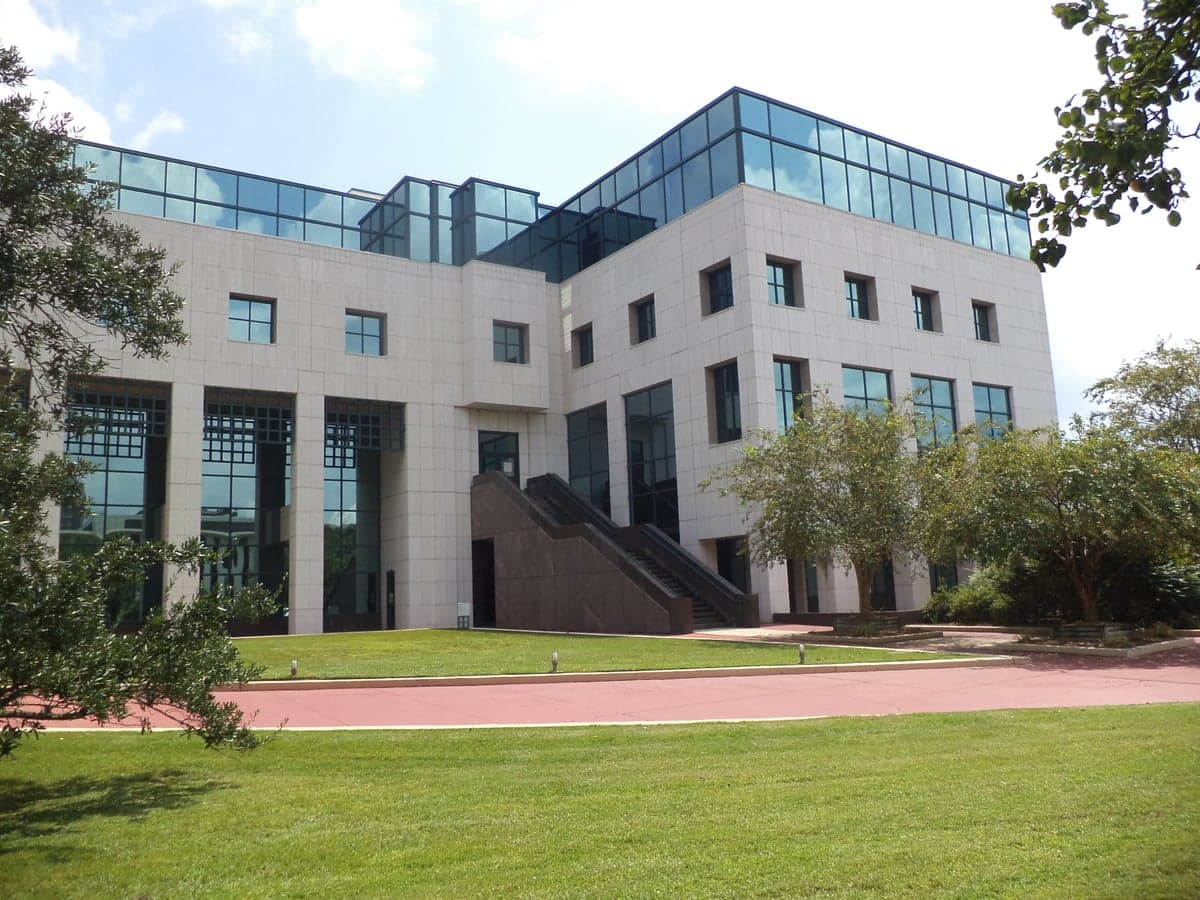
Photo: Wikipedia
Political ClimatePolitical Climate in Leon County
Showing district-level results — no local-only data available.
Local Political AnalysisPolitical Analysis of Leon County
Leon County is a deep blue island in a reddening state, anchored by Tallahassee’s government and university workforce. While Florida’s Cook PVI is R+5, Leon County’s R+8 rating actually understates its Democratic dominance — in 2024, Kamala Harris carried the county by 32 points, a margin that has held steady since 2020. The real story is the stark urban-rural split within the county: Tallahassee proper votes like a college town, while the rural panhandle precincts around Woodville, Miccosukee, and Chaires lean as red as any in the Florida Panhandle.
How it compares
Leon County is one of only three counties in the Florida Panhandle that voted blue in 2024, alongside Gadsden and Jefferson. The R+8 PVI is misleading because it averages the deep-blue city with the deep-red countryside. In practice, Tallahassee’s precincts around Florida State University and Florida A&M vote 75-80% Democratic, while rural precincts east of Lake Talquin vote 65-70% Republican. The swing precincts are in the midtown and south Monroe corridors, where mixed-income neighborhoods and state-worker households shift between parties depending on the cycle. Compared to Florida’s R+5 statewide lean, Leon County is a Democratic stronghold that has actually become more blue since 2016, when Hillary Clinton won it by 26 points — the margin has grown by six points in two cycles.
What this means for residents
For liberal residents, Leon County is a comfortable bubble where Democratic candidates rarely face serious competition in countywide races. The county commission is solidly Democratic, and Tallahassee’s city council is among the most progressive in the South, with policies like a $15 minimum wage for city employees and strong tenant protections. For conservative residents, the reality is more complex: they are a permanent minority in county politics but hold sway in the rural precincts and in state-level races. The county’s state legislative delegation is split — the House district covering Woodville and the eastern panhandle is held by a Republican, while the Tallahassee-based districts are Democratic. This means conservative residents have representation in the state capitol but little influence over local zoning, school board decisions, or county budget priorities.
The cultural and policy distinctions are sharpest around growth and education. Tallahassee’s urban core has embraced transit-oriented development and historic preservation, while rural Leon County fights to maintain agricultural zoning and low property taxes. The school board, controlled by Democrats, has pushed for equity-based funding formulas that rural residents argue shortchange their schools. Meanwhile, the presence of Florida State University and Florida A&M means the county has a younger, more transient population than the rest of the Panhandle — about 30% of residents are between 18 and 24, compared to 15% statewide. This demographic pressure keeps the county blue but also creates friction over housing costs, noise ordinances, and the pace of development that cuts across party lines. Longtime residents, regardless of party, often share a skepticism of Tallahassee’s growth machine, even if they disagree on how to manage it.

State Political ClimatePolitical Climate in Florida
State Political AnalysisPolitical Environment in the State
Florida is a Republican-leaning state with a Cook PVI of R+5, but calling it a solid red state misses the real story. Over the past 20 years, Florida has shifted from a classic swing state — famously deciding the 2000 presidential election by 537 votes — to a reliably right-of-center powerhouse where Republicans now hold a voter registration advantage and control every lever of state government. The dominant coalition is a mix of conservative retirees from the Midwest and Northeast, ex-urban and rural native Floridians, and a growing bloc of Hispanic voters in South Florida, particularly Cuban-Americans and Venezuelan-Americans, who have trended Republican. Democrats still hold strong majorities in urban cores like Miami-Dade, Broward, and Orange counties, but their statewide margin has eroded as the suburbs and exurbs have moved right.
Urban vs. rural divide
The political map of Florida is a study in contrasts. The Democratic strongholds are the dense, diverse urban corridors: Miami-Dade County, which voted for Hillary Clinton by 29 points in 2016 but only for Joe Biden by 7 points in 2020, showing a dramatic rightward shift; Broward County (Fort Lauderdale), still deeply blue; and Orange County (Orlando), which remains reliably Democratic. On the Republican side, the rural Panhandle — places like Santa Rosa County and Okaloosa County — routinely vote 70-80% Republican. The real battleground is the suburban and exurban ring around the major metros. Pinellas County (St. Petersburg) and Hillsborough County (Tampa) have become true swing counties, while Duval County (Jacksonville) flipped from blue to red in 2020. The I-4 corridor, stretching from Tampa through Lakeland to Orlando and Daytona Beach, remains the state's political fulcrum, but it has moved right in recent cycles as transplants from redder states settle in places like The Villages and Ocala.
Policy environment
Florida's policy environment is defined by a low-tax, low-regulation posture that has been consistent for decades. There is no state income tax, which is the single biggest draw for relocators. Property taxes are moderate, and the state caps annual assessment increases at 3% for homesteaded properties (Save Our Homes amendment). Sales tax is 6%, but local options can push it to 7.5% or higher. The regulatory climate is business-friendly, with a right-to-work law and minimal labor union influence. Education policy has been a flashpoint: the state has one of the nation's largest school voucher programs (the Family Empowerment Scholarship), and Governor Ron DeSantis signed the Parental Rights in Education Act (HB 1557) in 2022, which restricts classroom instruction on sexual orientation and gender identity in early grades. Healthcare policy is mixed — Florida did not expand Medicaid under the Affordable Care Act, leaving roughly 800,000 residents in the coverage gap, but the state has a robust private insurance market and a large Medicare population. Election laws have been tightened: the 2021 SB 90 law added voter ID requirements, limited drop boxes, and restricted third-party ballot collection, which Democrats argue suppresses turnout. Gun laws are among the most permissive in the country: permitless carry (constitutional carry) was signed into law in 2023, and the state has a "Stand Your Ground" statute that has been on the books since 2005.
Recent policy direction
Over the past five years, Florida has moved decisively in a conservative direction across multiple fronts. On gun rights, the 2023 permitless carry law (HB 543) eliminated the requirement for a concealed weapons permit, though a three-day waiting period for handgun purchases remains. On education and parental rights, the 2022 Parental Rights in Education Act and the 2023 "Stop WOKE Act" (HB 7) restricted how race and gender can be taught in schools and workplaces. On immigration, Governor DeSantis signed SB 1718 in 2023, which requires private employers with 25 or more employees to use E-Verify, invalidates out-of-state driver's licenses for undocumented immigrants, and increases penalties for human smuggling. On medical and bodily autonomy, Florida passed a 15-week abortion ban in 2022 (HB 5) and then a six-week ban in 2023 (SB 300), which took effect after the Florida Supreme Court upheld the state's 15-week ban in April 2024. On property rights, the state has preempted local rent control ordinances and limited local governments' ability to regulate short-term rentals like Airbnb. On voting and ballot access, the 2021 SB 90 law remains in effect, though parts were struck down by a federal judge in 2024. On privacy and surveillance, the state passed a biometric privacy law in 2023 that restricts how private companies can collect and use biometric data, but law enforcement surveillance powers remain broad.
Civil unrest & political movements
Florida has seen its share of political flashpoints in recent years. The 2020 Black Lives Matter protests in Miami, Tampa, and Jacksonville were large but largely peaceful, though property damage occurred in some areas. In response, the state passed the "Combating Public Disorder" law (HB 1) in 2021, which created new penalties for participating in violent protests and expanded protections for drivers who strike protesters. Immigration politics are a constant source of tension, particularly in South Florida, where the 2022 migrant flights from Texas to Martha's Vineyard and the 2023 relocation of migrants from the border to Sacramento made national headlines. The state has a formal "sanctuary city" ban (SB 4, 2019), which prohibits local governments from adopting policies that limit cooperation with federal immigration enforcement. Election integrity remains a live issue: the 2020 election in Florida was widely seen as smooth and well-run, but the 2022 midterms saw high-profile controversies over ballot drop boxes and voter roll maintenance. There is no serious secession or nullification movement in Florida, though the state has aggressively challenged federal authority on immigration, environmental regulation, and education policy through lawsuits.
Projection
Over the next 5-10 years, Florida is likely to remain Republican-leaning but could see some moderation as the population continues to grow and diversify. The state is adding roughly 900 new residents per day, many from blue states like New York, California, and Illinois. These newcomers tend to be more moderate than the native Republican base, and some early evidence from the 2022 and 2024 elections suggests that the GOP's margin in suburban counties like Pinellas and Hillsborough may be shrinking. However, the Republican Party has successfully consolidated support among Hispanic voters in South Florida, particularly in Miami-Dade, which could offset any suburban drift. The Democratic Party's path to statewide victory depends on turning out young voters and non-Cuban Hispanic voters in large numbers, which has proven difficult. The state's political trajectory will also be shaped by climate change and insurance costs, which could drive out some coastal residents and reshape the electorate. A relocator moving to Florida in 2026 should expect a state that is solidly conservative on fiscal and cultural issues, with a growing but still minority liberal presence in the urban cores.
For a new resident, the bottom line is that Florida offers a low-tax, business-friendly environment with conservative governance on education, gun rights, and immigration. Liberal residents will find welcoming communities in Miami, Orlando, Tampa, and St. Petersburg, but will face a state government that is actively hostile to many of their policy priorities. Conservative residents will find a state that largely aligns with their values, but should be aware that the rapid population growth is slowly diversifying the electorate. The practical takeaway: Florida is a place where your political experience will vary dramatically depending on which city or county you choose to live in, but the statewide direction is clearly conservative and likely to remain so for the foreseeable future.
* Values derived from national, state, county, city and local statistics and may differ in a specific area. Last updated: 2026-06-16T13:10:59.000Z
Narrative content on this page is AI-generated and may contain mistakes. Verify any details that matter before acting on them.
ReloMaps may earn a commission from affiliate links at no extra cost to you.

