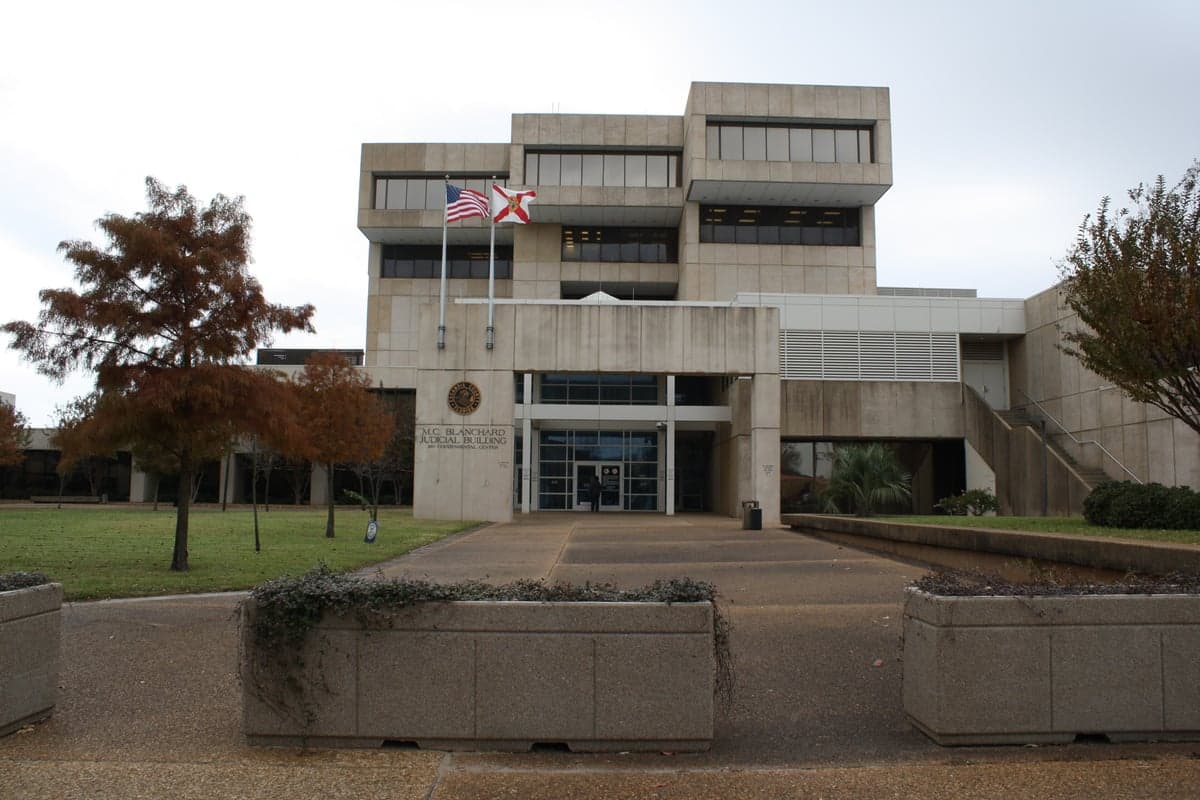
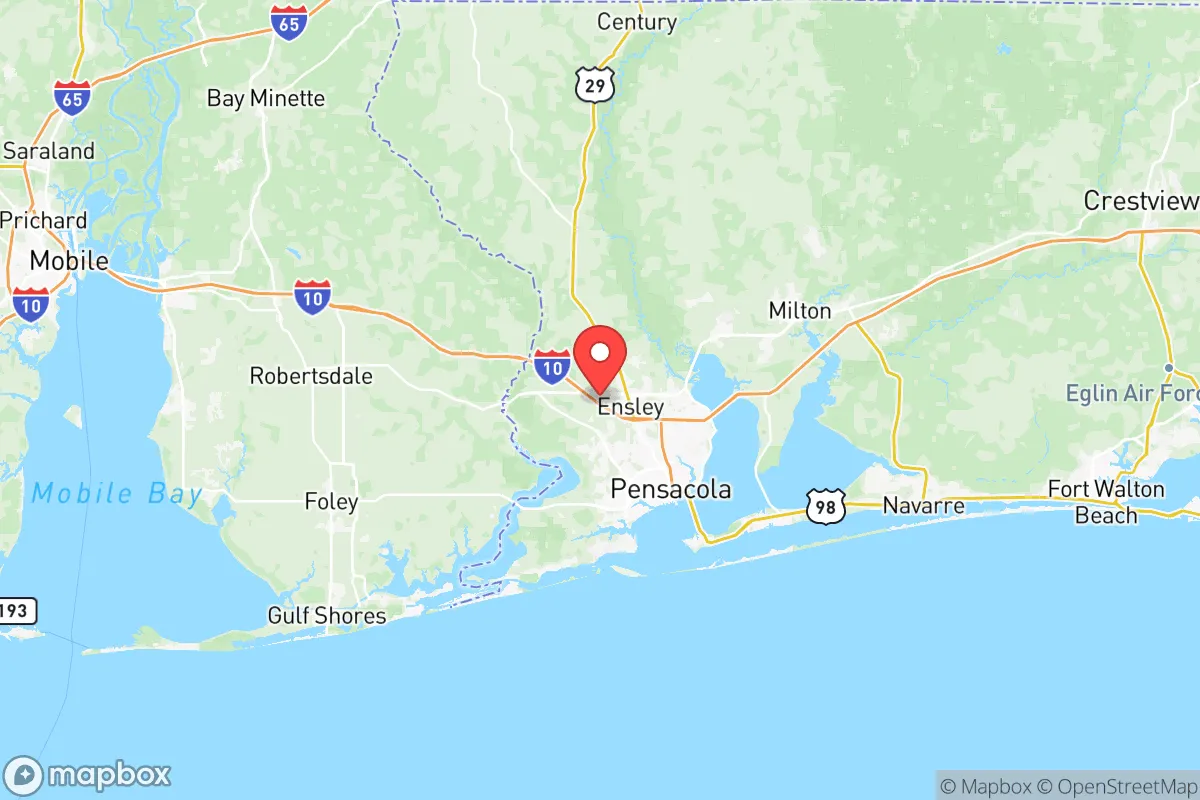
Photo: Wikipedia
Political ClimatePolitical Climate in Escambia County
Showing state-level results — no local-only data available.
Local Political AnalysisPolitical Analysis of Escambia County
Escambia County is one of the most reliably Republican strongholds in Florida, carrying a Cook Partisan Voting Index (PVI) of R+18 — a full 13 points more conservative than the state of Florida as a whole, which sits at R+5. This isn't a recent shift; the county has voted for the GOP presidential candidate in every election since 2000, and the margins have only widened. In 2024, Donald Trump carried Escambia by roughly 30 points, a margin that far outstrips the statewide result. The political center of gravity here is anchored by the sprawling military presence — Naval Air Station Pensacola and Corry Station — along with a deeply rooted evangelical Christian population and a strong tradition of gun rights and fiscal conservatism. That said, the county isn't a monolith: the city of Pensacola itself, particularly its downtown core and the historic East Hill neighborhood, consistently votes blue, while the suburban and rural stretches — places like Cantonment, Century, and the areas around Pace and Milton — are deeply red.
How it compares
To understand how Escambia differs from the rest of Florida, look at the margins. Florida as a state is a classic swing state, with a PVI of R+5 that reflects razor-thin elections decided by suburban voters in places like Pinellas and Hillsborough counties. Escambia, by contrast, is a safe Republican seat where Democratic candidates rarely break 40% of the countywide vote. The political culture is also distinct: while South Florida and the I-4 corridor are shaped by transplants, tourism, and a more transient population, Escambia feels more like the Deep South. Local politics here revolve around military base retention, hurricane recovery funding, and property rights — not the growth-management or immigration debates that dominate in Miami or Orlando. The county's Republican primary is often the real election, especially in state legislative and county commission races, whereas in the rest of Florida, general elections can still be competitive.
What this means for residents
For conservative residents, Escambia offers a political environment where their values are the default. Local government is reliably pro-business, taxes are low, and Second Amendment protections are robust. There's little friction in daily life for someone who leans right — the local news, the school board, and the county commission all reflect that worldview. For liberal residents, the reality is more nuanced. While Pensacola's urban core provides a blue oasis — with a growing arts scene, a walkable downtown, and a visible LGBTQ+ community — the countywide dynamic means progressive policies rarely gain traction. Social issues like abortion access or police reform are nonstarters at the county level. That said, the city of Pensacola has elected a Democratic mayor in recent cycles, and the city council includes progressive voices. The trade-off for left-leaning residents is clear: you can live comfortably in the city, but you'll have little influence over county-level decisions on schools, zoning, or law enforcement.
One cultural distinction worth noting is the role of the military. Escambia is home to one of the oldest naval air stations in the country, and that presence shapes everything from the local economy to the political discourse. You'll see "Support Our Troops" signage year-round, not just on holidays, and base-related issues — like flight noise or development near runways — are perennial local topics. Another distinction is the county's relationship with the Florida Panhandle's broader identity: Escambia is more culturally aligned with Alabama and Mississippi than with South Florida. That shows up in everything from the local accent to the pace of life. For anyone moving here, understanding that Escambia is politically and culturally distinct from the rest of Florida is key to knowing what to expect — and where you'll fit in.

State Political ClimatePolitical Climate in Florida
State Political AnalysisPolitical Environment in the State
Florida is a Republican-leaning state with a Cook PVI of R+5, but calling it simply "red" misses the real story. Over the past 20 years, the state has shifted from a quintessential presidential battleground — decided by 537 votes in 2000 — to a solidly right-of-center state where Republicans now hold a supermajority in the legislature and control every statewide office. The dominant coalition is a mix of conservative retirees from the Midwest and Northeast, Cuban-American and Venezuelan-exile voters in South Florida, and a growing population of conservative-leaning transplants from blue states. Democrats still hold sway in dense urban cores and among younger, diverse voters, but the state's overall trajectory has been a steady march rightward since roughly 2010.
Urban vs. rural divide
The political map of Florida is a study in stark contrasts. The reliably blue strongholds are Miami-Dade County, Broward County (Fort Lauderdale), and Orange County (Orlando), where dense, diverse, and younger populations deliver Democratic margins. But even here, the story is shifting: Miami-Dade, once a Democratic firewall, has been trending right for a decade, with Donald Trump winning it in 2024 after losing it narrowly in 2020. The rural Panhandle — places like Panama City and Pensacola — is deeply conservative, often voting 70-80% Republican. The I-4 corridor, stretching from Tampa through Lakeland to Daytona Beach, remains the state's most competitive swing territory, though it has tilted red in recent cycles. Tampa itself is a purple city with a blue core and red suburbs, while Jacksonville leans Republican overall but has a Democratic-leaning urban center. The biggest shift has been in once-purple counties like Pinellas (St. Petersburg) and Seminole, which have moved right as new arrivals from the North brought conservative voting habits with them.
Policy environment
Florida's policy environment is defined by a low-tax, low-regulation posture that has been aggressively expanded under Governor Ron DeSantis. There is no state income tax, which is a major draw for relocators. Property taxes are moderate, and the state's homestead exemption provides meaningful relief for primary residents. The regulatory climate is business-friendly, with streamlined permitting and a right-to-work labor law. Education policy has been a flashpoint: the state has one of the nation's largest school voucher programs (the Family Empowerment Scholarship) and has passed laws restricting classroom discussion of sexual orientation and gender identity (the Parental Rights in Education Act, often called "Don't Say Gay"). Healthcare policy is market-driven; Florida did not expand Medicaid under the Affordable Care Act, leaving roughly 800,000 residents in the coverage gap. Election laws have been tightened since 2020, with stricter voter ID requirements, limits on drop boxes, and a new election police force. The state also has a "stand your ground" self-defense law and constitutional carry (permitless concealed carry) as of 2023.
Recent policy direction
The last five years have seen Florida move decisively in a conservative direction across nearly every policy domain. On gun rights, the state passed constitutional carry (HB 543) in 2023, allowing concealed carry without a permit, while maintaining a three-day waiting period for long guns — a compromise that left some Second Amendment advocates wanting more. On education and parental rights, the Parental Rights in Education Act (HB 1557) and the Stop WOKE Act (HB 7) restricted classroom instruction on sexual orientation and critical race theory, respectively. On speech and privacy, the state passed a social media "deplatforming" law aimed at tech companies, though parts of it were struck down in court. On medical and bodily autonomy, Florida banned abortion after six weeks (HB 5) in 2023, with limited exceptions, and has restricted gender-affirming care for minors. On property rights, the state has preempted local rent control ordinances and limited local government authority over development. On voting, the SB 90 election integrity law (2021) added new ID requirements for mail ballots, limited drop box hours, and restricted third-party ballot collection. The overall direction is toward maximizing individual liberty in economic and self-defense matters while imposing conservative social values through state law.
Civil unrest & political movements
Florida has seen its share of political flashpoints, though large-scale civil unrest has been less common than in some other states. The Parkland school shooting in 2018 sparked the March for Our Lives movement, with massive student-led protests in Tallahassee and across the state, leading to the Marjory Stoneman Douglas High School Public Safety Act, which raised the gun purchase age to 21 and created a "red flag" law. Immigration politics are particularly charged in South Florida, where Cuban and Venezuelan exile communities push for hardline policies, while agricultural and tourism industries rely on immigrant labor. There is no sanctuary city policy in Florida; the state has banned such designations by law. Election integrity controversies have been persistent, with the 2020 and 2022 cycles seeing intense scrutiny of mail voting and drop boxes, though no widespread fraud was ever proven. Organized activist movements include the conservative Moms for Liberty, which has been influential in school board races, and progressive groups like the Florida Rising coalition, which focuses on voting rights and economic justice. A new resident would notice the omnipresence of political messaging — from yard signs to talk radio to the governor's frequent national media appearances — but actual street-level unrest is rare outside of organized protests in Miami and Tallahassee.
Projection
Over the next 5-10 years, Florida is likely to remain Republican-leaning but could see a slight softening of its red tilt as demographic trends evolve. The state is growing rapidly — roughly 1,000 new residents per day — and many of these newcomers are coming from high-tax blue states like New York, California, and Illinois. Historically, these transplants have leaned conservative on fiscal issues and moderate to conservative on cultural ones, reinforcing the state's rightward drift. However, the younger, more diverse population already in Florida — particularly in Orlando, Tampa, and South Florida — tends to vote Democratic, and as these cohorts age into the electorate, they could gradually shift the balance. The wild card is national politics: if the Republican brand weakens nationally, Florida could become more competitive again, but for now, the state's political infrastructure, legislative supermajority, and cultural momentum are firmly conservative. A relocator moving in now should expect a state where conservative policies are the norm, but where local political culture varies dramatically — from the progressive enclave of St. Petersburg to the deep-red suburbs of Naples and The Villages.
For a new resident, the bottom line is that Florida offers a low-tax, business-friendly environment with a strong conservative tilt on social and cultural issues. Conservative families will find a state that largely aligns with their values on education, gun rights, and limited government. Liberal residents will find vibrant urban communities in Miami, Orlando, and Tampa where their views are shared, but will face a state government that is actively hostile to many of their policy priorities. The practical takeaway: choose your city carefully, because the political experience of living in Gainesville versus Fort Myers is night and day, even though both are in the same state.
* Values derived from national, state, county, city and local statistics and may differ in a specific area. Last updated: 2026-08-02T10:22:54.000Z
Narrative content on this page is AI-generated and may contain mistakes. Verify any details that matter before acting on them.
ReloMaps may earn a commission from affiliate links at no extra cost to you.

