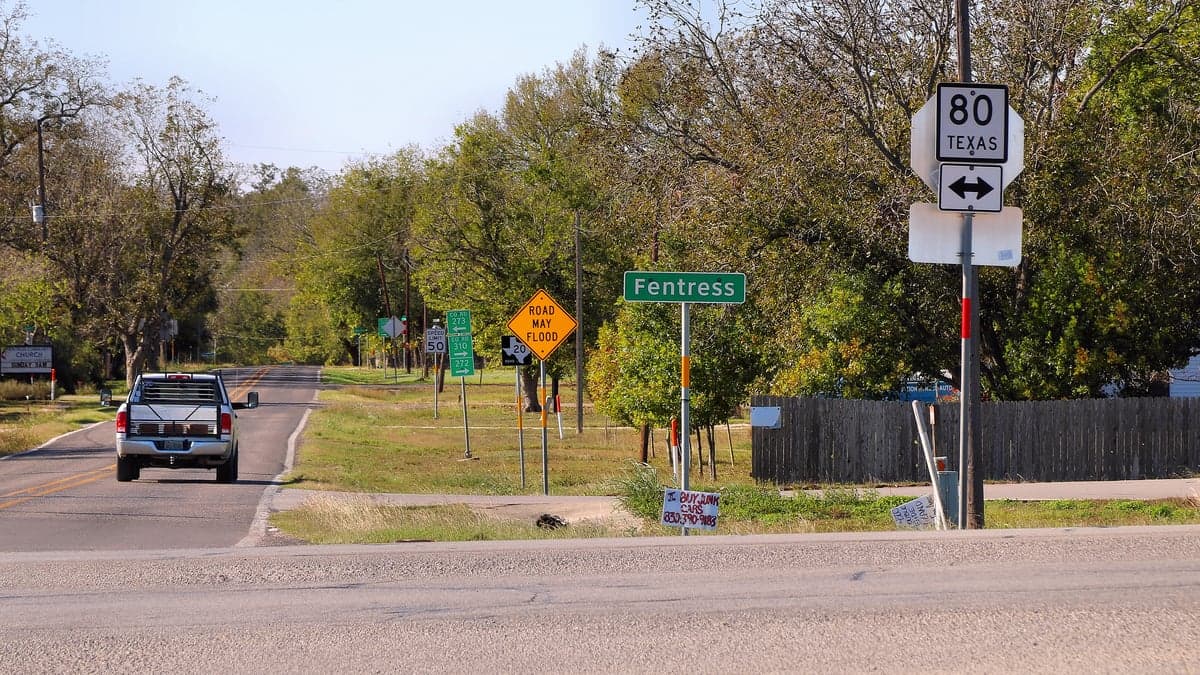
Photo: Wikipedia
Political ClimatePolitical Climate in Fentress, TX
District shown is the primary district for this city’s centroid. Cities may span multiple districts.
Local Political AnalysisPolitical Analysis of Fentress, TX
Fentress, Texas, sits in a deeply conservative pocket of the state, with a Cook Partisan Voting Index (PVI) of R+14 — that’s ten points redder than Texas as a whole, which sits at R+4. This isn’t a recent shift; the area has been reliably Republican for decades, and if anything, the margin has widened slightly as newcomers from bluer parts of the state have settled in but largely aligned with the local political culture. The trajectory here is steady: expect continued Republican dominance in local and national elections, with primary races often being the real contest.
How it compares
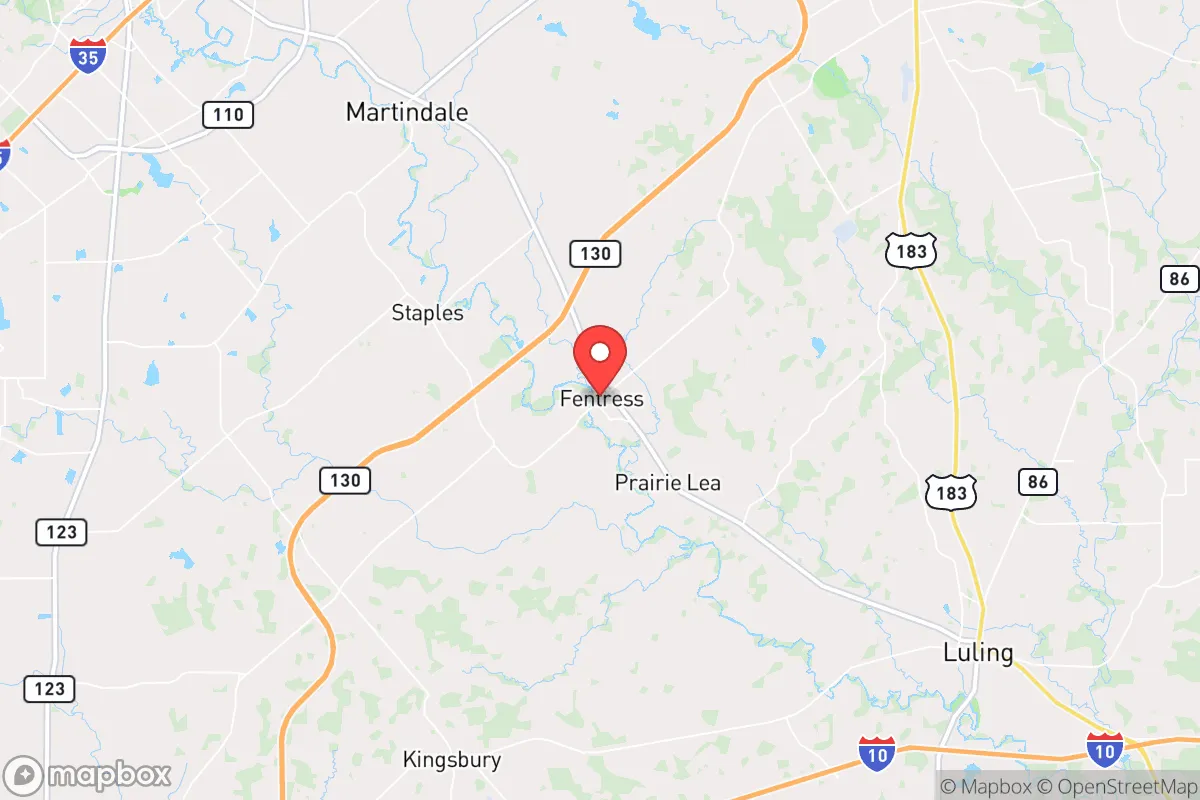
To understand Fentress’s politics, it helps to look at its neighbors. San Marcos, about 20 miles south, is a college town (Texas State University) that leans Democratic — its precincts often vote blue by 10-15 points. Lockhart, closer to Fentress, is more purple but still trends Republican. Fentress itself, though, is a different animal. The R+14 PVI means a Republican candidate can expect to win by roughly 14 points in a neutral national environment. Compare that to Texas’s statewide R+4, which reflects a state that’s competitive enough to have close Senate races (like Ted Cruz’s 2018 squeaker). In Fentress, that kind of nail-biter doesn’t happen. The local electorate is older, whiter, and more rural than the state average, and that demographic reality drives the politics. You’ll see Trump flags on trucks year-round, not just during election season.
What this means for residents
For conservative residents, this political climate means their values are reflected in local governance — low taxes, limited regulation, and a sheriff’s office that’s vocal about Second Amendment rights. School board meetings and county commissioner races are where the real action happens, and conservative candidates usually win without much drama. For liberal residents, the reality is more about finding community. There’s no organized Democratic party presence in Fentress itself; you’d need to drive to San Marcos or even Austin (45 minutes north) for a progressive meetup. That said, most folks here are neighborly regardless of party — politics doesn’t dominate daily life the way it does in more polarized suburbs. You’ll still get a wave from the guy with the “Don’t Tread on Me” sticker on his truck, even if you’ve got a “Coexist” bumper sticker on yours.
Culturally, Fentress is a place where the local Baptist church’s potluck is a bigger social event than any political rally. The policy distinctions from Texas at large are subtle but real: the county government here is more skeptical of state-level mandates (like mask orders during COVID) and more aggressive in opposing any federal land-use proposals. Property taxes are a perennial gripe, but they’re lower than in Austin or San Marcos. In the long term, as the I-35 corridor grows, Fentress may see more exurban development, which could nudge the politics slightly toward the center — but don’t expect a blue wave anytime soon. This is R+14 country, and it’s likely to stay that way for the foreseeable future.

State Political ClimatePolitical Climate in Texas
State Political AnalysisPolitical Environment in the State
Texas is a solidly Republican state with a Cook PVI of R+4, meaning it leans about four points more conservative than the national average in presidential elections. Over the past 10-20 years, the dominant coalition has been a blend of suburban fiscal conservatives, rural social conservatives, and a growing number of business-minded independents, but the state has been inching leftward as fast-growing metros like Austin, Dallas, and Houston bring in a wave of new, more moderate-to-liberal residents. The long arc shows a state that was deep red in the 2000s and early 2010s, tightened to a 5.6-point margin in 2020, and in 2024 saw Trump win by roughly 14 points — a reminder that while the suburbs are shifting, the rural and exurban vote has only hardened.
Urban vs. rural divide
The political map of Texas is a story of three distinct worlds. The major urban centers — Austin (Travis County), Dallas (Dallas County), Houston (Harris County), San Antonio (Bexar County), and El Paso (El Paso County) — are solidly Democratic, with Harris County alone delivering over 1.2 million votes for Biden in 2020. These cities are powered by a mix of young professionals, minority communities (especially Hispanic and Black voters), and a growing tech and creative class. In contrast, the vast rural and exurban expanse — places like the Panhandle around Lubbock, East Texas piney woods, and the Hill Country west of Austin — votes Republican by margins of 70-80%. The real battleground is the suburbs: Collin County (north of Dallas) and Fort Bend County (southwest of Houston) were once reliably red but have trended purple, with Collin County voting for Trump by only 8 points in 2024 after a 20-point margin in 2016. Meanwhile, Bexar County (San Antonio) has become a Democratic stronghold, while Tarrant County (Fort Worth) flipped blue in 2020 before snapping back to red in 2024, showing the volatility of the suburban vote.
Policy environment
Texas’s policy environment is defined by a low-tax, low-regulation posture that appeals to conservative relocators. There is no state income tax, though property taxes are high — averaging about 1.6% of home value, among the highest in the nation — and the state relies heavily on sales tax (6.25% state rate, plus local options up to 8.25%). The regulatory climate is business-friendly, with no state-level minimum wage above the federal $7.25 and weak collective bargaining laws. Education policy is a flashpoint: the state funds schools through a Robin Hood system that redistributes property tax revenue from wealthy districts to poor ones, and the 2023 school voucher bill (SB 1) passed after years of debate, allowing families to use public funds for private school tuition. Healthcare is a mixed bag — Texas has the highest uninsured rate in the country (around 17%), and the state has refused to expand Medicaid under the ACA. Election laws have tightened: SB 1 (2021) restricted mail-in voting, added ID requirements for absentee ballots, and banned 24-hour and drive-through voting. On social issues, the state has a near-total abortion ban (trigger law from 2021, with no exceptions for rape or incest), and permitless carry of handguns became law in 2021 (HB 1927).
Recent policy direction
The last few legislative sessions have pushed Texas decisively to the right on a broad front. On gun and self-defense law, the 2021 permitless carry law (HB 1927) allows any adult who can legally own a firearm to carry it openly or concealed without a license. On parental and education rights, the 2023 law (HB 900) restricts "sexually explicit" books in school libraries and requires parental consent for library materials, while a 2021 law (SB 3) bans the teaching of critical race theory in public schools. On speech and privacy, the state passed a law (HB 20 in 2023) that prohibits social media platforms from moderating content based on viewpoint, though it has been challenged in court. On medical and bodily autonomy, the 2021 abortion ban (SB 8) created a unique private enforcement mechanism that allows anyone to sue anyone who performs or aids an abortion after six weeks. On property rights, the state has strong eminent domain protections for landowners, and a 2023 law (SB 2038) limits local governments' ability to regulate short-term rentals. On taxation, the 2023 session saw a $18 billion property tax cut (SB 2) that raised the homestead exemption from $40,000 to $100,000 and compressed school tax rates. On voting and ballot access, SB 1 (2021) added a mail-in ballot ID requirement, banned unsolicited mail-in ballot applications, and limited early voting hours.
Civil unrest & political movements
Texas has seen its share of political flashpoints. The 2020 Black Lives Matter protests in Austin and Houston were large and occasionally violent, leading to a backlash that helped fuel the 2021 permitless carry law and a "defund the police" backlash in Austin that was later reversed. Immigration politics are a constant: the state has bused over 100,000 migrants to Democratic-led cities since 2022, and Governor Abbott's Operation Lone Star has deployed state troopers and National Guard to the border, leading to legal battles with the Biden administration over razor wire and buoys in the Rio Grande. Sanctuary city policies are banned statewide (SB 4, 2017), and sheriffs who refuse to cooperate with ICE can face removal. Secession rhetoric flares up periodically — the Texas Nationalist Movement has some grassroots support, but it remains a fringe position. Election integrity controversies have been a recurring theme: the 2020 election saw Trump win Texas by 5.6 points, but some GOP activists pushed for a forensic audit, leading to a 2022 law (SB 1) that tightened voting rules. A new resident would notice the omnipresence of political messaging — billboards, yard signs, and talk radio are loud, especially in rural areas.
Projection
Over the next 5-10 years, Texas is likely to become more competitive at the statewide level, but not necessarily blue. The in-migration of roughly 1,000 people per day — many from California, New York, and Illinois — is disproportionately young, diverse, and moderate-to-liberal, which will continue to shift the suburbs of Dallas, Houston, and Austin leftward. However, the rural and exurban vote is also growing, and the Hispanic vote — long assumed to be a Democratic lock — has shown signs of shifting right, especially among working-class voters in the Rio Grande Valley (like Zapata County, which flipped to Trump in 2020). The state legislature will remain under Republican control for the foreseeable future due to gerrymandering, but the governor's race in 2026 could be competitive if Democrats nominate a moderate. A relocator moving in now should expect a state that remains conservative on taxes, guns, and social issues, but where the political temperature will keep rising as the urban-rural divide widens. The practical takeaway: if you're a conservative, you'll find a state that largely aligns with your values, but you'll need to navigate increasingly blue cities; if you're a liberal, you'll have strong communities in the metros, but you'll face a state government that is actively hostile to many of your priorities.
For a new resident, the bottom line is that Texas offers a low-tax, high-freedom environment for those who align with its conservative tilt, but the political landscape is not monolithic. You can find a deep-blue bubble in Austin or a deep-red stronghold in Lubbock, and the suburbs are where the real action is. If you're moving for jobs, schools, or space, you'll get all three — just be ready for a state that is unapologetically itself, with all the political friction that comes with rapid growth and deep divisions.
* Values derived from national, state, county, city and local statistics and may differ in a specific area. Last updated: 2026-09-03T06:07:58.000Z
Narrative content on this page is AI-generated and may contain mistakes. Verify any details that matter before acting on them.
ReloMaps may earn a commission from affiliate links at no extra cost to you.

