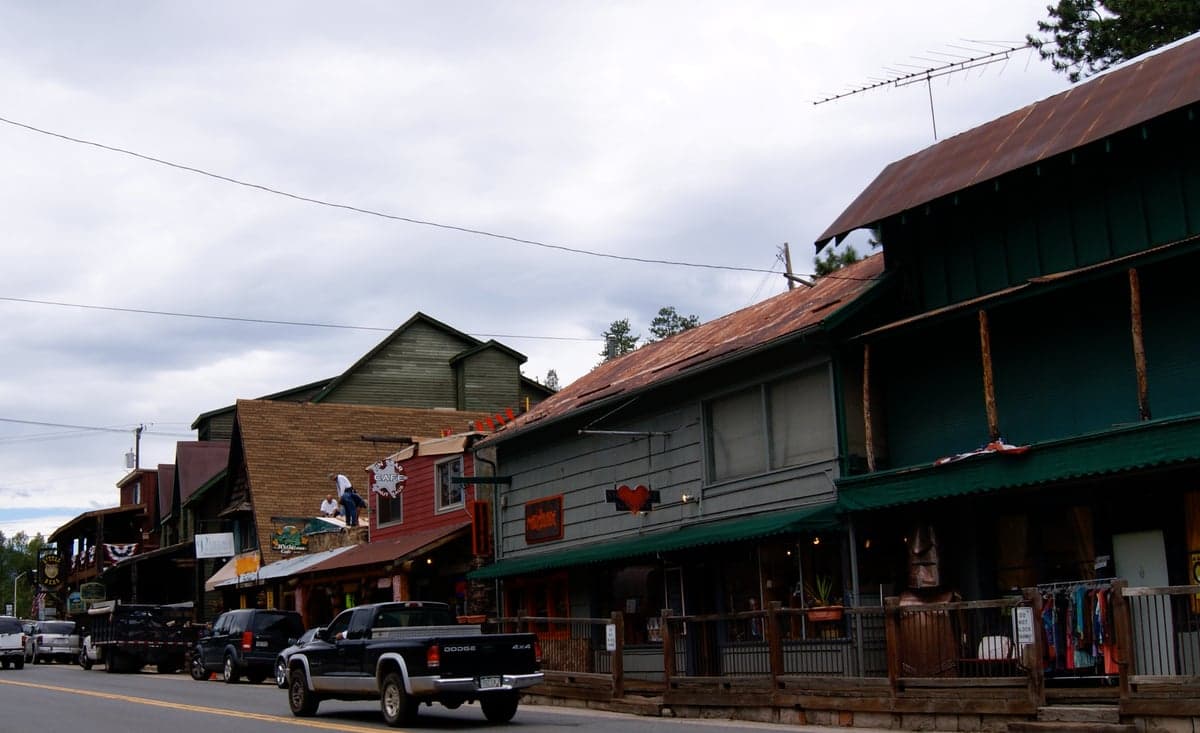
Photo: Wikipedia
Political ClimatePolitical Climate in Evergreen, CO
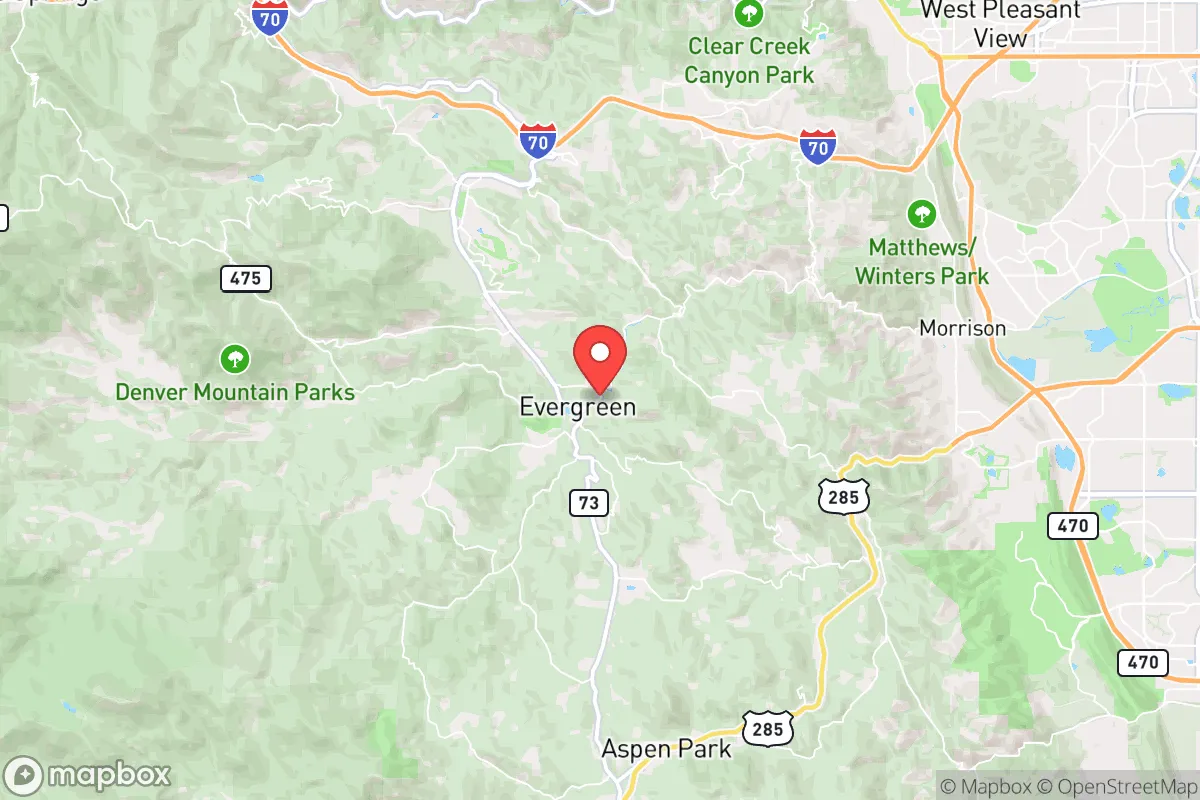
District shown is the primary district for this city’s centroid. Cities may span multiple districts.
Local Political AnalysisPolitical Analysis of Evergreen, CO
Evergreen, Colorado, has a political climate that leans distinctly to the left, with a Cook Partisan Voting Index (PVI) of D+8, meaning the area votes about eight points more Democratic than the national average. This isn’t a recent shift; it’s been a gradual evolution over the past two decades, driven by an influx of remote workers and second-home owners from Denver and the Front Range who bring more progressive values. While the town itself feels like a blue island in a sea of red, the surrounding Jefferson County has trended purple-to-blue in recent cycles, though you’ll still find plenty of conservative strongholds just a few miles down the road in places like Conifer or Bailey.
How it compares
Compared to the rest of Colorado, Evergreen is notably more liberal than the state average. Colorado as a whole is a classic swing state—it voted for Joe Biden by about 13 points in 2020, but its Cook PVI is only D+4, reflecting a more balanced electorate. Evergreen’s D+8 puts it in the same league as Boulder or parts of Denver, but with a distinctly mountain-town flavor. Drive 20 minutes east to the suburbs of Lakewood or Golden, and you’ll find a more moderate mix; head west into Park County or up to Conifer, and the political landscape flips sharply conservative. The contrast is stark: Evergreen’s town meetings often focus on environmental conservation and affordable housing, while just over the ridge in Bailey, the chatter is more about property rights and limited government. This split makes Evergreen a microcosm of Colorado’s broader urban-rural divide.
What this means for residents
For liberal residents, Evergreen feels like a comfortable fit. You’ll find strong support for local environmental initiatives—like the Evergreen Park & Recreation District’s open-space preservation—and a general acceptance of progressive social policies. The local schools, like Evergreen High School, tend to emphasize inclusivity and sustainability. For conservative residents, the reality is more nuanced. You’re not out of place, but you’re definitely in the minority. Many longtime locals, especially those in ranching or outdoor trades, feel the area has shifted away from its more independent, libertarian roots. That said, there’s still a live-and-let-live ethos; you won’t see the kind of heated political clashes you might in a Denver suburb. The practical impact is that local elections often hinge on development and land-use issues, where conservatives can still find common ground with liberals who want to limit sprawl.
One cultural distinction that sets Evergreen apart is its strong sense of community identity, which often transcends party lines. The town’s famous Evergreen Lake, the annual Christmas parade, and the local farmers’ market are gathering spots where politics takes a backseat. Policy-wise, the area leans into progressive priorities like renewable energy incentives and wildlife corridor protections, but it’s not a hotbed of activism. For both sides, the biggest takeaway is that Evergreen’s political climate is less about red vs. blue and more about balancing growth with preservation—a tension that unites and divides residents in equal measure. If you’re moving here, expect a place where your vote matters locally, but where the daily rhythm is more about hiking trails and coffee shops than campaign signs.

State Political ClimatePolitical Climate in Colorado
State Political AnalysisPolitical Environment in the State
Colorado has shifted from a classic purple swing state to a reliably blue state over the past two decades, but it’s a blue built on a very specific coalition. The Denver-Boulder-Aurora metroplex, along with the resort counties of Summit and Pitkin, now drive statewide elections, while the Eastern Plains, Western Slope, and the southern tier remain deeply conservative. The state hasn’t voted for a Republican presidential candidate since 2004, and Democrats now control every lever of state government. But the margin isn’t overwhelming — it’s a lean-blue state where the urban core’s growth has simply outpaced the rural vote, not erased it.
Urban vs. rural divide
The political map of Colorado is a story of two states. The Front Range urban corridor — Denver, Boulder, Aurora, Lakewood, and Fort Collins — is the engine of Democratic power. These areas vote 60-70% Democratic in statewide races, and their population growth has been relentless. In contrast, the Eastern Plains (counties like Yuma, Kit Carson, and Prowers) vote 75-80% Republican, as do the Western Slope counties like Mesa (Grand Junction) and Montrose. The resort counties — Summit (Breckenridge), Pitkin (Aspen), and San Miguel (Telluride) — are an interesting hybrid: wealthy, environmentally focused, and reliably Democratic, but with a libertarian streak on property rights and local control. The swing counties that used to decide elections — Jefferson, Arapahoe, and Larimer — have all trended blue over the last decade, though they still elect moderate Republicans at the local level. The 2022 governor’s race saw Jared Polis win by nearly 20 points, but Republicans still hold a handful of state legislative seats in these suburban districts, showing the blue wave has limits.
Policy environment
Colorado’s policy environment is a mix of progressive ambition and voter-imposed constraints. The state has a flat income tax rate of 4.4% (set by the Taxpayer’s Bill of Rights, or TABOR, which requires voter approval for tax increases). Property taxes are relatively low compared to Texas or the Northeast, but the Gallagher Amendment (which capped residential property tax rates) was repealed by voters in 2020, meaning residential rates are now set by the legislature. Sales tax varies widely by locality — Denver’s combined rate is around 8.8%, while rural areas can be under 7%. Education policy is a flashpoint: the state has a school choice system with charter schools and open enrollment, but per-pupil funding remains below the national average. Healthcare is dominated by a strong Medicaid expansion and a state-run insurance exchange (Connect for Health Colorado) that has kept uninsured rates low. Election laws are among the most accessible in the country — universal mail-in ballots, same-day registration, and automatic voter registration have been in place for years. The state also has a robust campaign finance disclosure system, though dark money groups still operate.
Recent policy direction
The last five years have seen a clear progressive push on several fronts. On gun and self-defense law, Colorado passed a red-flag law (Extreme Risk Protection Orders) in 2019, a three-day waiting period for firearm purchases in 2023, and raised the minimum purchase age to 21 in 2024. Concealed carry remains shall-issue, but the state banned large-capacity magazines in 2013. On parental and education rights, the state has moved toward more inclusive curriculum standards, including mandatory LGBTQ+ history in social studies, which has sparked backlash in conservative districts like Douglas County and El Paso County (Colorado Springs). On speech and privacy, Colorado passed one of the nation’s strongest data privacy laws (the Colorado Privacy Act) in 2021, and it has a broad anti-SLAPP statute protecting free speech. On medical and bodily autonomy, the state codified abortion rights into law in 2022 and passed a shield law protecting providers and patients from out-of-state prosecution. On property rights, the state has tightened oil and gas regulations (SB 19-181), which has limited new drilling near homes and schools, a major issue in Weld County. On taxation, voters rejected a progressive income tax bracket in 2024, keeping the flat rate. On voting and ballot access, the state has made it easier to vote, including automatic voter registration at the DMV and ballot drop boxes in every county. The net effect is a state that is broadly permissive on personal liberties (abortion, marijuana, data privacy) but increasingly restrictive on gun rights and energy development.
Civil unrest & political movements
Colorado has seen its share of political flashpoints. The 2020 protests in Denver over George Floyd’s death were large and occasionally violent, leading to a curfew and National Guard deployment. The state has a strong sanctuary movement — Denver and Boulder County have “sanctuary city” policies limiting cooperation with federal immigration enforcement, though the state as a whole does not have a sanctuary law. Immigration politics are heated in the agricultural communities of the San Luis Valley and the Eastern Plains, where many farms rely on migrant labor. The “Colorado Project” — a coordinated effort by conservative activists to flip the state legislature — has been largely unsuccessful, though it has energized grassroots organizing in rural areas. There have been periodic calls for secession from the Eastern Plains (the “State of Jefferson” movement), but they remain symbolic. Election integrity controversies have been less intense than in states like Arizona or Georgia, though some rural counties have considered hand-counting ballots. The most visible flashpoint for a new resident would be the constant tension between urban environmentalism and rural resource extraction — you’ll see “Keep It Colorado” bumper stickers next to “Drill Baby Drill” signs, often within the same county.
Projection
Over the next 5-10 years, Colorado will likely become more Democratic at the statewide level, but the margin of victory may shrink as the cost of living pushes some blue voters out and attracts more conservative retirees from California and Texas. The Denver metro area will continue to grow, but the suburbs — places like Castle Rock, Parker, and Windsor — are becoming more purple as families seek lower taxes and better schools. The state’s housing crisis (median home price over $550,000) is a wild card: it could suppress in-migration and shift the political balance toward the existing rural population. The energy transition will be a major battleground — expect more fights over oil and gas permitting in Weld County and solar farm siting on the Eastern Plains. The state’s water scarcity (the Colorado River Compact) will force hard choices that could pit urban against rural interests. A new resident moving in now should expect a state that is culturally liberal in its urban cores, fiscally moderate by necessity (thanks to TABOR), and deeply divided along geographic lines. The blue trend is real, but it’s not a monolith — and the rural vote, while outnumbered, is not going anywhere.
For a conservative-leaning relocator, the bottom line is this: Colorado is a blue state with a strong libertarian streak and a healthy rural conservative counterweight. You’ll find your people in Colorado Springs, Grand Junction, or the Eastern Plains, but you’ll be living under a state government that is consistently progressive on guns, education, and social policy. If you value low taxes, outdoor access, and a functioning state government, Colorado delivers. If you want a state that reflects your cultural values in its laws, you’ll need to pick your county carefully — and accept that statewide elections will not go your way. For a liberal relocator, the state is a comfortable fit, but the cost of living and the constant tension with rural Colorado can be exhausting. Either way, you’re moving to a place where people are passionate about their politics — and their public lands.
* Values derived from national, state, county, city and local statistics and may differ in a specific area. Last updated: 2026-09-24T17:27:52.000Z
Narrative content on this page is AI-generated and may contain mistakes. Verify any details that matter before acting on them.
ReloMaps may earn a commission from affiliate links at no extra cost to you.

