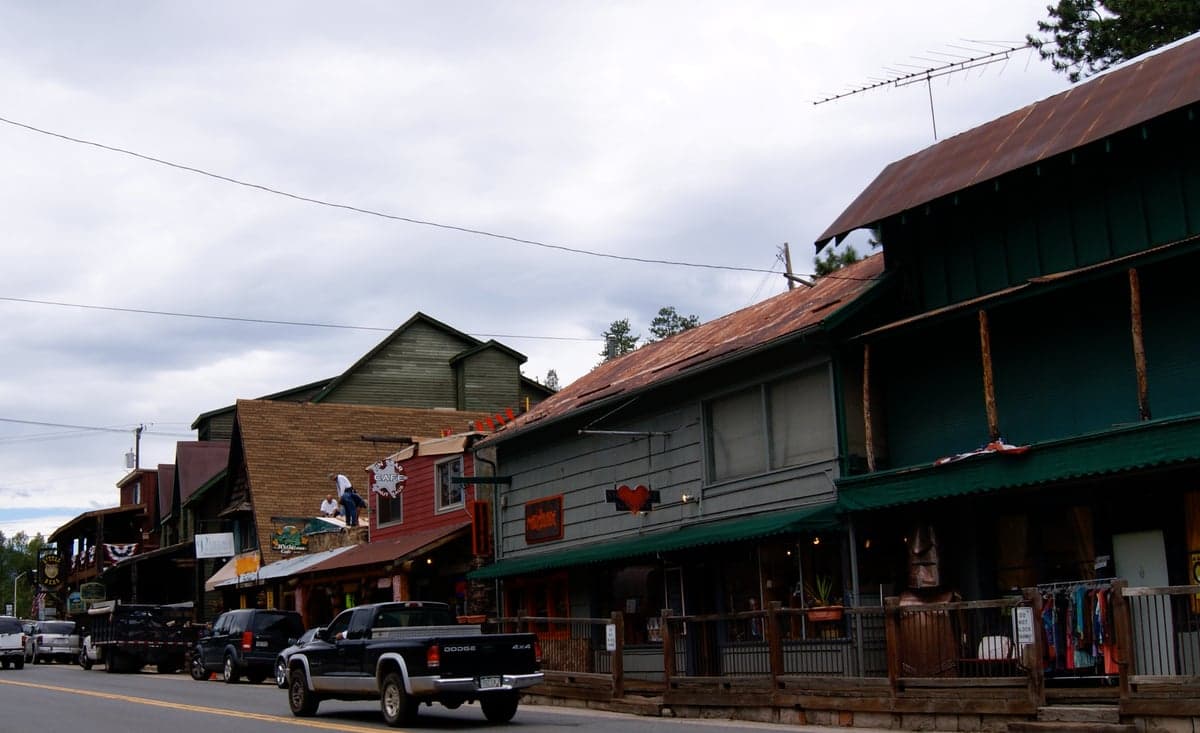
Photo: Wikipedia
Personal Sovereignty in Evergreen, CO
Viable for self-reliance. Generally workable, though some barriers may limit total independence.
What does Personal Sovereignty tell us?
Personal Sovereignty measures your capacity for self-reliance and independence with minimal government friction. Higher scores mean fewer barriers between you and the way you want to live... but it assumes you have the space you need and good neighbors.
What does this tell us?
Personal Sovereignty measures your capacity for self-reliance and independence with minimal government friction. Higher scores mean fewer barriers between you and the way you want to live... but it assumes you have the space you need and good neighbors.
State Policy
Energy independence: Net exporter (110% of energy produced in-state)
Personal Liberty
Homesteading

Personal Liberty Analysis
Evergreen, Colorado offers a notably high degree of personal sovereignty for individuals and families who prioritize autonomy, blending a strong Western libertarian streak with the practical realities of mountain living. While Colorado as a whole has moved left on certain social and environmental issues, Evergreen’s unincorporated Jefferson County status, its distance from the Denver regulatory apparatus, and its culture of self-reliance create an environment where personal freedom is the default, not the exception. For a relocation-minded reader weighing tax burden, self-defense rights, homesteading feasibility, and personal liberties, Evergreen presents a compelling balance of low-touch governance and high-trust community norms.
Tax burden and regulatory posture in Evergreen and Jefferson County
Evergreen’s tax environment is a clear draw for those seeking to keep more of their earnings. Colorado’s state income tax is a flat 4.4% as of 2026, with no progressive brackets, and Jefferson County imposes a relatively low 0.74% sales tax on top of the state’s 2.9% rate. Property taxes in Evergreen are among the lowest in the Front Range, averaging roughly 0.5% to 0.6% of assessed value, thanks to Colorado’s Gallagher Amendment legacy (though modified in 2020) and local levies that remain modest. There is no county or city vehicle tax, no personal property tax on vehicles, and no estate or inheritance tax. The regulatory posture is light-touch for a mountain community: Jefferson County’s planning department is known for being pragmatic rather than punitive, especially for single-family homes on existing lots. Building permits are required, but the county does not impose the kind of strict design review or energy codes seen in Boulder or Summit County. For a family or individual looking to buy land and build, the process is straightforward, with no countywide growth caps or urban growth boundaries. The primary regulatory friction comes from wildfire mitigation requirements—defensible space zones and fire-resistant materials—which are sensible for safety and not ideological. Overall, the tax and regulatory burden here is well below the national average for a high-amenity mountain area, making it attractive for those who want to keep more of their income and avoid bureaucratic overreach.
Self-defense and gun law specifics in Evergreen and Colorado
Colorado is a shall-issue state for concealed carry permits, meaning Jefferson County must issue a permit to any applicant who meets basic criteria (age 21, no felony, no recent domestic violence, completion of a certified training course). The process is efficient, with permits typically issued within 30 days. Evergreen itself has no additional local gun ordinances—Jefferson County is preempted by state law from enacting its own restrictions, so the rules are uniform across the county. Open carry is legal without a permit for anyone 18 or older, though in practice it is uncommon in Evergreen’s commercial core. The state does have a red flag law (Extreme Risk Protection Order) enacted in 2019, which allows law enforcement or family members to petition a court to temporarily remove firearms from an individual deemed a risk. This law is enforced in Jefferson County, but local sheriffs have been publicly skeptical of its application, and the county’s district attorney has a reputation for using it sparingly. Magazine capacity is limited to 15 rounds for handguns and 10 for rifles under state law, a restriction that applies statewide. For the self-defense-minded reader, the key takeaway is that Evergreen offers robust access to firearms for personal protection, with no local waiting periods, no handgun roster, and no ammunition restrictions beyond the magazine limit. The culture is strongly pro-Second Amendment, with multiple gun shops and ranges in the area, and the Jefferson County Sheriff’s Office is known for being supportive of lawful gun ownership. For those who prioritize the ability to defend themselves and their property, Evergreen’s legal environment is favorable, with the red flag law being the primary point of caution.
Self-reliance and homesteading viability: lot sizes, zoning, and off-grid feasibility
Evergreen’s zoning and land-use patterns are a major asset for those seeking self-reliance. The area is unincorporated, so there is no city council dictating lot sizes or building styles. Most residential parcels in the Evergreen area are zoned A-1 (Agricultural/Residential) or R-1 (Residential), with minimum lot sizes ranging from 1 to 5 acres depending on the specific subdivision. This means a family can purchase a 2.5-acre parcel with room for a large garden, a chicken coop, and even a small livestock operation (goats, sheep, or a horse) without needing a special permit. The county allows accessory dwelling units (ADUs) by right on most residential lots, enabling multigenerational living or rental income. Off-grid feasibility is high: while the county requires a septic system and well permit, there is no mandate to connect to municipal water or sewer. Solar panels are permitted without special review, and many homes in the area are already solar-powered. The county does not prohibit composting toilets or rainwater collection, though well water is the norm. The primary limitation is wildfire risk: building in high-hazard zones may require fire-resistant construction and a defensible space plan, but these are practical, not ideological, hurdles. For the homesteader, Evergreen offers genuine viability for a self-sufficient lifestyle, with the ability to produce food, generate power, and live without utility dependence. The growing season is short (May to September) due to the 7,200-foot elevation, but cold-hardy crops and greenhouse use are common. The local culture is supportive of self-reliance, with active 4-H programs, farmers’ markets, and a strong network of local food producers.
Personal liberties: parental rights, medical autonomy, speech, and property
Personal liberties in Evergreen are shaped by Colorado’s state-level policies and Jefferson County’s local governance. On parental rights, Colorado has a strong presumption of shared parenting in custody cases, and the state does not mandate any specific curriculum in private or homeschool settings. Homeschooling is straightforward: parents file a notice of intent with the school district, but there is no state testing requirement or curriculum approval. Evergreen’s local school district (Jeffco Public Schools) is generally hands-off with homeschoolers, and there are numerous co-ops and enrichment programs in the area. Medical autonomy is a mixed picture: Colorado has legalized recreational marijuana (since 2012) and has a robust medical marijuana program, but the state also has a vaccine mandate for school attendance (with medical and religious exemptions available). The state does not have a right-to-try law for terminally ill patients, but it does allow physician-assisted suicide under the End of Life Options Act. For those seeking alternative medical treatments, the regulatory environment is permissive for cannabis but restrictive for unapproved therapies. Speech and assembly rights are fully protected under the First Amendment, and Jefferson County has no local ordinances restricting political speech or protest. Property rights are strong: Colorado is a “Dillon’s Rule” state for municipalities, but Evergreen’s unincorporated status means the county has limited ability to impose land-use restrictions beyond basic zoning. There is no countywide rent control, no short-term rental ban (though a 2023 county ordinance requires a license for STRs), and no moratorium on new construction. For the reader prioritizing personal liberties, Evergreen offers a high degree of freedom in parenting, property use, and political expression, with the main caveats being state-level health mandates and the red flag law.
In the broader Colorado context, Evergreen stands out as a pocket of strong personal sovereignty relative to more regulated areas like Boulder, Denver, or Summit County. The combination of low taxes, permissive gun laws, viable homesteading, and a culture of self-reliance makes it a top choice for individuals and families who want to live with minimal government interference. While no location is a libertarian utopia—state-level laws on magazine capacity and red flag orders apply—Evergreen’s unincorporated status and Jefferson County’s pragmatic governance create an environment where personal freedom is the norm, not something you have to fight for. For the relocation researcher advising a conservative-leaning audience, Evergreen offers a rare blend of mountain beauty and genuine autonomy, with the trade-off being a higher cost of land and the practical challenges of high-altitude living. It is a place where you can truly live on your own terms, provided you respect the wildfire risk and the snow.

* Values derived from national, state, county, city and local statistics and may differ in a specific area. Last updated: 2026-09-24T17:27:52.000Z
Narrative content on this page is AI-generated and may contain mistakes. Verify any details that matter before acting on them.
ReloMaps may earn a commission from affiliate links at no extra cost to you.

