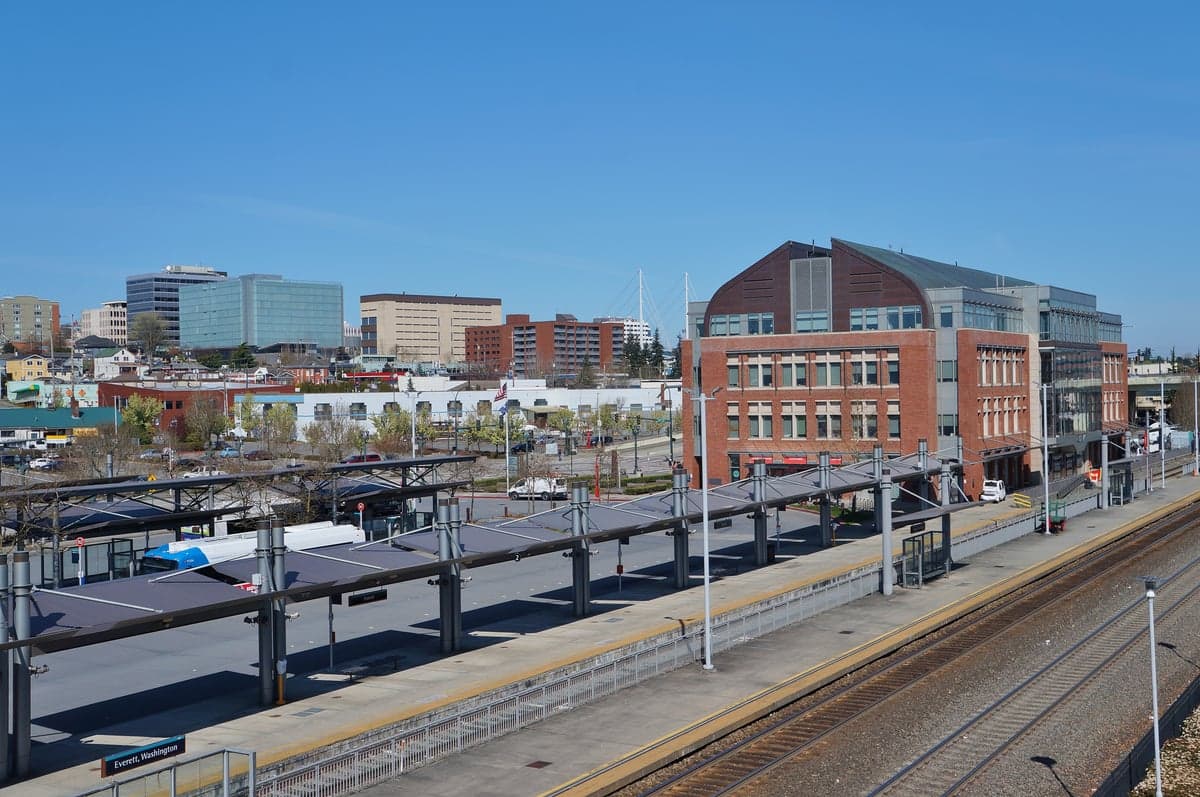
Photo: Wikipedia
Demographics of Everett, WA
Affluence Level in Everett, WA
A middle-class area roughly in line with national averages across income, home values, education, and employment.
People of Everett, WA
The people of Everett, Washington today form a working-to-middle-class, industrially-rooted population of 111,083 that is notably more diverse than its suburban neighbors yet retains a distinctly blue-collar character. With a foreign-born share of 11.8% and a population that is 57.7% white, 17.3% Hispanic, 9.2% East/Southeast Asian, and 6.4% Black, Everett is a city where aerospace and maritime employment anchor a community that values practicality over pretense. The city’s identity is shaped by its history as a company town turned regional hub, producing a populace that is resilient, ethnically varied, and increasingly family-oriented in its newer suburban-style neighborhoods.
How the city was settled and grew
Everett was founded in the 1890s as a speculative industrial boomtown, built on the promise of a transcontinental railroad terminus and deep-water port on Port Gardner Bay. The original white settlers—largely of Northern European stock, including Swedes, Norwegians, and Germans—arrived to work in the city’s first major industries: timber milling, shingle manufacturing, and the smelting of copper ore from the nearby Monte Cristo mines. These early workers settled in the Port Gardner neighborhood along the waterfront, where company-built housing and boarding houses lined the steep hillsides. By the early 1900s, the arrival of the Everett & Monte Cristo Railway and the establishment of the Weyerhaeuser timber mill drew a second wave of Scandinavian and Finnish immigrants, who clustered in the Riverside district near the Snohomish River. The city’s population grew steadily through the 1920s, reaching roughly 30,000, with a small but established Japanese American community working in fishing and agriculture around the Delta neighborhood. The Great Depression and World War II brought a major shift: the U.S. Navy established Naval Station Everett in 1942, and Boeing opened its first Everett plant in 1967, drawing thousands of workers from across the Midwest and South. These newcomers, predominantly white and often from rural backgrounds, settled in the newly developed Beverly Park and Harbour Pointe areas, transforming Everett from a timber town into an aerospace and military hub.
Modern era (post-1965)
The post-1965 era, following the Hart-Cellar Immigration Act, reshaped Everett’s demographics significantly. The Boeing boom of the late 1960s and 1970s attracted not only domestic migrants but also a growing number of Filipino and Vietnamese immigrants, who found work in aerospace manufacturing and the region’s expanding service sector. These East/Southeast Asian communities concentrated in the Evergreen neighborhood, near the Boeing plant, where affordable post-war housing and proximity to employment made settlement practical. The 1980s and 1990s saw a steady influx of Hispanic workers, primarily of Mexican origin, drawn by construction, landscaping, and warehouse jobs; they established a visible presence in the Delta and North Everett districts, where older, lower-cost housing stock and multi-generational households became common. The Black population, historically small, grew modestly during this period, with many families settling in the Pinehurst area near the city’s central corridor. By 2020, Everett’s white share had declined to 57.7%, while Hispanic (17.3%) and East/Southeast Asian (9.2%) communities had become substantial minorities. The Indian-subcontinent population remains tiny at 0.8%, concentrated among professionals in tech-adjacent roles. The city’s college-educated share, at 28.9%, is lower than the Snohomish County average, reflecting the persistence of blue-collar employment in aerospace and trades.
The future
Everett’s population is heading toward greater ethnic diversity and a slow but steady increase in educational attainment, driven by the expansion of the aerospace sector and the growth of the University of Washington’s satellite campus in the city. The Hispanic and East/Southeast Asian communities are growing organically through both immigration and higher birth rates, while the white population is aging and declining slightly. The city is not tribalizing into starkly segregated enclaves—neighborhoods like Evergreen and Delta are becoming more mixed—but distinct ethnic clusters persist: Filipino and Vietnamese families remain anchored in Evergreen, while Hispanic households are spreading from Delta into the South Everett area. The foreign-born share, at 11.8%, is plateauing as domestic in-migration from other parts of Washington and the West Coast accelerates, particularly among younger professionals priced out of Seattle. Over the next 10-20 years, Everett is likely to become a more suburban, family-oriented city, with a growing middle class of mixed ethnic backgrounds, but it will retain its industrial core and working-class ethos.
For someone moving to Everett now, the city offers a stable, ethnically diverse community where blue-collar values and family life remain central. The population is becoming more educated and more diverse, but it is not gentrifying rapidly—housing remains relatively affordable by Puget Sound standards, and the aerospace economy provides steady employment. This is a place where a newcomer can find both rooted working-class neighborhoods and emerging mixed-income areas, with a demographic trajectory that points toward gradual integration rather than fragmentation.

* Values derived from national, state, county, city and local statistics and may differ in a specific area. Last updated: 2026-04-21T11:03:12.000Z
Narrative content on this page is AI-generated and may contain mistakes. Verify any details that matter before acting on them.
ReloMaps may earn a commission from affiliate links at no extra cost to you.

