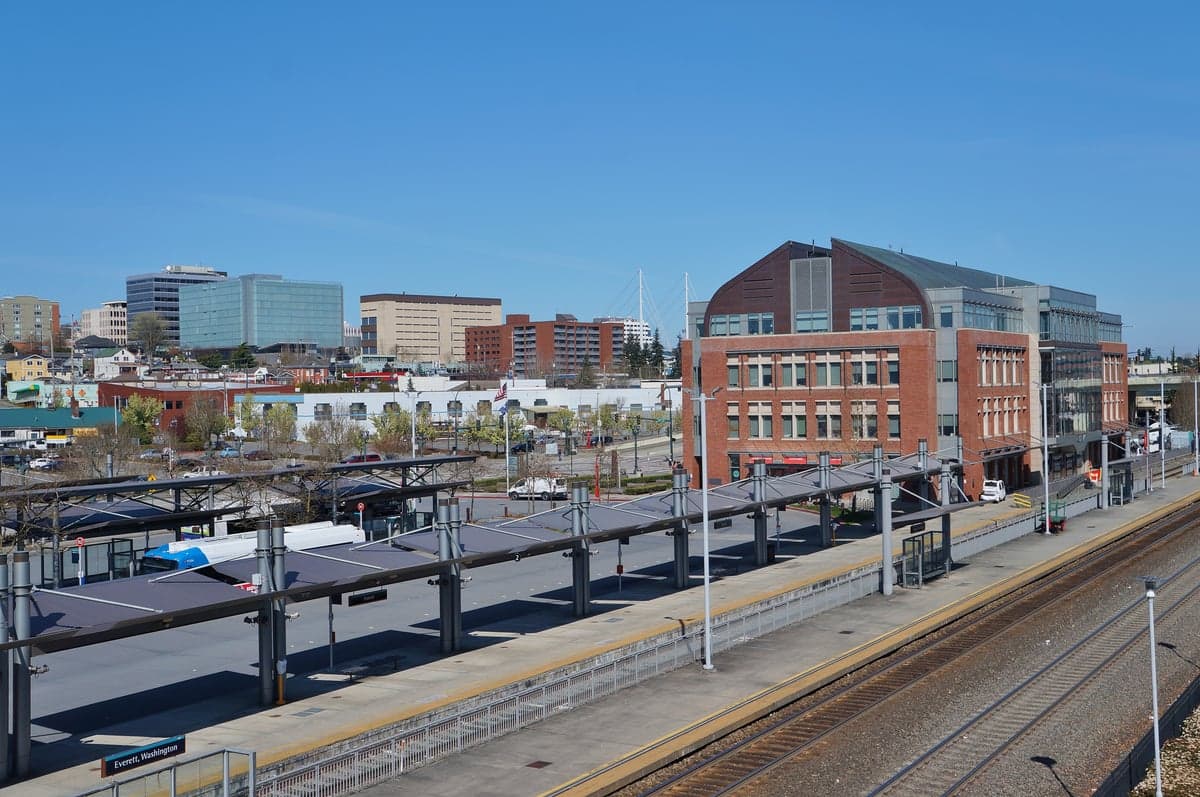
Photo: Wikipedia
Strategic Assessment of Everett, WA
Multiple tactical vulnerabilities. Population density, target proximity, or disaster risk are likely compounding. A retreat property and exit planning is required.
What does the Strategic Assessment tell us?
Our Strategic Assessment grades tactical survivability of an area. Major population centers, military targets, fallout zones, natural disasters, and border exposure all drive risk — lower exposure means a more defensible position in a crisis.
This is heavily inspired by Joel Skousen's Strategic Relocation book. Highly recommended you checkout the book ($)What does this tell us?
Our Strategic Assessment grades tactical survivability of an area. Major population centers, military targets, fallout zones, natural disasters, and border exposure all drive risk — lower exposure means a more defensible position in a crisis.
This is heavily inspired by Joel Skousen's Strategic Relocation book. Highly recommended you checkout the book ($)Strategic Pillars

Key Distances
Regional Safe Places
Below is our recommended "safe zones" in Washington and the surrounding area based on our strategic heuristics. For most people, it's unrealistic to live in a “safe zone” full-time due to work, family or other personal reasons. They tend to be more rural. However, many of these areas are perfect for second homes and retreat properties that double as a vacation home or even a short-term rental.
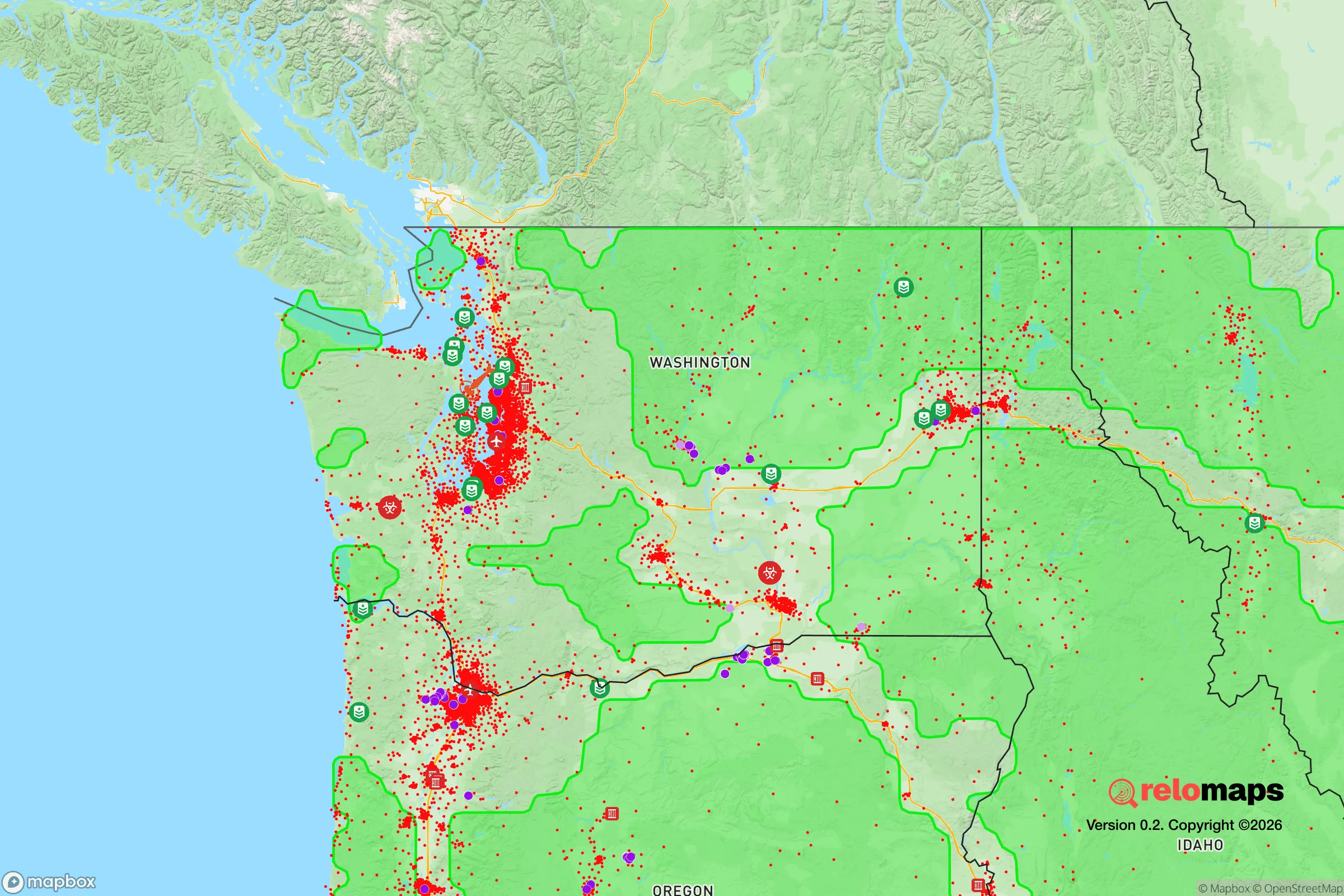
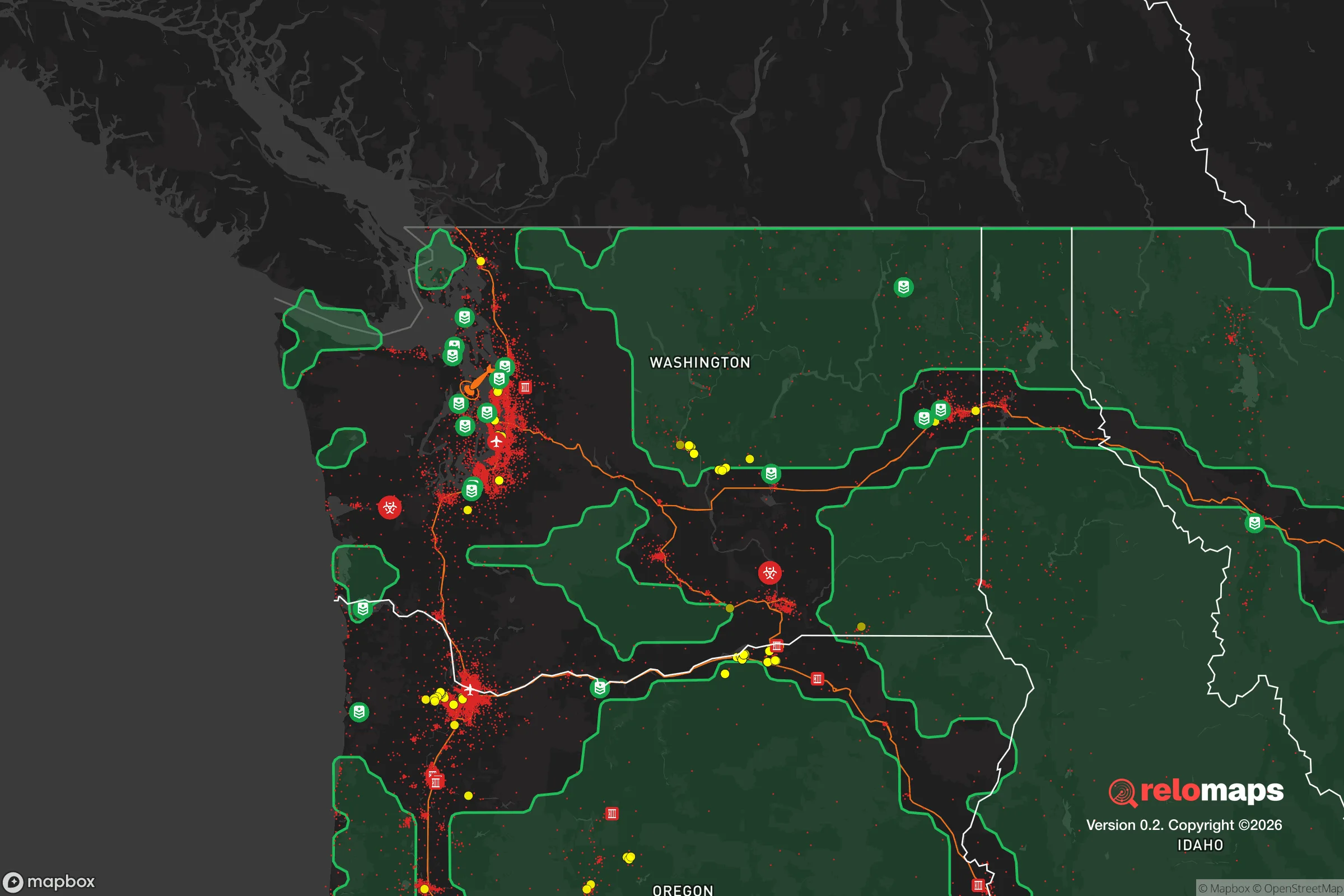


Important Note: For informational purposes only. This does not mean nothing bad ever happens in the green zones. Please use common sense. This is based on public data and modeled with AI. We tried to take a conservative approach but mistakes happen. We update this regularly as new information becomes available.
Solar Generator Recommendations
Backup power matters more here than in safer locations. We've picked three solar generators across budgets and capacity tiers — start with the budget unit if you only need a few essentials, or step up if you want to run a fridge and HVAC for days at a time.

Jackery Portable Power Station Explorer 300
Budget OptionPower on the Go: Weighing only 11 lbs, it's convenient to set up and store with book-sized foldable solar panels

BLUETTI Portable Power Station AC180
Designed for both indoor and outdoor scenarios, AC180 is highly capable as it has a robost capacity and continuous output power.

EF ECOFLOW DELTA Pro Ultra Power Station
Upgraded PickEcoFlow DELTA Pro Ultra is a whole-home energy system designed to grow with your family. Integrated with the Smart Home Panel 2, it scales to meet your evolving energy needs — keeping your home powered, intelligent, and secure through every stage of life.
We earn a commission, at no additional cost to you.
Strategic Assessment Analysis
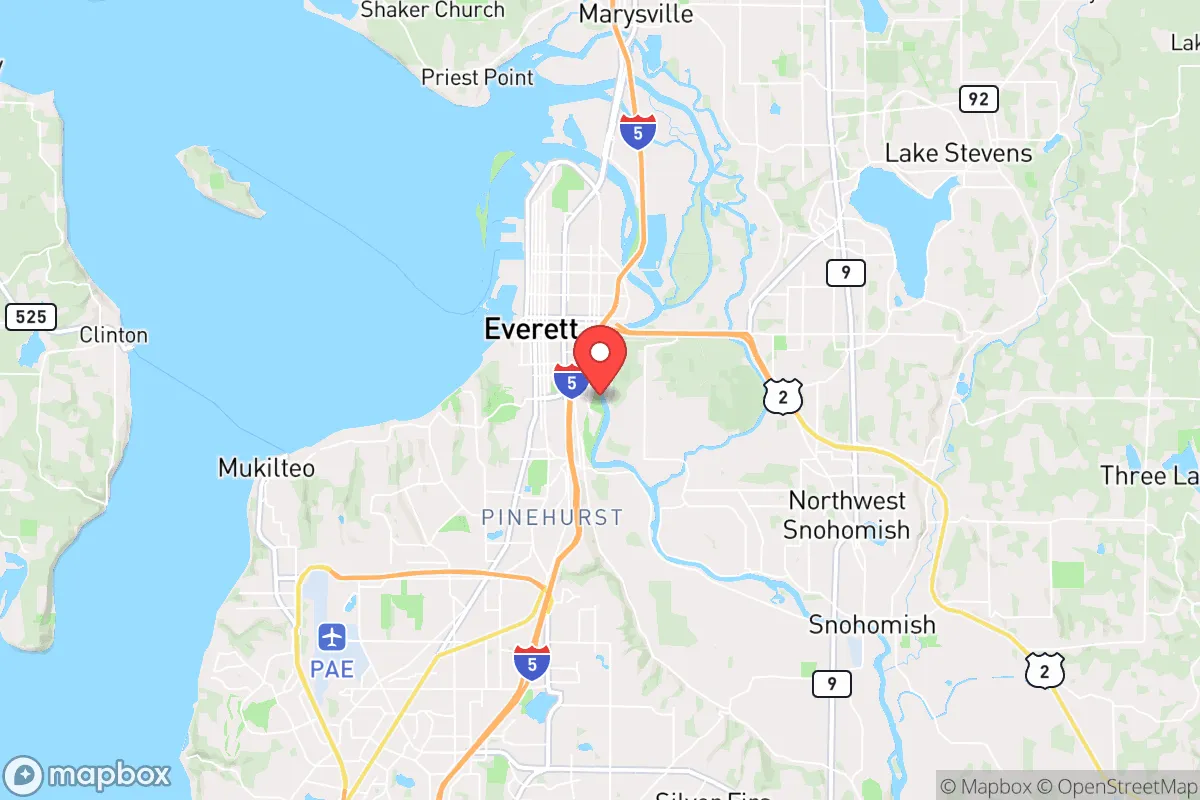
Everett, Washington, sits in a precarious strategic position that demands hard-nosed evaluation. Its location on Puget Sound, roughly 30 miles north of Seattle, offers both genuine resilience advantages and serious exposure risks that any relocator with a prepper mindset must weigh. The area benefits from a robust industrial base anchored by Boeing’s largest assembly plant and Naval Station Everett, which provide economic stability and infrastructure that could prove vital during disruptions. However, its proximity to a major metropolitan hub, critical military assets, and key transportation corridors means it is also a likely target or chokepoint in any widespread crisis scenario. For the conservative-leaning individual or family prioritizing self-reliance and security, Everett presents a mixed bag: real potential for long-term sustainability, but only if you understand and mitigate its very real vulnerabilities.
Geographic position and natural advantages for long-term survival
Everett’s geography is a double-edged sword, but the natural advantages are substantial. The city sits at the mouth of the Snohomish River, with the Cascade Range to the east and the Olympic Mountains to the west, creating a natural buffer zone that limits easy overland access from the south. The Puget Sound provides a deep-water port and potential maritime escape route, while the surrounding forests and watersheds offer abundant fresh water, timber, and game. The region’s temperate maritime climate means no extreme temperature swings, reducing the strain on heating and cooling systems during grid-down scenarios. The Snohomish River and its tributaries, including the Skykomish and Snoqualmie, provide reliable water sources for filtration and small-scale hydropower. For a relocator willing to invest in off-grid infrastructure, the area’s rainfall—averaging 35 inches annually—supports rainwater catchment and year-round gardening in protected microclimates. The nearby Cascade foothills also offer defensible terrain with limited road access, ideal for a retreat property that remains within a reasonable commute to Everett’s industrial and medical resources.
Risks, exposures, and proximity to fallout-relevant landmarks
The downsides are equally significant and cannot be ignored. Everett’s proximity to Seattle—a likely epicenter for civil unrest, mass casualty events, or cascading infrastructure failures—means that any major disruption in the metro area will ripple north. Interstate 5, the region’s primary north-south artery, runs directly through Everett and would become a choke point for refugees fleeing south or north, creating security and supply risks. Naval Station Everett, home to multiple destroyers and support vessels, is a high-value military target in any conflict scenario, and its presence could draw precision strikes or secondary attacks on surrounding infrastructure. The Boeing Everett Factory, the world’s largest building by volume, is another critical industrial asset that could become a target for sabotage or collateral damage. Additionally, the region sits within the Cascadia subduction zone, meaning a major earthquake (the “Big One”) could trigger tsunamis in the Sound, liquefaction in low-lying areas, and long-term disruption of roads, ports, and power grids. The Hanford Site, a decommissioned nuclear production facility 200 miles southeast, is a distant but real concern for airborne contamination in the event of a catastrophic release. For the survivalist, these exposures mean that a primary residence in Everett itself is risky; a secondary property in the foothills or on the Olympic Peninsula becomes a near-necessity.
Practical resilience for a relocator: food, water, energy, and defensibility
For those committed to making Everett work as a base of operations, practical resilience requires deliberate planning. The region’s agricultural capacity is limited by topography and urban development, but the Skagit Valley to the north and the Snohomish River delta offer fertile soil for small-scale farming. Local food sources include the Everett Farmers Market and numerous U-pick farms in the surrounding county, but a serious prepper should establish a home garden with cold-hardy crops like kale, potatoes, and root vegetables, supplemented by a greenhouse for year-round production. Water is abundant but requires treatment; the municipal supply from the Spada Lake Reservoir is reliable, but a well on a rural property with a hand pump or solar-powered pump is essential for grid-down scenarios. Energy resilience is achievable through solar panels with battery storage, though the region’s frequent cloud cover reduces efficiency—wind turbines or micro-hydro from a creek are better long-term bets. Defensibility is the weakest link in Everett proper: the city’s dense neighborhoods, multiple bridges, and waterfront access make it hard to secure. A better strategy is to locate on the outskirts—north toward Marysville or east toward Granite Falls—where rural roads offer natural chokepoints and neighbors are more likely to share a self-reliant mindset. The local gun culture is strong, with multiple ranges and gun shops, and Washington’s firearm laws are relatively permissive compared to King County, though recent state-level restrictions on magazines and certain firearms require careful compliance.
The overall strategic picture for Everett is one of calculated risk. It offers genuine advantages in water, climate, and industrial infrastructure that could sustain a community through prolonged disruptions, but its proximity to Seattle, military targets, and seismic hazards demands a layered approach to security and self-sufficiency. For the conservative relocator who values economic opportunity and natural resources but is willing to invest in a secondary retreat and maintain a low profile, Everett can serve as a viable forward operating base. The key is to treat the city as a hub for supplies, medical care, and community connections—not as a final redoubt. Those who move here expecting to ride out a crisis in a suburban home will be disappointed; those who treat it as a launching point for deeper wilderness preparedness will find the region’s assets align well with a serious survivalist strategy. In short, Everett is a place to work and resupply, not a place to hunker down. Plan accordingly.

* Values derived from national, state, county, city and local statistics and may differ in a specific area. Last updated: 2026-04-21T11:03:12.000Z
Narrative content on this page is AI-generated and may contain mistakes. Verify any details that matter before acting on them.
ReloMaps may earn a commission from affiliate links at no extra cost to you.

