
Photo: Wikipedia
Political ClimatePolitical Climate in Elizabethton, TN
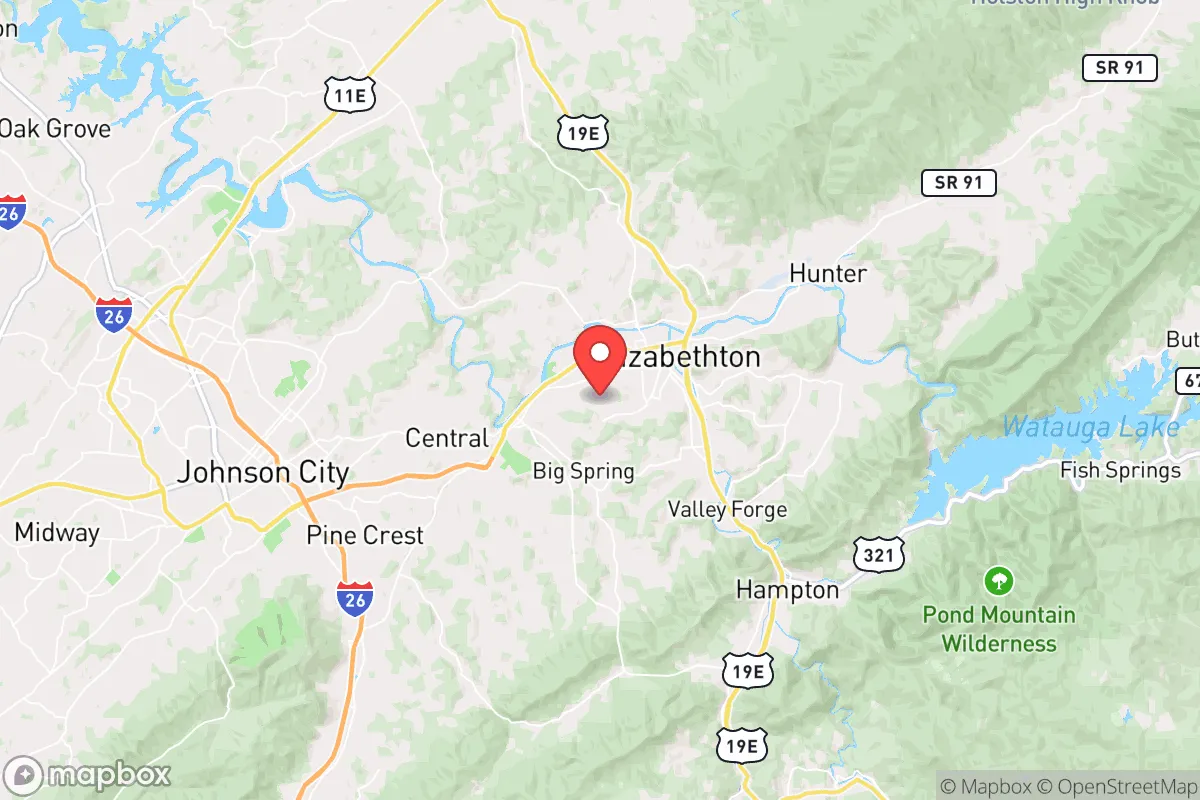
District shown is the primary district for this city’s centroid. Cities may span multiple districts.
Local Political AnalysisPolitical Analysis of Elizabethton, TN
Elizabethton is about as deep red as it gets in Tennessee, and it’s been that way for a long time. The Cook PVI here is R+29, which is more than double the state’s already solid R+13 rating. That means in a typical presidential election, Republicans win Elizabethton by nearly 30 points more than the national average. If you look at the 2024 results, Carter County—where Elizabethton sits—went about 78% for Donald Trump, while Tennessee as a whole was around 65%. The gap isn’t new, either; it’s been widening slowly over the past two decades as the area’s older, more rural base has solidified, and younger transplants from places like Johnson City haven’t shifted the needle much.
How it compares
Compared to the rest of Tennessee, Elizabethton is a conservative outlier even within a conservative state. The state’s R+13 PVI is driven by places like Nashville (which is blue-leaning) and Memphis (solidly Democratic), but Elizabethton’s R+29 puts it in the same league as the most Republican counties in the state, like Pickett or Van Buren. The closest city of any size, Johnson City, is about 15 miles west and has a PVI around R+18—still very red, but noticeably less so than Elizabethton. Bristol, about 20 miles north, is closer to R+22. The contrast is sharpest with Knoxville, about 90 miles southwest, which sits at R+10 and has a more mixed political scene thanks to the University of Tennessee. So if you’re coming from a place like Nashville or even Johnson City, Elizabethton will feel like a step further into conservative territory, especially on social issues.
What this means for residents
For conservative residents, this political climate means their values are the default in local governance. The city council and county commission are overwhelmingly Republican, and policy debates tend to focus on tax cuts, Second Amendment rights, and keeping regulations light. School board meetings rarely see the kind of culture-war fights you’d find in more purple suburbs. For liberal residents, it’s a different story. You’ll be in a clear minority, and while most people are polite about it, you won’t find many like-minded neighbors in local politics. There’s no real Democratic Party infrastructure in the county—no active local chapter, no regular meetings. That said, the area is small enough that personal relationships often override political labels in day-to-day life. You can still be friends with your conservative neighbor even if you disagree on everything at the ballot box.
One cultural distinction worth noting: Elizabethton’s politics are tied closely to its Appalachian identity and its history as a manufacturing and farming hub. There’s a strong sense of self-reliance and suspicion of federal overreach, which shows up in everything from local opposition to mask mandates during COVID to the popularity of the local gun show. The trajectory seems stable—there’s no sign of the area trending purple anytime soon. If anything, as retirees from more liberal states move in for the mountains and lower cost of living, they tend to be conservative-leaning themselves, so the R+29 number might even nudge a point or two redder over the next decade. For anyone moving here, the takeaway is simple: if you’re conservative, you’ll feel right at home politically. If you’re liberal, you’ll need to find your community in shared hobbies or church groups rather than local politics.

State Political ClimatePolitical Climate in Tennessee
State Political AnalysisPolitical Environment in the State
Tennessee is a solidly Republican state with a Cook PVI of R+13, meaning it votes about 13 points more Republican than the national average. Over the past 20 years, the state has shifted from a competitive purple state—where Democrats still held statewide offices as recently as 2010—to a deep-red stronghold, driven by suburban realignment, rural consolidation, and in-migration from blue states. The dominant coalition is a mix of rural conservatives, suburban families, and a growing number of transplants from California and the Northeast who are drawn to low taxes and conservative governance, though they sometimes bring more moderate social views.
Urban vs. rural divide
The political map of Tennessee is starkly divided. The major metros—Nashville (Davidson County) and Memphis (Shelby County)—are reliably Democratic, with Nashville voting about 65% for Biden in 2020 and Memphis around 80%. These cities drive the state's blue vote, powered by young professionals, minority communities, and a growing creative class. In contrast, the rest of the state is overwhelmingly Republican. Knoxville and Chattanooga are more conservative than Nashville or Memphis, though both have liberal pockets near their downtowns. The rural counties in Middle and East Tennessee—like Putnam County (Cookeville) and Washington County (Johnson City)—routinely vote 70-80% Republican. The most dramatic shift has been in the Nashville suburbs: counties like Williamson County (Franklin) and Rutherford County (Murfreesboro) were once swing areas but now lean heavily red, with Williamson voting 60% for Trump in 2020. Meanwhile, the state's fastest-growing region, the I-24 corridor between Nashville and Chattanooga, is solidifying Republican dominance as new subdivisions fill with conservative-leaning families.
Policy environment
Tennessee's policy environment is defined by its no state income tax—one of only nine states without one—and a low property tax burden, though sales tax is high (9.55% average combined rate). The regulatory posture is business-friendly, with a right-to-work law and minimal zoning restrictions outside major cities. Education policy is a flashpoint: the state has a robust school voucher program (the Education Savings Account pilot, expanded in 2023) and a strong charter school presence, but teacher pay remains below the national average. Healthcare is a mixed bag: Tennessee did not expand Medicaid under the ACA, leaving about 300,000 residents in the coverage gap, but the state has a thriving telehealth sector and a growing number of direct-primary care clinics. Election laws have tightened: voter ID requirements are strict, early voting is available but limited to 14 days, and the state passed a law in 2023 banning private funding for election administration. Abortion is effectively banned after six weeks (the "Heartbeat Bill," passed in 2020 and triggered in 2022), with no exceptions for rape or incest—only to save the mother's life. Gun laws are among the most permissive in the nation: permitless carry (constitutional carry) was enacted in 2021, and there is no waiting period or universal background check for private sales.
Recent policy direction
Over the past five years, Tennessee has moved decisively to the right on nearly every front. In 2023, the legislature passed a ban on gender-affirming care for minors (SB 1), which was challenged in court but upheld by the Sixth Circuit. The same year, a law was enacted requiring public schools to notify parents if a student requests a name or pronoun change (the "Parental Bill of Rights"). On gun rights, the 2021 permitless carry law was followed by a 2023 law allowing teachers to carry firearms on school grounds with limited training. On speech and privacy, the state passed a law in 2024 requiring age verification for adult websites and restricting social media access for minors under 18. Property rights were strengthened with a 2022 law limiting the use of eminent domain for private economic development. On taxes, the state accelerated its phase-out of the Hall income tax (on investment income), eliminating it entirely in 2021. Voting access saw a 2023 law that made it a felony for election officials to send unsolicited absentee ballot applications. The overall direction is toward maximum individual liberty in economic and self-defense matters, combined with strong government intervention on social and medical issues.
Civil unrest & political movements
Tennessee has seen its share of political flashpoints. In 2023, the Nashville Covenant School shooting sparked massive protests at the state capitol, leading to the expulsion of two Democratic lawmakers (Justin Jones and Justin Pearson) for violating decorum rules—they were later reinstated by local councils. The event galvanized the state's gun control movement, but no significant legislation passed. On the right, the Tennessee Freedom Coalition and local Moms for Liberty chapters have been active in school board races, particularly in Williamson and Rutherford counties. Immigration politics are relatively quiet, as Tennessee has no sanctuary cities and passed a 2024 law requiring local law enforcement to cooperate with ICE. There is a small but vocal secessionist movement in East Tennessee, rooted in the region's historical Unionist sentiment, but it has no real political traction. Election integrity remains a live issue: the 2020 election saw no major fraud in Tennessee, but the legislature has continued to tighten laws, and some rural counties have adopted hand-counting of ballots for certain races. A new resident would notice the strong presence of political signage—especially in rural areas—and the occasional protest at the capitol, but overall, civil unrest is low compared to states like Oregon or Georgia.
Projection
Over the next 5-10 years, Tennessee is likely to become even more Republican, but with a growing internal tension between traditional rural conservatives and the more moderate suburban transplants. The state's population is projected to grow by about 10% by 2030, driven by in-migration from California, Illinois, and New York. These newcomers tend to be fiscally conservative but socially moderate, which could push the state toward a more libertarian-leaning Republicanism—think lower taxes and less regulation, but with some softening on social issues like marijuana (medical use is already being debated) and maybe a slight loosening of the abortion ban. However, the rural-dominated legislature is unlikely to shift dramatically, as redistricting after 2020 has locked in Republican supermajorities. The biggest wildcard is Nashville: if the city continues to grow and attract young, diverse residents, it could become a more powerful Democratic counterweight, but it will still be outvoted by the rest of the state. Expect continued fights over school funding, gun laws, and transgender rights, with the legislature likely to pass further restrictions on local control (e.g., preempting Nashville's zoning or anti-discrimination ordinances). A new resident moving in now should expect a state that remains deeply conservative on social issues, but with a growing libertarian streak on economics and personal freedom.
For a new resident, the bottom line is straightforward: if you're a conservative, you'll find a state that largely aligns with your values on taxes, guns, and education, with a government that actively pushes those priorities. If you're a liberal, you'll find vibrant blue cities in Nashville and Memphis, but you'll be living under a state government that is actively hostile to many of your policy preferences—especially on abortion, LGBTQ+ rights, and voting access. The practical takeaway is that Tennessee offers a high degree of personal freedom in economic and self-defense matters, but with strong social conservatism baked into state law. Your experience will depend heavily on where you live: Williamson County feels very different from Davidson County, and both are worlds apart from rural Grundy County. Choose your county carefully, because in Tennessee, local politics matter as much as state policy.
* Values derived from national, state, county, city and local statistics and may differ in a specific area. Last updated: 2026-09-29T21:41:25.000Z
Narrative content on this page is AI-generated and may contain mistakes. Verify any details that matter before acting on them.
ReloMaps may earn a commission from affiliate links at no extra cost to you.

