Photo: Wikipedia
Demographics of Elizabethton, TN
Affluence Level in Elizabethton, TN
A below-average socioeconomic profile. Incomes, home values, and educational attainment trail the U.S., with higher poverty and unemployment.
People of Elizabethton, TN
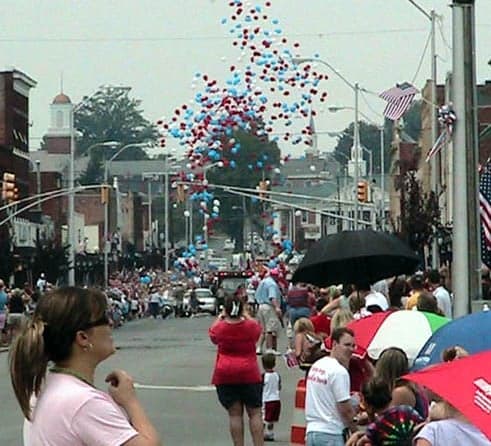
The people of Elizabethton, Tennessee, today number 14,364, forming a predominantly white (90.5%) community with a small but established Black population (4.3%) and very limited foreign-born presence (1.0%). The city’s identity is rooted in its Appalachian setting and a history of industrial boom-and-bust cycles, producing a population that is older than the national median and notably less diverse than the state average. With only 25.2% of adults holding a college degree, the workforce leans heavily toward manufacturing, healthcare, and retail, and the cultural character remains distinctly Southern and rural, with a strong sense of local tradition.
How the city was settled and grew
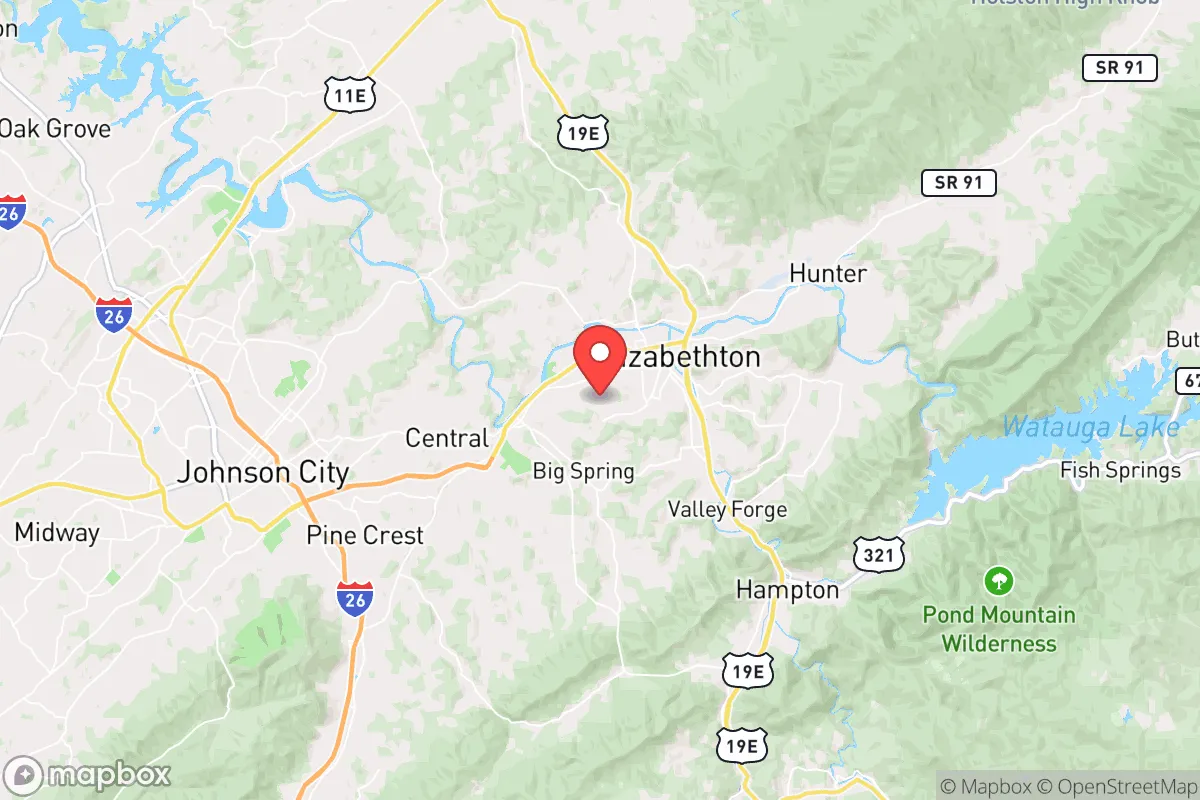
Elizabethton’s original population arrived in the late 18th century as part of the westward push across the Appalachian Mountains. The Watauga Settlement, established in the 1770s, drew Scots-Irish and English frontiersmen who were granted land under the Watauga Association, a self-governing body predating Tennessee statehood. These early settlers clustered along the Watauga River in what is now the Historic Downtown district, building log homes and small farms. The city was formally chartered in 1907, but its major population wave came with the arrival of the Bemberg and Glanzstoff rayon plants in the 1920s. These German-owned factories drew thousands of workers from the surrounding rural counties and from Southern Appalachia more broadly, creating the Bemberg Addition neighborhood, a company-built housing area that still contains many of the original bungalows. A smaller but notable wave of African American workers came during this period, settling primarily in the West Side area near the factories, where a tight-knit Black community formed around the St. John Baptist Church. The post-World War II era saw modest growth as returning veterans took jobs at the plants, expanding into the Southside neighborhood, a grid of modest single-family homes built in the 1950s.
Modern era (post-1965)
After the 1965 Hart-Cellar Act, Elizabethton saw virtually no new immigration; the foreign-born share remains at just 1.0%, and the city’s East/Southeast Asian population (0.4%) and Indian subcontinent population (0.0%) are negligible. The major demographic shift since the 1970s has been domestic: the closure of the rayon plants in the 1990s triggered a population decline from a peak of roughly 14,500 in 1980 to a low of about 13,500 in 2000, followed by a slow recovery. During this period, many younger residents left for larger cities, while retirees from Florida and the Northeast began moving in, drawn by low housing costs and the nearby Watauga Lake. These newcomers have concentrated in the Watauga Point area, a newer subdivision of ranch-style homes and townhouses near the lake, and in the Lynn Valley corridor, where larger lots and newer construction appeal to out-of-state buyers. The Black population, which was 6.8% in 2000, has declined to 4.3% today, reflecting out-migration of younger African Americans to metro areas like Johnson City and Knoxville. The Hispanic population (1.8%) is small but growing, with families settling in the West Side and Southside neighborhoods, often working in the remaining manufacturing plants and in poultry processing.
The future
Elizabethton’s population is projected to remain stable or grow very slowly, with the Carter County planning office estimating a 2-3% increase by 2035. The city is becoming slightly more diverse, driven by a gradual increase in Hispanic residents (likely reaching 3-4% by 2035) and a small but steady inflow of retirees from outside the region. Younger families are increasingly priced out of nearby Johnson City and are moving into the Southside and Lynn Valley areas, where home prices remain below $200,000. The cultural identity is slowly shifting from a purely Appalachian industrial town to a bedroom community for the Tri-Cities metro area, but the pace of change is slow. The foreign-born population is unlikely to rise significantly, as the local economy lacks the high-skilled job base that attracts immigrants. For a new resident, Elizabethton offers a stable, low-cost, and culturally homogeneous environment where change comes gradually and community ties remain strong.
Elizabethton is becoming a quieter, more retirement-oriented community with a slowly diversifying but still overwhelmingly white population. For someone moving in now, the city offers affordable housing, a strong sense of local history, and proximity to outdoor recreation, but limited ethnic diversity and a modest job market outside of healthcare and manufacturing.

* Values derived from national, state, county, city and local statistics and may differ in a specific area. Last updated: 2026-09-29T21:41:25.000Z
Narrative content on this page is AI-generated and may contain mistakes. Verify any details that matter before acting on them.
ReloMaps may earn a commission from affiliate links at no extra cost to you.

