
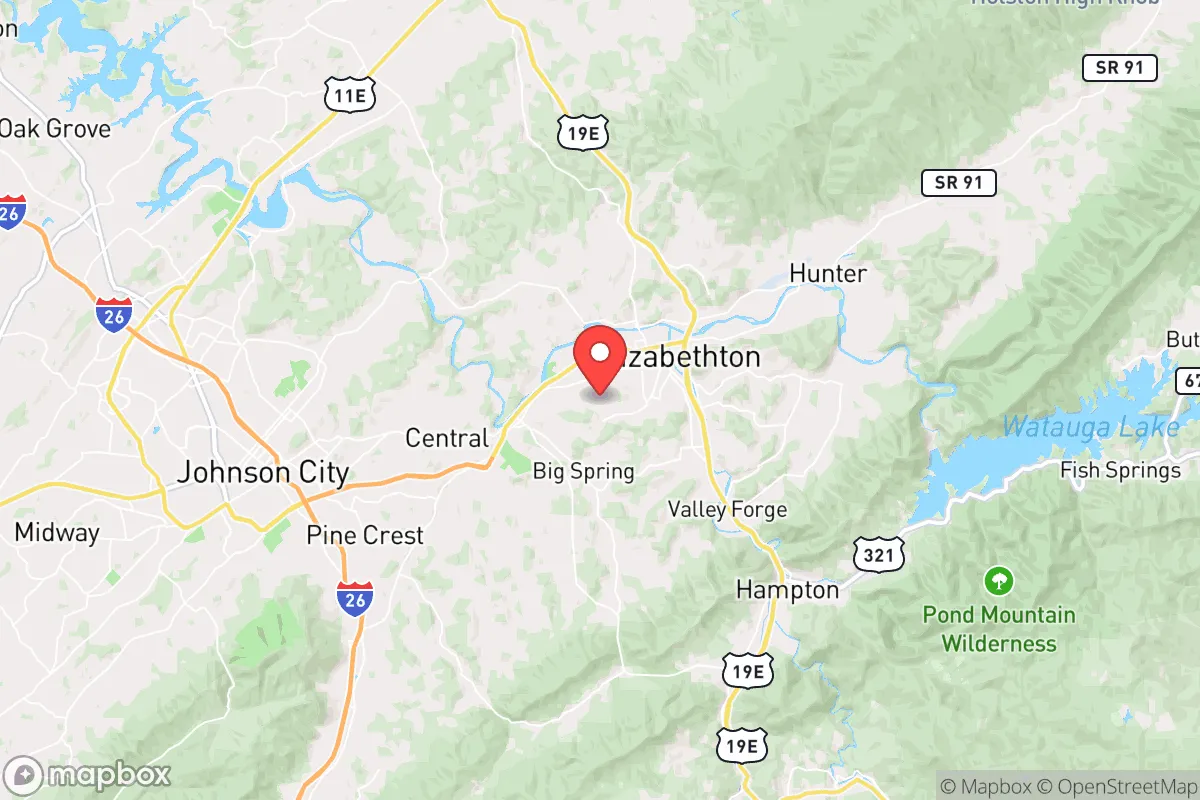
Photo: Wikipedia
Personal Sovereignty in Elizabethton, TN
Viable for self-reliance. Generally workable, though some barriers may limit total independence.
What does Personal Sovereignty tell us?
Personal Sovereignty measures your capacity for self-reliance and independence with minimal government friction. Higher scores mean fewer barriers between you and the way you want to live... but it assumes you have the space you need and good neighbors.
What does this tell us?
Personal Sovereignty measures your capacity for self-reliance and independence with minimal government friction. Higher scores mean fewer barriers between you and the way you want to live... but it assumes you have the space you need and good neighbors.
State Policy
Energy independence: Importer (25% of energy produced in-state)
Personal Liberty
Homesteading

Personal Liberty Analysis
Elizabethton, Tennessee, offers a personal sovereignty environment shaped primarily by state-level policies that consistently rank among the most freedom-oriented in the nation, with local conditions in Carter County adding a distinctly rural, hands-off character. For single individuals and families who prioritize autonomy—whether in financial decisions, self-defense, or lifestyle choices—the area presents a regulatory landscape where the default answer from government is often "yes" or "none of our business." Tennessee’s lack of a state income tax, its constitutional carry law, and its strong property rights framework create a baseline of personal liberty that is amplified by Elizabethton’s small-town culture and limited local government footprint.
Tax burden and regulatory posture for residents and business owners
Tennessee’s tax structure is among the most favorable in the country for those seeking to keep more of their earnings. The state imposes no personal income tax on wages or salaries, a fact that directly increases disposable income for every working resident. The state sales tax rate is 7%, which is high, but local option taxes in Carter County bring the combined rate to 9.75%—a figure that is noticeable on everyday purchases but offset by the absence of income tax. Property taxes are exceptionally low: Carter County’s rate is approximately $2.20 per $100 of assessed value, and Elizabethton’s municipal rate adds roughly $0.80, meaning a $200,000 home carries an annual tax bill of around $1,200 to $1,500. For comparison, that is roughly half the property tax burden of a similar home in Knoxville or Nashville. The regulatory posture at the local level is light-touch. Elizabethton does not impose rent control, business licensing is straightforward, and zoning is minimal outside the historic downtown core. There are no county-level building codes for most rural residential construction, though the city enforces basic standards within its limits. For a small business owner or a family looking to minimize government overhead in daily life, the combined tax and regulatory environment here is genuinely low-friction.
Self-defense and gun law specifics in Tennessee
Tennessee is a constitutional carry state, meaning that as of July 1, 2021, any law-abiding adult 21 or older can carry a handgun, openly or concealed, without a permit. This is a foundational personal sovereignty right that Elizabethton residents exercise routinely—gun ownership is common, and the culture around firearms is one of normalcy rather than controversy. For those who want a permit for reciprocity with other states, Tennessee issues an enhanced handgun carry permit that requires an 8-hour training course and a background check. The state has a "stand your ground" law with no duty to retreat in any place where the person is lawfully present, and Castle Doctrine protections extend to vehicles and occupied structures. Carter County is a Second Amendment sanctuary county, with a formal resolution affirming that local resources will not be used to enforce federal gun laws deemed unconstitutional. Local sheriff’s office policy is generally supportive of lawful carry. There are no local ordinances in Elizabethton that restrict magazine capacity, ban specific firearm types, or impose waiting periods beyond state law. For a reader prioritizing self-defense rights, this is about as permissive an environment as exists in the eastern United States.
Self-reliance and homesteading viability in Carter County
Elizabethton’s position at the edge of the Cherokee National Forest and the Appalachian foothills makes it a practical location for homesteading and off-grid living. Outside the city limits, Carter County has minimal zoning restrictions—there is no county-wide zoning ordinance, meaning that on unincorporated land, a resident can generally keep livestock, build structures, and use their property as they see fit, provided they meet basic state health and safety codes. Lot sizes vary widely: in the rural parts of the county, parcels of 1 to 10 acres are common and affordable, with raw land prices ranging from $3,000 to $8,000 per acre depending on access and topography. Within Elizabethton city limits, standard residential lots are typically 0.25 to 0.5 acres, and the city does enforce building permits and setbacks, but there are no HOA-style restrictions on gardening, chickens, or small-scale agriculture in most neighborhoods. Off-grid feasibility is high: the area receives ample rainfall (about 45 inches annually), well water is accessible in most rural locations, and solar potential is moderate but workable with battery storage. The local utility, Elizabethton Electric System, does not have a net metering policy that is particularly favorable, but off-grid systems are legal and not subject to special permitting. For a family wanting to raise food, harvest rainwater, or reduce dependence on municipal services, the regulatory and practical barriers are low.
Personal liberties: parental rights, medical autonomy, speech, and property
Tennessee has enacted several laws that strengthen parental rights in education and healthcare. The state’s "Parental Bill of Rights" (Tennessee Code § 49-6-9001) affirms that parents have the fundamental right to direct the upbringing, education, and medical care of their children. This includes the ability to opt children out of any curriculum materials the parent finds objectionable, and schools are required to notify parents of any changes in a student’s emotional or physical well-being. Medical autonomy is similarly protected: Tennessee does not have a state-level vaccine mandate for adults, and while school vaccine requirements exist for standard childhood immunizations, religious and medical exemptions are available and are not subject to judicial override. On speech and property rights, the state has a strong tradition of protecting both. There is no state-level hate speech law that criminalizes expression, and property rights are reinforced by Tennessee’s "Private Property Protection Act," which requires government to compensate landowners for any regulatory taking that reduces property value by more than 20%. Local government in Elizabethton is small enough that most residents interact with city hall only for utility payments and building permits—there is no pervasive surveillance, no local mask or vaccine mandates, and no noise ordinances that would prevent a resident from using their property for reasonable personal activities. The overall atmosphere is one of live-and-let-live, with government intervention being the exception rather than the rule.
Compared to most of the United States, Elizabethton and Carter County offer a personal sovereignty profile that is genuinely high—ranking in the top tier for tax freedom, gun rights, and property autonomy. The trade-offs are the ones typical of rural Appalachia: lower access to specialized healthcare, fewer high-paying jobs, and a slower pace of life that some may find isolating. But for a single individual or family whose priority is maximum personal control over finances, safety, lifestyle, and family decisions, this area delivers a regulatory environment that is consistently light, predictable, and respectful of individual choice. It is not a libertarian utopia—state sales tax is high, and the local economy is modest—but for the core freedoms that matter most to a sovereignty-minded person, Elizabethton is a strong practical choice.

* Values derived from national, state, county, city and local statistics and may differ in a specific area. Last updated: 2026-09-29T21:41:25.000Z
Narrative content on this page is AI-generated and may contain mistakes. Verify any details that matter before acting on them.
ReloMaps may earn a commission from affiliate links at no extra cost to you.

