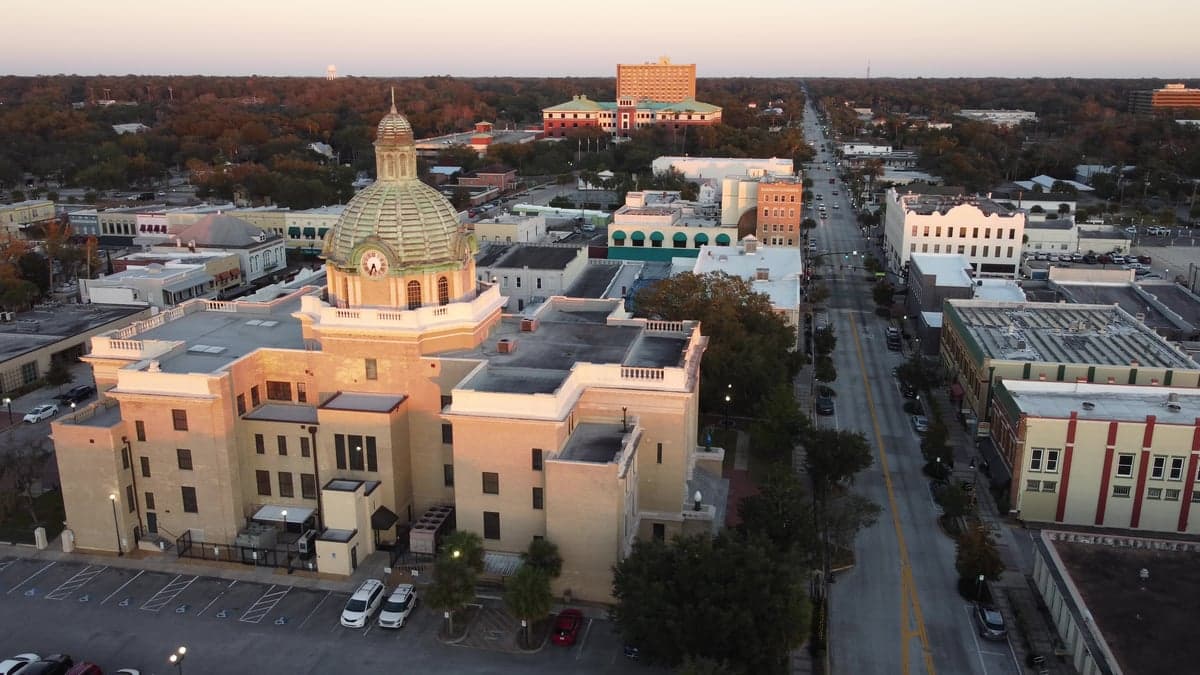
Photo: Wikipedia
Political ClimatePolitical Climate in DeLand, FL
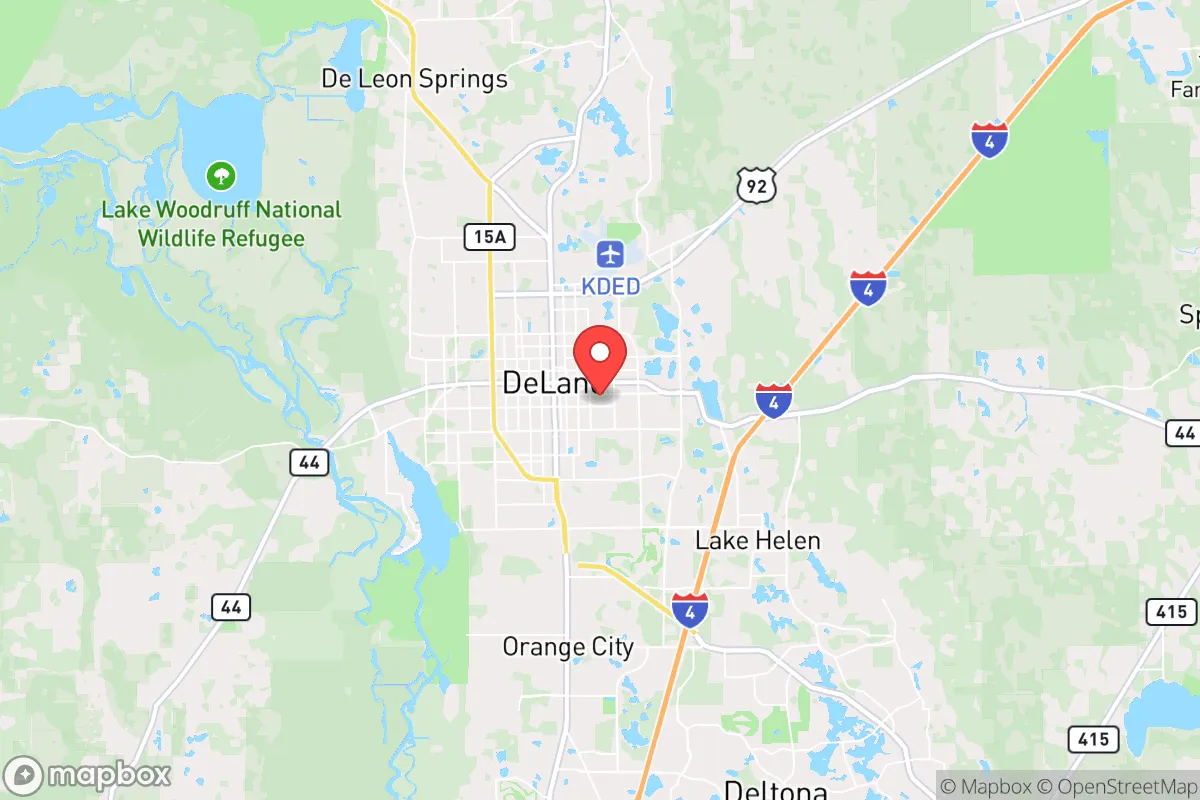
District shown is the primary district for this city’s centroid. Cities may span multiple districts.
Local Political AnalysisPolitical Analysis of DeLand, FL
DeLand leans solidly Republican, with a Cook Partisan Voting Index of R+14, making it one of the more conservative pockets in Central Florida. That R+14 means the district is 14 points more Republican than the national average, and in practice, you see that in local elections where GOP candidates routinely win by double digits. The trajectory here has been steadily redder over the past decade, driven by an influx of retirees from the Midwest and Northeast who are drawn to the quieter, slower pace of life in Volusia County. But don't let the R+14 fool you into thinking it's a monolith — DeLand itself, especially around Stetson University, has a noticeable liberal streak that keeps things interesting.
How it compares
Compared to Florida as a whole, DeLand is significantly more conservative. The state of Florida is a swing state — it voted for Trump in 2024 by about 3 points, but it's been purple for years, with Miami-Dade and Broward counties pulling it left and the Panhandle and rural areas pulling it right. DeLand's R+14 puts it in the same ballpark as nearby conservative strongholds like Orange City (R+12) and Deltona (R+10), but it's noticeably redder than Daytona Beach (R+6) and much redder than Gainesville (D+8) or Orlando (D+5). The contrast is sharpest with St. Augustine (R+4) to the north, which has a more tourist-driven, moderate vibe. Within Volusia County, DeLand is the conservative anchor, while New Smyrna Beach and Port Orange lean more moderate. The university presence in DeLand — Stetson has about 4,000 students — creates a small but vocal liberal enclave that makes local politics more contested than the raw PVI suggests.
What this means for residents
For conservative residents, DeLand is a comfortable place to live. Local government is reliably Republican, so you'll see lower taxes, fewer regulations, and a general "stay out of my business" attitude. The county commission and school board are GOP-dominated, and issues like gun rights and property rights get a sympathetic hearing. For liberal residents, it's not hostile, but you'll be in the minority. The university area provides a social and political bubble — you'll find like-minded folks at coffee shops near campus or at local Democratic club meetings. The practical reality is that both sides coexist without much friction. You won't see the kind of heated culture-war battles you get in bigger cities. People here are generally polite and neighborly, even when they disagree. The biggest policy distinction from the rest of Florida is that DeLand is more resistant to rapid development — the city has stricter growth management rules than, say, Deltona or Port Orange, which keeps the small-town feel intact but also means fewer housing options and higher prices for new construction.
Looking ahead, the political trajectory is likely to stay red, but the margin might narrow slightly as more young families and remote workers move in from Orlando and Tampa. The 2024 election saw a small uptick in Democratic turnout in DeLand proper, driven by Stetson students and younger professionals. But the surrounding rural areas — like DeLeon Springs and Pierson — are deeply conservative and will keep the overall lean solidly Republican for the foreseeable future. If you're moving here, just know that the political climate is friendly if you're conservative, and manageable if you're liberal — as long as you don't mind being the lone voice at the neighborhood barbecue.

State Political ClimatePolitical Climate in Florida
State Political AnalysisPolitical Environment in the State
Florida has transformed from a quintessential swing state into a solidly Republican-leaning state over the past decade, with Republicans holding a trifecta in state government since 1999 and a voter registration advantage that has steadily widened. The state’s political trajectory is driven by a combination of domestic migration from blue states, a growing Hispanic electorate that leans right in many regions, and a state-level policy agenda that has aggressively pushed conservative priorities. While Democrats remain competitive in presidential races (within 3-4 points in 2020 and 2024), the state legislature and governor’s mansion have been firmly in GOP control, and the 2024 election saw Donald Trump win Florida by over 13 points, a stark shift from the state’s 2000-era nail-biters.
Urban vs. rural divide
The political map of Florida is a textbook study in geographic polarization. The major Democratic strongholds are the urban cores of Miami-Dade County, Orlando (Orange County), and Tampa (Hillsborough County), along with the college town of Gainesville (Alachua County). However, even these bastions have shifted right in recent cycles — Miami-Dade, once a Democratic firewall, voted for Trump in 2024, driven by Cuban-American and Venezuelan voters who prioritize anti-socialism rhetoric and economic freedom. The Republican base is anchored in the sprawling suburban and exurban counties of the I-4 corridor, such as Polk County (Lakeland) and Volusia County (Daytona Beach), plus the entire Panhandle and rural interior. Jacksonville (Duval County) is a bellwether that has trended red, while Fort Lauderdale (Broward County) remains reliably blue but with shrinking margins. The Naples and Sarasota areas on the Gulf Coast are deep red, fueled by conservative retirees and snowbirds. The divide isn’t just urban vs. rural — it’s also coastal vs. inland, with the Atlantic coast’s northern counties (St. Johns, Flagler) trending redder as newcomers arrive from the Northeast.
Policy environment
Florida’s policy environment is defined by a low-tax, low-regulation posture that appeals to conservative relocators. There is no state income tax, a major draw for high-earners and retirees. Property taxes are moderate (averaging around 0.8% of assessed value), but homeowners benefit from a $50,000 homestead exemption and a 3% annual cap on assessed value increases (Save Our Homes). The state’s regulatory climate is business-friendly, with right-to-work laws and minimal labor union influence. Education policy has been a flashpoint: Governor Ron DeSantis signed the Parental Rights in Education Act (HB 1557, dubbed “Don’t Say Gay” by critics) in 2022, restricting classroom instruction on sexual orientation and gender identity through third grade, and expanded it through high school in 2023. School choice is robust, with universal Education Savings Accounts (ESAs) available to all students, making Florida a national leader in school vouchers. Healthcare policy is market-driven: Florida did not expand Medicaid under the ACA, leaving roughly 800,000 residents in the coverage gap. Election laws have been tightened: the 2021 SB 90 law restricted drop boxes, added voter ID requirements, and limited third-party ballot collection, while the 2023 SB 7050 created a new election police force and increased penalties for registration errors. Gun laws are permissive — Florida is a “shall issue” state for concealed carry, and in 2023, permitless carry (HB 543) was signed into law, allowing most adults to carry a concealed firearm without a license.
Recent policy direction
The last three years have seen an aggressive conservative legislative agenda. On gun and self-defense law, the 2023 permitless carry law (HB 543) eliminated the training and background check requirement for concealed carry, though open carry remains illegal. Parental and education rights expanded with the 2023 expansion of the Parental Rights law (HB 1069) and the Stop WOKE Act (HB 7), which restricts workplace and school training on race and gender. Speech and privacy saw the passage of a social media ban for minors under 14 (HB 3, 2024), requiring parental consent for 14- and 15-year-olds. On medical and bodily autonomy, Florida enacted a 6-week abortion ban (HB 5, 2023) after a 15-week ban was upheld by the state Supreme Court, with no exceptions for rape or incest. Property rights were strengthened by the 2023 Live Local Act, which preempts local zoning to allow affordable housing development on commercial land, and by a 2024 law limiting homeowners’ association (HOA) fines and foreclosure powers. Taxation saw a permanent 25% reduction in the corporate income tax rate (from 5.5% to 4.5%) in 2024, plus a one-year sales tax exemption for children’s items and disaster supplies. Voting and ballot access tightened further with the 2023 law requiring voters to re-register if they change addresses within a county, and a ban on ranked-choice voting in local elections. The overall direction is toward more individual liberty in economic and self-defense matters, but with greater state control over education, medical decisions, and election administration.
Civil unrest & political movements
Florida has seen relatively low levels of sustained civil unrest compared to states like Oregon or Minnesota, but there have been notable flashpoints. The 2020 Black Lives Matter protests in Miami, Orlando, and Tampa were large but largely peaceful, with curfews imposed in a few cities. The state’s response was aggressive: DeSantis created the Office of Election Crimes and Security in 2022, which arrested 20 former felons for voting illegally, and the state’s “anti-riot” law (HB 1, 2021) enhanced penalties for protest-related offenses and created a cause of action for injuries during “unlawful assemblies.” Immigration politics are a major driver: Florida passed the toughest state-level immigration enforcement law in the country (SB 1718, 2023), requiring businesses with 25+ employees to use E-Verify, making it a felony to transport undocumented immigrants into the state, and invalidating out-of-state driver’s licenses for undocumented residents. This has created a climate of fear in immigrant communities, particularly in Miami and Orlando. There is no sanctuary city movement — the state preempts any local “sanctuary” policies. Election integrity controversies have been persistent: the 2020 election was certified without major issues, but the 2022 and 2024 cycles saw increased scrutiny of voter rolls and ballot drop boxes, with the state conducting a controversial “election police” operation that drew criticism for potential voter intimidation. The most visible political movement is the “Free Florida” conservative coalition, which rallies around school choice, gun rights, and anti-lockdown policies, while progressive organizing is concentrated in college towns and urban centers but has struggled to gain legislative traction.
Projection
Over the next 5-10 years, Florida is likely to become even more solidly Republican at the state level, though presidential races may tighten as new arrivals from blue states bring some Democratic votes. The state’s population is growing by roughly 300,000-400,000 people per year, with the largest inflows from New York, California, and New Jersey — these migrants tend to be older, wealthier, and more conservative than the average American, reinforcing the GOP lean. The Hispanic electorate, now over 20% of voters, is shifting rightward, particularly among Cuban-Americans in Miami-Dade and Puerto Ricans in Orlando, though younger Latinos may trend left over time. The Democratic Party’s base is shrinking geographically as rural and suburban counties become more Republican, and the party has struggled to rebuild after 2024 losses. Climate change and sea-level rise will become a bigger political issue, especially in Miami Beach and Fort Lauderdale, potentially creating a new cleavage between coastal development interests and environmental activists. The state’s policy direction will likely continue on its current path: further tax cuts, expanded school choice, tighter immigration enforcement, and continued restrictions on abortion access. A new resident moving in now should expect a state where conservative policies are the norm, but where local politics in cities like Tampa and Orlando remain competitive and culturally diverse.
For a new resident, the bottom line is that Florida offers a low-tax, business-friendly environment with strong protections for gun rights and parental control in education, but with significant restrictions on abortion access and a highly regulated election system. Conservatives will find a state government that aligns with their priorities on most issues, while liberals will find vibrant urban communities and a growing progressive movement, but limited state-level influence. The practical takeaway: if you value low taxes, school choice, and a permissive regulatory climate, Florida is a strong fit. If you prioritize expansive healthcare access, strong labor protections, or progressive social policies, you’ll find the state’s direction increasingly at odds with your values. Either way, the political climate is stable and predictable — what you see now is likely what you’ll get for the next decade.
* Values derived from national, state, county, city and local statistics and may differ in a specific area. Last updated: 2026-09-17T20:24:07.000Z
Narrative content on this page is AI-generated and may contain mistakes. Verify any details that matter before acting on them.
ReloMaps may earn a commission from affiliate links at no extra cost to you.

