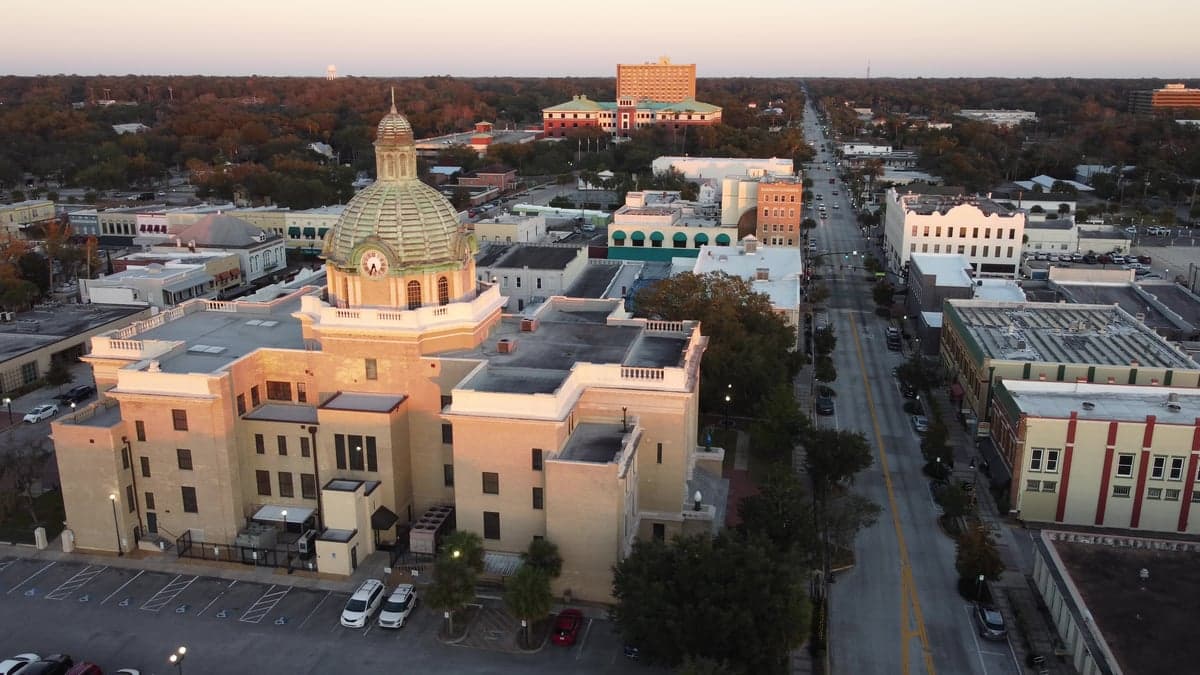
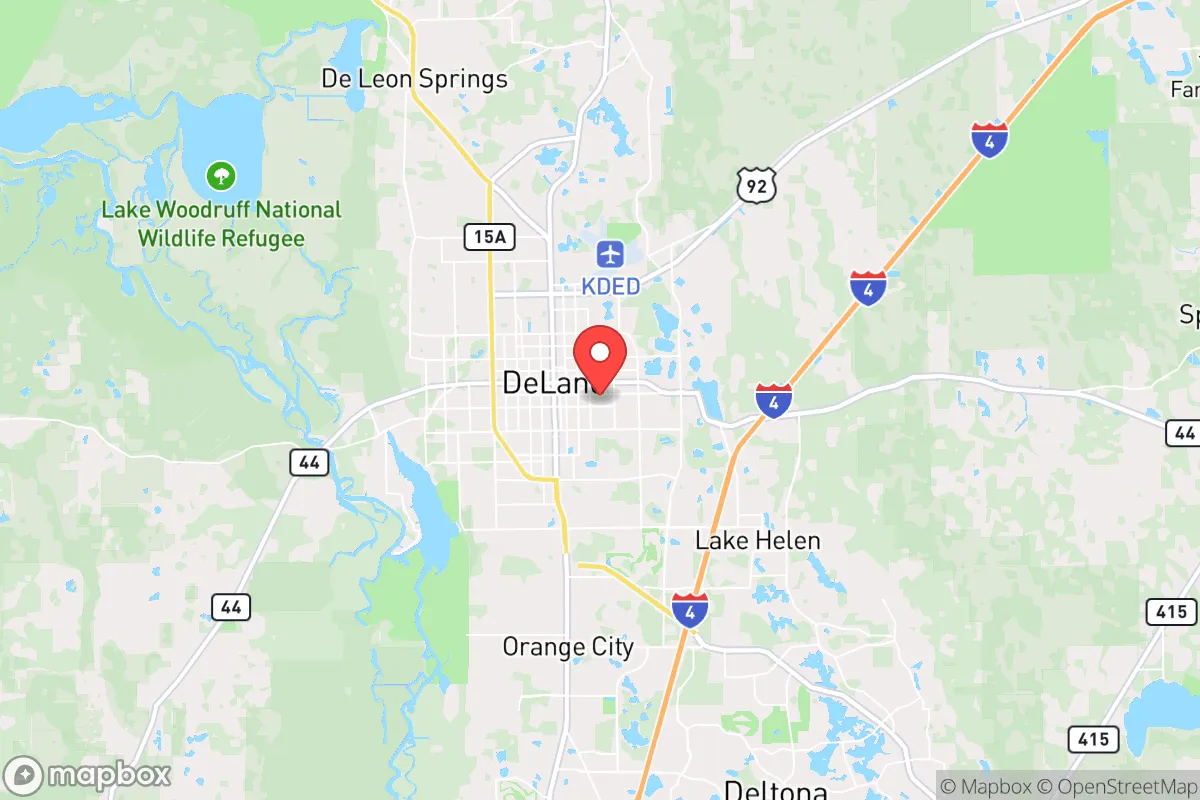
Photo: Wikipedia
Demographics of DeLand, FL
Affluence Level in DeLand, FL
A middle-class area roughly in line with national averages across income, home values, education, and employment.
People of DeLand, FL
DeLand, Florida, is a city of roughly 40,000 residents where a predominantly white population (61.9%) coexists with a substantial Hispanic community (21.5%) and a notable Black population (12.5%), creating a cultural landscape that is more diverse than many of its Volusia County neighbors. The city’s identity is shaped by its historic small-town character, anchored by Stetson University, and a population that is slightly more college-educated (33.4%) than the state average. With a very low foreign-born share of just 3.9%, DeLand’s demographic story is overwhelmingly one of domestic migration — Americans moving from other parts of Florida and the Northeast — rather than international immigration.
How the city was settled and grew
DeLand was founded in 1876 by Henry Addison DeLand, a baking soda magnate from New York who envisioned a temperate agricultural colony for Northerners. The original settlers were overwhelmingly white, middle-class families from upstate New York and New England, drawn by land grants and the promise of citrus farming. The city’s historic core — the Downtown DeLand Historic District, centered on Woodland Boulevard and Indiana Avenue — was built by these early Northern transplants, who erected the brick storefronts and Victorian homes that still define the area. A second wave arrived after the Great Freeze of 1894-95 destroyed the citrus crop, prompting a shift toward tourism and education. Stetson University, founded in 1883, became the city’s economic anchor, attracting faculty and students from across the South. The Stetson University area, a walkable neighborhood of early 20th-century bungalows and oak-lined streets, housed many of these academic families. By the 1920s, a small Black community had formed in the Spring Hill neighborhood, a historically African American area west of downtown, where descendants of railroad and agricultural workers built churches, schools, and a tight-knit community that persists today.
Modern era (post-1965)
The post-1965 period brought significant demographic change, driven not by the Hart-Cellar Act’s immigration reforms — DeLand’s foreign-born population remains minimal — but by domestic migration from the Northeast and Midwest. The 1970s and 1980s saw a wave of white retirees and working-class families from New York, New Jersey, and Ohio settling in subdivisions like Victoria Park, a master-planned community on the city’s southwest side that began development in the 2000s. This area attracted families seeking newer homes and good schools, reinforcing the city’s white, middle-class character. Meanwhile, the Hispanic population grew steadily from the 1990s onward, driven by Puerto Rican and Mexican families moving from Orlando and other parts of Florida for construction, service, and agricultural work. Many settled in the West DeLand area, west of U.S. 17, where older, more affordable housing stock and proximity to farm labor drew Latino families. The Black population, which had been concentrated in Spring Hill and the Midtown neighborhood near Clara Avenue, saw modest growth as some families moved into newer subdivisions, though the community remains largely in its historic core. The Asian population (1.0%) and Indian population (0.3%) are very small, with most families concentrated in the Victoria Park area, drawn by professional opportunities at Stetson University and regional healthcare employers.
The future
DeLand’s population is projected to grow moderately over the next decade, with the Hispanic share likely to increase as younger families move in from Orlando’s expanding suburbs. The white population, while still the majority, is aging in place, and the city is seeing a slow influx of younger, more diverse residents drawn by relatively affordable housing compared to coastal Volusia County. New development is concentrated in the southwest corridor near Victoria Park and along State Road 44, where large-scale subdivisions are attracting a mix of white and Hispanic families. The Black population is expected to remain stable, with little new in-migration from outside the region. The city’s cultural identity is evolving from a quiet, predominantly white college town into a more diverse, family-oriented suburb of the Orlando-Daytona Beach corridor. For someone moving in now, DeLand offers a lower-cost, slower-paced alternative to Orlando, with a growing Hispanic community adding new restaurants and cultural events, while the historic downtown and Stetson University preserve a distinctly traditional Florida feel.
DeLand is becoming a more diverse, family-oriented community that retains its small-town character while absorbing the demographic shifts of Central Florida. For a conservative-leaning family or individual, the city offers a stable, predominantly American-born population, a strong sense of local history, and a growing Hispanic presence that is integrated into the community rather than segregated. The next decade will likely see continued growth in the southwest subdivisions and a gradual diversification of the city’s schools and neighborhoods, but DeLand’s core identity — rooted in its university, its historic downtown, and its legacy as a Northern settlement in the South — will remain intact.

* Values derived from national, state, county, city and local statistics and may differ in a specific area. Last updated: 2026-09-17T20:24:07.000Z
Narrative content on this page is AI-generated and may contain mistakes. Verify any details that matter before acting on them.
ReloMaps may earn a commission from affiliate links at no extra cost to you.

