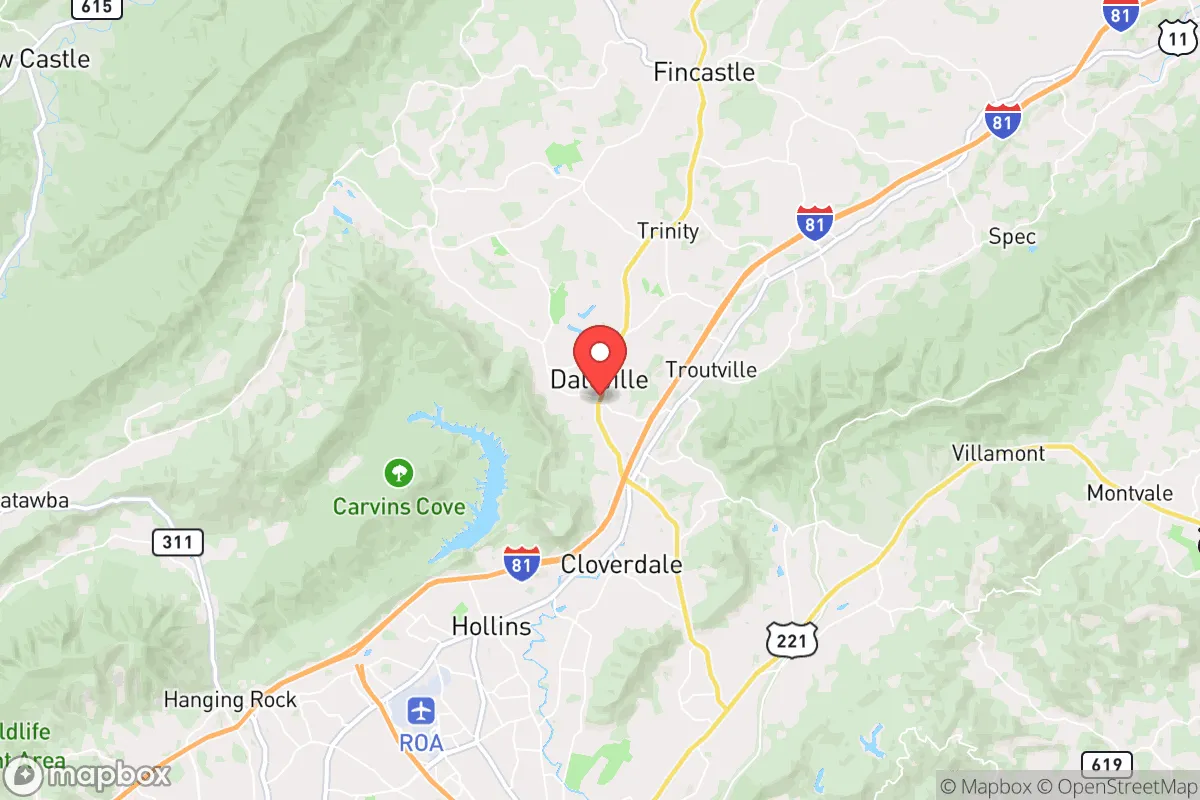

Political ClimatePolitical Climate in Daleville, VA
District shown is the primary district for this city’s centroid. Cities may span multiple districts.
Inherited from parent state — no local data available.
Local Political AnalysisPolitical Analysis of Daleville, VA
Daleville, Virginia, sits squarely in a deep red pocket of the state, with a Cook Partisan Voting Index (PVI) of R+12, meaning it votes about 12 points more Republican than the national average. That’s a stark contrast to the state of Virginia as a whole, which has shifted to a D+4 PVI, reflecting the Democratic lean of the fast-growing northern Virginia suburbs and the Richmond and Hampton Roads areas. If you’ve been around here for a while, you’ve seen this gap widen: Daleville’s politics have stayed reliably conservative, while the state’s overall tilt has moved left, especially after the 2020 and 2024 elections. The local vibe is still very much “small-town, live-and-let-live,” but the national and state-level trends are pulling in opposite directions.
How it compares
To understand Daleville’s political climate, you have to look at its neighbors. Roanoke, just 15 minutes north, is a blue island in a red sea—it voted for Joe Biden in 2020 and leans Democratic, though not as heavily as Northern Virginia. Botetourt County, where Daleville sits, is solidly Republican, and that’s been true for decades. Drive 30 minutes south to the city of Salem, and you’ll find a more moderate, swing-ish area that sometimes votes Republican and sometimes Democratic. But Daleville itself? It’s the kind of place where you’ll see more Trump signs than Harris signs in any given election year, and local offices—county supervisors, school board, sheriff—are almost always held by Republicans. The state’s D+4 PVI is driven by places like Loudoun County (D+16) and Fairfax County (D+18), which feel like a different country compared to here. In practice, that means Daleville’s state legislative districts are drawn to be competitive, but the local electorate is overwhelmingly conservative.
What this means for residents
For conservative residents, Daleville is a comfortable place to live politically. You’ll find your views reflected in local government, from zoning decisions to school policies. The county’s Republican lean means tax rates are generally lower than in blue parts of the state, and there’s less push for progressive social policies. For liberal residents, it can feel isolating. You’re unlikely to find a strong local Democratic Party presence, and social issues like gun rights or abortion access are debated from a conservative standpoint. That said, the area’s “live-and-let-live” culture means most folks don’t make a big deal out of political differences in day-to-day life—neighbors help each other regardless of party. The real tension comes from state-level policies: Daleville’s representatives in Richmond often vote against the majority, so residents here sometimes feel like their voice is drowned out by the urban crescent. That’s a long-term trend that’s unlikely to reverse, given population growth in Northern Virginia.
One cultural distinction worth noting: Daleville is part of the “Virginia is for Lovers” ethos, but it’s a more traditional, church-going version of that. You’ll find fewer craft breweries and art galleries than in Roanoke, and more hunting clubs and VFW posts. The local economy is anchored by healthcare (Carilion Clinic) and manufacturing (like the nearby GE plant in Salem), not tech or government contracting. That economic base reinforces the conservative lean, as does the area’s slower growth. Looking ahead, I’d expect Daleville to stay R+12 or even move a point or two redder as the state’s blue shift accelerates, but the local culture will remain stable—it’s a place where political change happens at a glacial pace, and that’s just how most folks here like it.

State Political ClimatePolitical Climate in Virginia
State Political AnalysisPolitical Environment in the State
Virginia has shifted from a reliably purple swing state to a solidly Democratic-leaning one over the past two decades, carrying a Cook Partisan Voting Index of D+4. The dominant coalition is a suburban and urban alliance centered on the Washington, D.C. exurbs, Richmond, and Hampton Roads, powered by rapid population growth in Northern Virginia and a steady influx of college-educated professionals. While the state voted for Democrats in every presidential election since 2008, the margins have tightened in recent cycles — Joe Biden won by 10 points in 2020, down from Hillary Clinton’s 5-point margin in 2016 — and Republicans have held the governor’s mansion as recently as 2021, when Glenn Youngkin won by 2 points. The trajectory is a slow but steady Democratic consolidation, but with enough rural and exurban pushback to keep statewide races competitive.
Urban vs. rural divide
The political map of Virginia is a textbook case of the urban-rural split. The entire Democratic margin comes from three metro areas: Northern Virginia (Fairfax, Loudoun, Prince William counties), Richmond (Henrico and the city itself), and Hampton Roads (Virginia Beach, Norfolk, Chesapeake). Fairfax County alone, with over 1.1 million residents, delivers a Democratic margin of roughly 200,000 votes — enough to offset the entire rest of the state’s rural Republican vote. Loudoun County, once a GOP stronghold, flipped to Democrats in the 2010s and now votes D+15 or better. Meanwhile, Southwest Virginia — places like Bristol, Galax, and Wytheville — votes 70-80% Republican, driven by coal country, manufacturing decline, and cultural conservatism. The Richmond suburbs (Chesterfield, Hanover) are the key battleground: Chesterfield voted for Youngkin in 2021 but has trended leftward, while Hanover remains deeply red. The Virginia Beach area is a microcosm of the state — the city itself leans Democratic, but the surrounding rural counties of the Eastern Shore and Southside are solidly Republican.
Policy environment
Virginia’s policy environment is a mixed bag that reflects its purple-to-blue trajectory. The state has a flat income tax rate of 5.75%, with no local income taxes, and a sales tax of 5.3% (higher in Northern Virginia and Hampton Roads due to local add-ons). Property taxes are set locally and vary widely — Loudoun County has rates around $1.20 per $100 of assessed value, while Bristol is under $0.80. The regulatory posture is moderate: Virginia is a right-to-work state, but it has no statewide zoning preemption, leaving land-use battles to localities. Education policy is a flashpoint: the state has a school choice program (the Education Improvement Scholarships Tax Credit) but no universal voucher system. Governor Youngkin’s 2022 executive order on “cellphone-free education” and his push for “parents’ rights” in curriculum have been partially implemented but face legal challenges. Healthcare is a Democratic stronghold: Virginia expanded Medicaid under the Affordable Care Act in 2019, and the state has some of the strongest abortion protections in the South, codified into law after the Dobbs decision. Election laws are moderately restrictive: Virginia has no-excuse absentee voting and early voting (45 days), but requires a photo ID and has no same-day registration. The state’s gun laws are among the tightest in the South: universal background checks, a red-flag law (enacted 2020), a one-handgun-per-month limit, and a ban on assault weapons for those under 21. There is no permitless carry.
Recent policy direction
The last five years have seen Virginia lurch leftward on social and civil liberties issues, then partially pull back under Youngkin. On gun rights, the 2020 Democratic trifecta passed the red-flag law and the one-handgun-per-month rule; Youngkin has not rolled these back but has signed a bill allowing concealed carry in churches. On parental rights and education, Youngkin’s 2022 executive order on “inherent parental rights” led to a model policy on transgender students that requires parental notification and restricts bathroom and pronoun use — but it’s been blocked in court. The state also passed a ban on critical race theory in K-12 classrooms (2022), though enforcement is spotty. On medical and bodily autonomy, Virginia has codified abortion access up to 26 weeks and allows late-term abortions for health reasons; there is no waiting period or mandatory counseling. On privacy and surveillance, the state passed a comprehensive data privacy law (the Virginia Consumer Data Protection Act) in 2021, giving residents the right to access, correct, and delete personal data held by companies. On voting and ballot access, the 2020 Democratic legislature expanded early voting and no-excuse absentee voting, but a 2023 law tightened voter ID requirements and limited drop boxes. On property rights, Virginia has no statewide rent control, but localities can impose short-term rental regulations. The overall direction is a slow, contested march toward a more regulated, socially liberal state, with Republican governors acting as a brake rather than a reversal.
Civil unrest & political movements
Virginia has been a national flashpoint for political movements. The 2017 Unite the Right rally in Charlottesville — which turned violent and left one counter-protester dead — remains the state’s most infamous political event, cementing Virginia as a symbol of the national far-right vs. anti-fascist conflict. Since then, the state has seen organized Moms for Liberty chapters in Loudoun and Chesterfield counties, pushing for book bans and parental oversight in schools. On the left, Indivisible and Swing Left groups are active in Northern Virginia and Richmond, organizing canvassing and protest actions. Immigration politics are a live wire: Northern Virginia has sanctuary policies (Fairfax County limits cooperation with ICE), while rural counties like Augusta and Rockingham have passed resolutions opposing them. Election integrity controversies flared after 2020, with Republican activists challenging absentee ballots in Fairfax and Loudoun, but no widespread fraud was found. The 2021 gubernatorial race saw Youngkin win by focusing on education and parental rights, a template that national Republicans have since adopted. A new resident in Northern Virginia will see yard signs for both parties, but in rural areas, the political landscape is overwhelmingly red, with Confederate monuments and “Don’t Tread on Me” flags common.
Projection
Over the next 5-10 years, Virginia will likely continue its slow drift leftward, driven by demographic trends. Northern Virginia is adding 50,000-60,000 new residents annually, mostly from out of state, and they lean Democratic. The Richmond suburbs are trending blue as young professionals move in, while Hampton Roads is aging and slowly becoming more competitive. The rural vote will shrink as a share of the electorate, but it will remain deeply Republican. The key wildcard is the exurban swing: places like Stafford and Spotsylvania counties, which voted for Trump in 2020 but Youngkin in 2021, could determine whether Virginia becomes a safe blue state or remains a purple one. Expect continued fights over education, gun laws, and abortion, with the state legislature likely to flip back to Democratic control in 2025 or 2027. A new resident moving in now should expect a state where the political climate is increasingly shaped by the D.C. suburbs, but where rural and exurban resistance will keep the culture wars alive for at least another decade.
For a new resident, the bottom line is this: Virginia offers a moderate-to-liberal policy environment on most issues, with a tax burden that’s middle-of-the-pack nationally. If you’re a conservative, you’ll find your people in the rural counties and exurbs, but you’ll be fighting uphill on state-level policy. If you’re a liberal, you’ll feel at home in the cities and inner suburbs, but you’ll encounter sharp cultural divides outside them. The state is not a safe haven for either side — it’s a battleground where the outcome of every election matters, and where your daily life will be shaped by which county you choose to live in.
* Values derived from national, state, county, city and local statistics and may differ in a specific area. Last updated: 2026-10-06T21:24:16.000Z
Narrative content on this page is AI-generated and may contain mistakes. Verify any details that matter before acting on them.
ReloMaps may earn a commission from affiliate links at no extra cost to you.

