
Photo: Wikipedia
Political ClimatePolitical Climate in Crystal Springs, MS
District shown is the primary district for this city’s centroid. Cities may span multiple districts.
Local Political AnalysisPolitical Analysis of Crystal Springs, MS
Crystal Springs is a genuine political outlier in Mississippi, carrying a Cook PVI of D+11 while the state as a whole sits at R+11 — a 22-point gap that makes this small Copiah County town one of the most reliably Democratic communities in the Deep South. That lean isn't new, but it's become more pronounced as the surrounding rural areas have shifted hard right over the last decade. If you're looking at a map of Mississippi's political geography, Crystal Springs stands out like a blue dot in a sea of red, and locals will tell you it's been that way for as long as anyone can remember.
How it compares
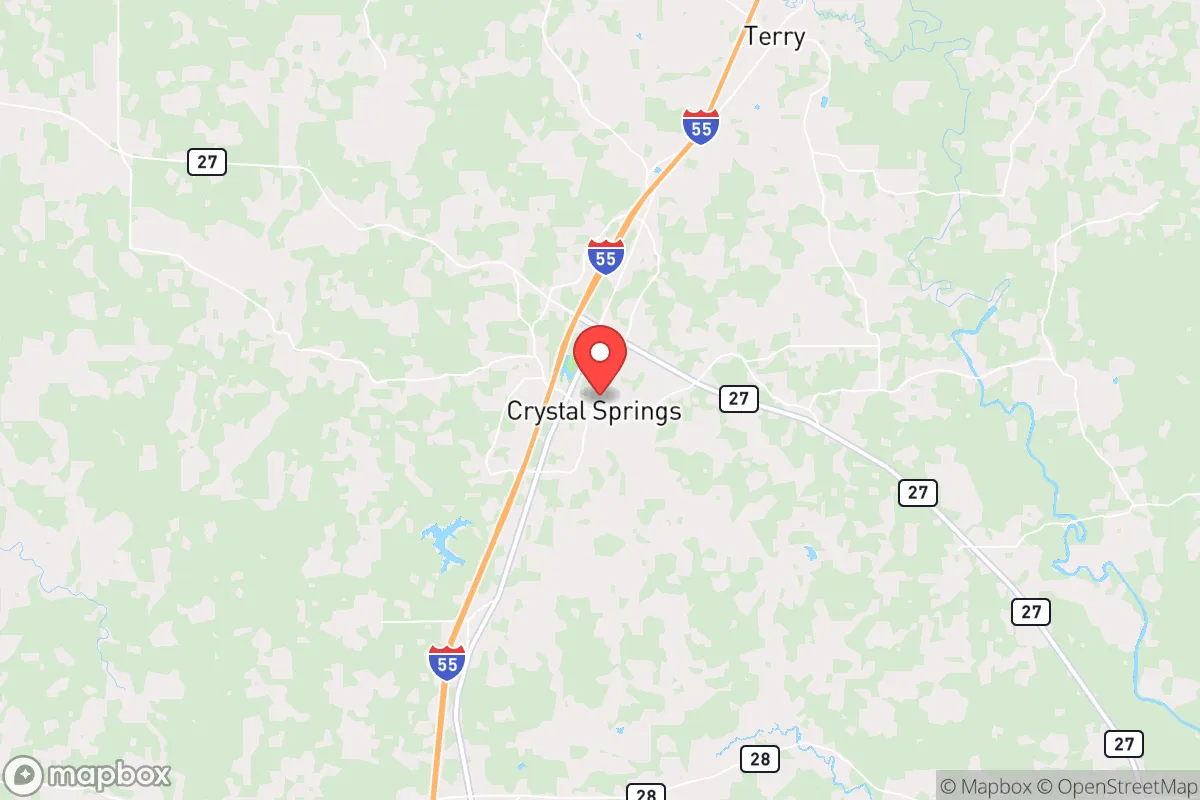
The contrast between Crystal Springs and its neighbors is stark. Just a few miles up Interstate 55, the city of Jackson shares a similar Democratic tilt, but the suburbs in between — places like Terry and Byram in Hinds County — have swung Republican in recent cycles. Head south toward Hazlehurst or west toward Utica, and you're in solidly conservative territory where Republican margins routinely top 30 points. The D+11 rating for Crystal Springs isn't just a statistical quirk; it reflects a historically Black majority population and a working-class base that has stayed loyal to Democratic candidates even as white voters across the state consolidated behind the GOP. In the 2023 gubernatorial race, for example, Crystal Springs precincts went heavily for Democrat Brandon Presley, while surrounding Copiah County precincts outside the city limits broke just as heavily for Republican Tate Reeves.
What this means for residents
For conservative residents, living in Crystal Springs means accepting that your vote is likely to be in the minority in local elections, though it doesn't make you powerless. The city council and mayor's office have been controlled by Democrats for decades, and policy priorities tend to reflect that — think public works spending, community development grants, and a focus on affordable housing. Republicans here often find themselves voting in state and federal races where their candidates win easily, then coming home to a local government that leans the other way. For liberal residents, the dynamic is reversed: you're in the majority locally, but you're living in a state where the legislature, governor's office, and both U.S. Senate seats are firmly Republican. That means local elections feel consequential and winnable, but statewide issues like Medicaid expansion, abortion access, and education funding are largely decided in Jackson by lawmakers who don't represent your political views.
What daily life is like for families
In practice, the political divide in Crystal Springs doesn't dominate daily life the way you might expect. People here know each other — it's a town of roughly 5,000 — and church, family, and high school football tend to matter more than party registration. The city's Democratic leadership has focused on bread-and-butter issues like water infrastructure and street repairs rather than ideological battles, which keeps things civil. That said, the political reality does shape what's available. Federal funding for community programs flows more easily through the city's Democratic connections, and there's a visible presence of civic organizations tied to the Black church community that anchor local activism. Conservative residents often participate through the county GOP or business groups, and they'll tell you that while they lose most local races, their voices are still heard on zoning, taxes, and public safety.
Looking ahead, Crystal Springs' political character seems stable, but not immune to change. The city's Democratic base is aging, and younger residents — both Black and white — are less tied to party labels than their parents were. If the national trend of younger voters drifting away from both parties continues, the D+11 rating could soften over the next decade. But for now, Crystal Springs remains what it's always been: a place where the politics are unmistakably Democratic, the culture is unmistakably Southern, and the two manage to coexist without much fuss.

State Political ClimatePolitical Climate in Mississippi
State Political AnalysisPolitical Environment in the State
Mississippi is one of the most reliably Republican states in the country, carrying a Cook PVI of R+11, meaning it votes about 11 points more Republican than the nation as a whole. The GOP has dominated every statewide office and both chambers of the legislature for over a decade, with the last Democrat to win a statewide race being Attorney General Jim Hood in 2011. The shift has been a long, steady arc — Mississippi was a reliably Democratic "Solid South" state through the 1990s, but the 2004 and 2008 presidential cycles cemented the realignment, and the state hasn't backed a Democrat for president since Jimmy Carter in 1976.
Urban vs. rural divide
The political map of Mississippi is a textbook case of the urban-rural split, but with a twist: even the state's largest cities are not as uniformly liberal as their counterparts elsewhere. The Jackson metro area, anchored by Hinds County, is the only reliably Democratic stronghold — Hinds County went for Joe Biden by roughly 40 points in 2020, driven by a majority-Black electorate and the state's concentration of government workers and educators. The Gulf Coast, particularly Harrison County (Biloxi and Gulfport), is a genuine swing area, leaning Republican but with a strong blue-collar Democratic streak that shows up in local races. The DeSoto County suburbs of Memphis, just south of the Tennessee line, are the fastest-growing and most staunchly Republican part of the state, with a heavy influx of Tennessee transplants and commuters. Meanwhile, the Delta region — places like Greenville and Clarksdale — remains deeply Democratic and majority-Black, but its population has been shrinking for decades, diluting its electoral weight. The rural white counties of the northeast and central hills, like Tishomingo and Rankin, are now Republican by margins of 60 to 70 points, a complete inversion from the 1990s when they elected conservative Democrats to the legislature.
Policy environment
Mississippi's policy environment is built around a low-tax, low-regulation model that has been in place since the 1990s. The state has no personal income tax on the first $10,000 of income, and the legislature is in the middle of a phased elimination of the income tax entirely, with a target of full repeal by 2026. The sales tax is a flat 7%, among the highest in the nation, which makes the tax burden regressive — lower-income residents pay a larger share of their income than wealthier ones. Property taxes are exceptionally low, with no state-level property tax and local millage rates that are a fraction of what you'd see in the Northeast or Midwest. The regulatory posture is business-friendly to the point of being permissive: Mississippi is a "right-to-work" state, has no state-level minimum wage (it defaults to the federal $7.25), and has some of the weakest environmental and land-use regulations in the country. Education policy is a mixed bag — the state has charter school laws but no voucher program, and per-pupil spending ranks near the bottom nationally. Healthcare is where the state stands out: Mississippi is one of the few states that has not expanded Medicaid under the Affordable Care Act, leaving roughly 100,000 residents in the "coverage gap," and it has some of the most restrictive abortion laws in the nation, with a near-total ban in effect since the Dobbs decision in 2022.
Recent policy direction
The last five years have pushed Mississippi decisively toward a conservative-libertarian posture on several fronts. On gun law, the state passed permitless carry in 2016 and has since added "stand your ground" protections and preemption laws that block local governments from enacting their own firearm restrictions. On education, the 2024 legislative session passed the "Mississippi Parental Rights Act," which requires schools to notify parents of any curriculum changes involving sexuality or gender identity and allows parents to opt their children out of such instruction. On speech and privacy, the state has enacted a law prohibiting social media platforms from deplatforming users based on political views, though it's currently tied up in court. On medical and bodily autonomy, Mississippi has banned abortion at all stages except to save the mother's life, and it has passed a law prohibiting gender-affirming care for minors. On property rights, the state has a strong "right to farm" law that shields agricultural operations from nuisance lawsuits, and it has no statewide zoning authority, leaving land-use decisions almost entirely to county supervisors. On voting, Mississippi requires a government-issued photo ID to vote, has no early voting (only in-person absentee with an excuse), and recently passed a law requiring mail-in ballots to be received by election day rather than postmarked by it — a change that voting rights groups have challenged in court.
Civil unrest & political movements
Mississippi's political movements are quieter than its history might suggest, but they're active. The most visible flashpoint in recent years has been the state flag — in 2020, amid nationwide protests after George Floyd's murder, the legislature voted to remove the Confederate battle emblem from the flag, a move that was unthinkable just a decade earlier. That decision sparked a small but vocal backlash, with some counties passing non-binding resolutions to fly the old flag, though the new state flag with the magnolia blossom has been widely adopted. The immigration debate is largely symbolic here — Mississippi has a tiny foreign-born population (about 2.5%), but the legislature has passed laws requiring local law enforcement to cooperate with federal immigration authorities and banning "sanctuary city" policies. Election integrity has been a recurring theme: the state's voter ID law and the recent mail-in ballot changes have drawn lawsuits from the NAACP and the ACLU, but there have been no widespread allegations of fraud or irregularities in recent cycles. The most organized activist movements are on the right — the Mississippi Republican Party has a strong grassroots base in the "TEA Party" tradition, and groups like the Mississippi Family Council have successfully lobbied for the parental rights and abortion restrictions. On the left, the Mississippi Poor People's Campaign, based in Jackson, has been active on Medicaid expansion and voting rights, but it operates with far less funding and visibility than its conservative counterparts.
Projection
Over the next five to ten years, Mississippi's political trajectory is likely to stay on the same course, with some interesting wrinkles. The population is aging and slowly shrinking overall, but the growth areas — DeSoto County, the Gulf Coast, and the Jackson suburbs like Madison and Rankin counties — are all trending more Republican. The Black population, which makes up about 38% of the state, remains overwhelmingly Democratic, but its share of the electorate is stable, not growing. The income tax repeal, if fully implemented, will make the state even more attractive to retirees and remote workers, which could accelerate in-migration from higher-tax states like California and Illinois — a trend that would likely reinforce the Republican lean. The wildcard is the Delta: as the population continues to decline, the Democratic base shrinks with it, which could push the state's PVI even further to the right. A new resident moving in now should expect a state that is firmly Republican, with a policy environment that prioritizes low taxes, gun rights, and parental control over education, and a political culture that is increasingly shaped by the suburbs rather than the rural counties that once dominated the legislature.
For a new resident, the bottom line is this: if you're conservative, you'll find a state where your values are reflected in law and where the political culture is welcoming. If you're liberal, you'll be in a clear minority, but you won't be isolated — Jackson, the Gulf Coast, and the college towns of Oxford and Starkville all have active Democratic communities, and the state's low cost of living and natural beauty are genuinely bipartisan. The practical takeaways are simple: expect low taxes, minimal regulation, and a government that is generally hands-off on personal conduct except in the areas of abortion and gender-affirming care, where the state has taken a firm and restrictive stance. The politics here are not subtle, but they are predictable — and for many relocators, that predictability is exactly the point.
* Values derived from national, state, county, city and local statistics and may differ in a specific area. Last updated: 2026-10-28T16:17:04.000Z
Narrative content on this page is AI-generated and may contain mistakes. Verify any details that matter before acting on them.
ReloMaps may earn a commission from affiliate links at no extra cost to you.

