
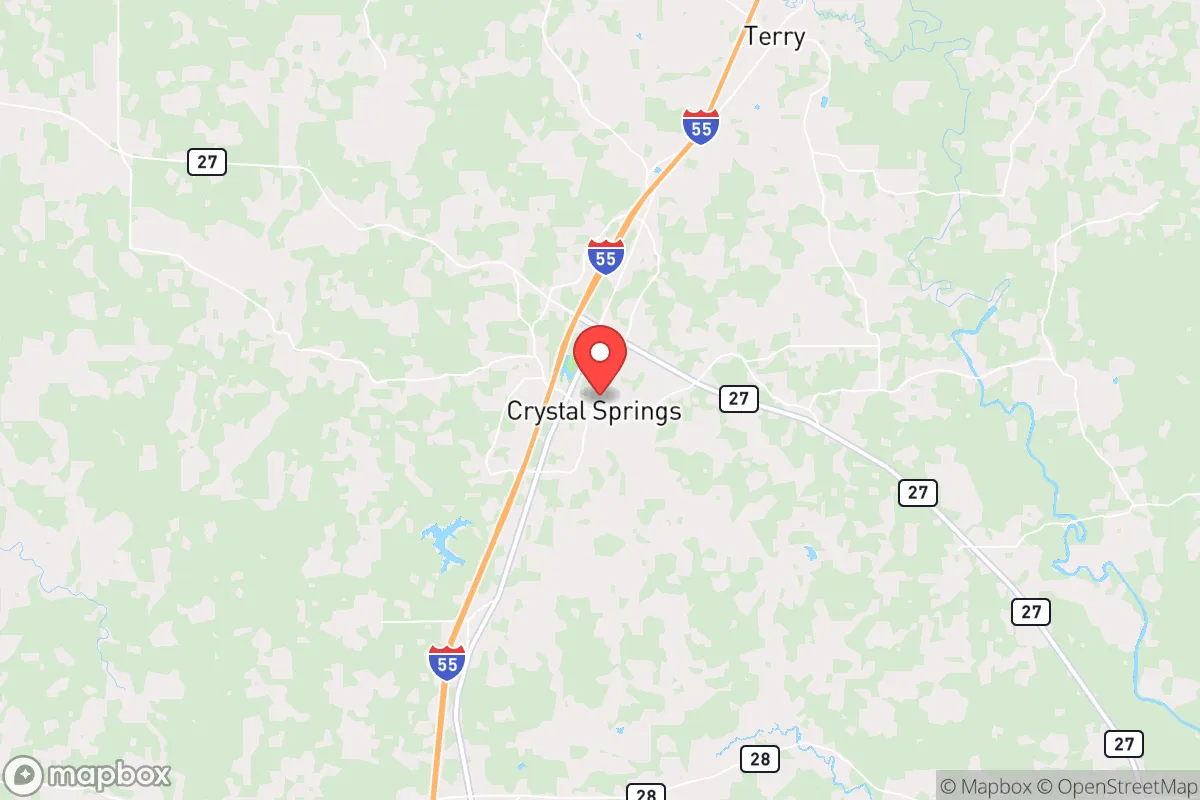
Photo: Wikipedia
Personal Sovereignty in Crystal Springs, MS
Viable for self-reliance. Generally workable, though some barriers may limit total independence.
What does Personal Sovereignty tell us?
Personal Sovereignty measures your capacity for self-reliance and independence with minimal government friction. Higher scores mean fewer barriers between you and the way you want to live... but it assumes you have the space you need and good neighbors.
What does this tell us?
Personal Sovereignty measures your capacity for self-reliance and independence with minimal government friction. Higher scores mean fewer barriers between you and the way you want to live... but it assumes you have the space you need and good neighbors.
State Policy
Energy independence: Importer (50% of energy produced in-state)
Personal Liberty
Homesteading

Personal Liberty Analysis
Crystal Springs, Mississippi, offers one of the most genuinely hands-off personal sovereignty environments in the Southeast, largely because state law preempts most local regulatory overreach. For a resident prioritizing independence, the operative reality is that Mississippi’s constitutional and statutory framework—from firearm carry to property use—leans heavily toward individual discretion rather than municipal control. The town itself, a small Copiah County hub of roughly 5,000 people, operates with a light administrative footprint, meaning fewer layers of bureaucracy between a citizen and their decisions.
Tax burden and regulatory posture: how much the state and local government take and restrict
Mississippi’s tax structure is among the most favorable in the nation for those who want to keep more of what they earn. The state personal income tax is a flat 4.7% on taxable income above $10,000, and the legislature has been actively phasing it out entirely, with a target of full elimination by 2026. That trajectory matters for long-term planning—a single filer or family relocating now will see their income tax liability shrink annually. Property taxes in Copiah County are strikingly low, with the average effective rate hovering around 0.72% of home value, roughly half the national average. A $200,000 home in Crystal Springs carries an annual tax bill near $1,440, a figure that would be considered impossibly low in most of the country.
Sales tax is the primary revenue workhorse, sitting at 7% in Crystal Springs (the 7% state rate with no additional local levy), which is a consumption-based approach that rewards saving and investing over spending. The regulatory posture at the state level is consistently ranked among the top ten most business-friendly in the nation by organizations like the Tax Foundation, and that ethos filters down to daily life. There is no state-level occupational licensing for a wide range of trades that require credentials elsewhere, no state income tax withholding complexity for small employers, and a right-to-work law that keeps union influence minimal. For a homeowner, the absence of county-level building codes outside municipal limits is a significant autonomy factor—Copiah County does not enforce the International Residential Code on unincorporated land, meaning a person building outside Crystal Springs city limits can construct a dwelling to their own standard without county inspection.
Self-defense and gun law specifics: what the law allows without a permit
Mississippi is a constitutional carry state, and Crystal Springs residents enjoy the full extent of that liberty. Since 2016, any person 18 or older who is not otherwise prohibited from possessing a firearm may carry a loaded handgun openly or concealed without a permit, both inside the city and throughout Copiah County. There is no duty to inform a law enforcement officer that you are carrying during a traffic stop unless directly asked, and no training requirement for lawful carry. The state also recognizes the "stand your ground" doctrine, removing any duty to retreat before using deadly force in any place where a person has a legal right to be, provided they are not engaged in criminal activity.
For those who want reciprocity when traveling, Mississippi issues an enhanced carry permit that is recognized in over 35 other states, but it is entirely optional for in-state use. The legal framework also protects self-defense in the home with a strong castle doctrine presumption—if an intruder unlawfully enters your dwelling, the law presumes you had a reasonable fear of imminent death or great bodily harm. Crystal Springs has a modest police department, and Copiah County Sheriff's Office response times in rural parts of the county can stretch to 15–20 minutes, which makes the permissive carry laws less a matter of political preference and more a practical necessity for personal security.
Self-reliance and homesteading viability: lot sizes, zoning, and off-grid feasibility
For the homesteader or off-grid aspirant, Crystal Springs presents a genuinely viable environment, provided you locate outside the city's zoning jurisdiction. Inside city limits, the zoning code is conventional—residential lots typically range from a quarter-acre to half-acre, and the city does enforce basic property maintenance standards. The real autonomy lies in the unincorporated areas of Copiah County surrounding the town, where there is no county-wide zoning ordinance at all. A person can purchase a 5- to 20-acre parcel along Highway 51 or deeper into the rural sections toward Hazlehurst and Georgetown, and the county will not dictate what you do with it.
Off-grid feasibility is high. Mississippi has no state law prohibiting rainwater collection, and in fact, the state encourages it through a sales tax exemption on rainwater harvesting equipment. Solar panel installation is unrestricted at the county level, and net metering is available through Entergy Mississippi, the dominant utility, allowing surplus generation to offset grid consumption. The state's homestead exemption reduces property taxes on your primary residence's first $75,000 of assessed value, which for a modest rural home can cut the effective tax rate by nearly half. Septic systems require a county health department permit, but the standards are straightforward—a percolation test and basic design approval—and there is no requirement to connect to municipal water or sewer outside city limits. Well drilling is permitted with a simple water well permit from the Mississippi Department of Environmental Quality, typically issued within days.
Personal liberties: parental rights, medical autonomy, speech, and property
Mississippi is one of the most protective states in the country for parental rights. The Parental Bill of Rights, codified in state law, gives parents explicit authority over their children's education, healthcare, and moral upbringing, and it requires schools to obtain parental consent before administering any medical or mental health services. The state has also enacted a Parents' Bill of Rights that prohibits school districts from withholding information about a child's well-being from parents, and it mandates that curriculum materials be available for parental review. In practice, this means a Crystal Springs family has substantial leverage over what their children are taught and what medical treatments they receive.
Medical autonomy is similarly strong. Mississippi does not mandate COVID-19 vaccination for any population, and state law prohibits employers from requiring vaccination as a condition of employment without providing broad exemption options. The state also has a conscience clause protecting healthcare workers who decline to participate in procedures they object to. On speech, Mississippi is a low-restriction environment—there is no state-level hate speech law that criminalizes expression, and the state has enacted a law prohibiting social media platforms from deplatforming users based on political viewpoint, though its enforcement remains contested. Property rights are reinforced by the Mississippi Tort Claims Act, which limits liability for landowners who allow recreational use of their land, and by the state's strong adverse possession and boundary laws that favor the landowner in disputes.
Relative to other regions, Crystal Springs and Copiah County rank in the top tier of American personal sovereignty. The combination of no county zoning, constitutional carry, a flat and declining income tax, low property taxes, and explicit statutory protection for parental and medical autonomy creates a legal environment where the default answer to most questions is "yes, you may." The trade-offs are real—rural infrastructure, limited healthcare options, and a slower pace of life—but for a reader whose priority is maximizing individual discretion over their family, property, and self-defense, this area delivers a level of independence that is increasingly difficult to find elsewhere in the continental United States.

* Values derived from national, state, county, city and local statistics and may differ in a specific area. Last updated: 2026-10-28T16:17:04.000Z
Narrative content on this page is AI-generated and may contain mistakes. Verify any details that matter before acting on them.
ReloMaps may earn a commission from affiliate links at no extra cost to you.

