
Photo: Wikipedia
Political ClimatePolitical Climate in Cottage Grove, OR
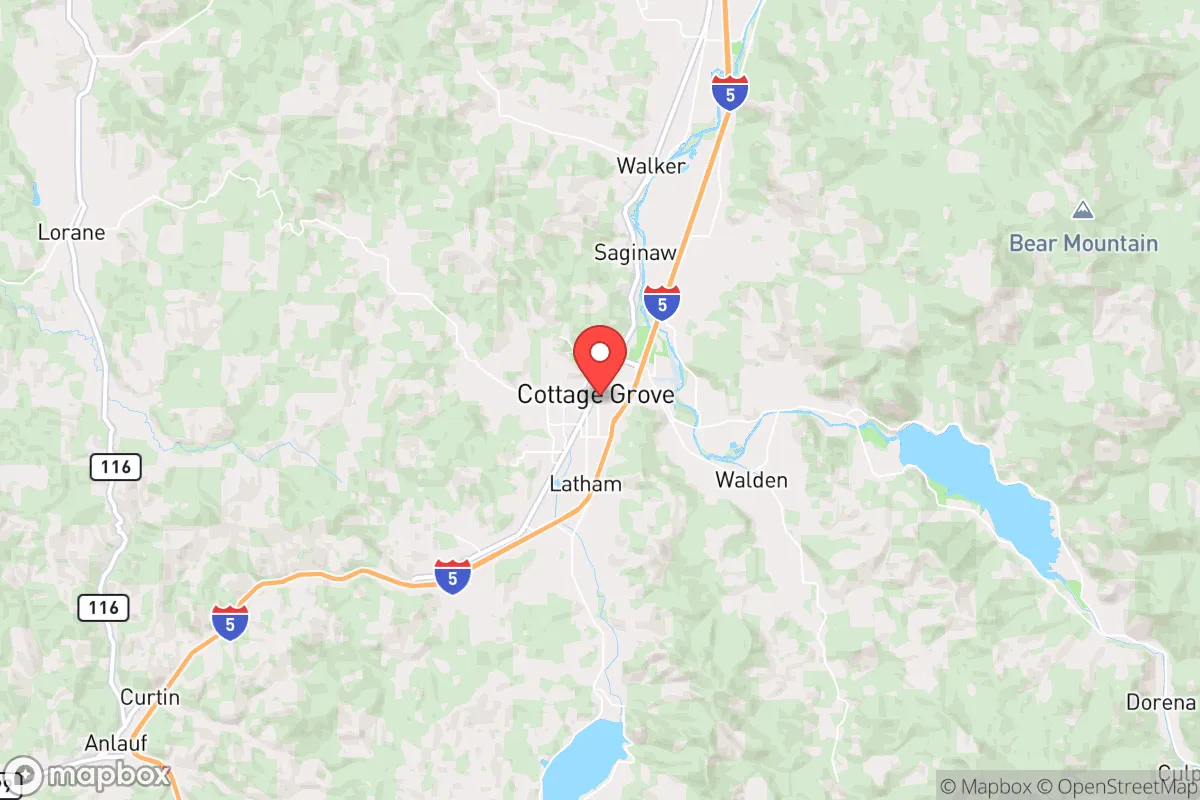
District shown is the primary district for this city’s centroid. Cities may span multiple districts.
Local Political AnalysisPolitical Analysis of Cottage Grove, OR
Cottage Grove, Oregon, leans Democratic, but it’s a more moderate shade of blue than the state as a whole. The Cook Partisan Voting Index (PVI) for the area is D+6, meaning it votes about six points more Democratic than the national average. That’s a couple notches to the right of Oregon’s overall D+8 rating, which reflects the deep-blue strongholds of Portland and the Willamette Valley. In practice, this means Cottage Grove is a place where Democrats hold a clear edge, but Republicans can still win local races and feel heard—especially in the more rural pockets outside the city limits.
How it compares
Compared to Oregon’s statewide average, Cottage Grove is slightly more conservative, but the gap is narrowing. The city sits in Lane County, which is reliably Democratic thanks to Eugene’s influence, but Cottage Grove itself has a stronger independent and Republican streak than its neighbors to the north. Drive 20 minutes west to Creswell, and you’ll find a similar mix; head 30 minutes north to Eugene, and the political temperature shifts sharply left. The surrounding rural areas—like the unincorporated communities along Row River Road—tend to vote more Republican, creating a patchwork where a single precinct can swing from +10 D to +15 R. This local contrast means Cottage Grove isn’t a monolith; it’s a bellwether for the broader tension between Oregon’s urban and rural divides.
What this means for residents
For liberal residents, Cottage Grove offers a comfortable baseline: local elections often favor Democrats, and progressive policies on housing and environmental issues get traction. The city council and school board lean left, but not aggressively so—there’s room for pragmatic compromise. Conservative residents, meanwhile, aren’t marginalized. They hold sway in county-level races and on issues like property rights and logging regulations, which remain hot topics. The real friction comes on state-level ballot measures: Cottage Grove voted for Measure 110 (drug decriminalization) by a slimmer margin than the state, and it’s split on gun control initiatives. In daily life, this means neighbors might disagree on a yard sign but still share a beer at the Axe & Fiddle pub. The political climate here is less about shouting matches and more about navigating a middle ground—though that’s getting harder as national polarization seeps in.
Culturally, Cottage Grove stands apart from Oregon’s coastal or Portland-centric identity. The city’s history as a timber and railroad hub gives it a blue-collar, self-reliant vibe that doesn’t always align with the state’s eco-conscious branding. You’ll see more pickup trucks with “Don’t Tread on Me” stickers than in Eugene, but also more “Coexist” bumper stickers than in the rural south. Policy-wise, this translates to a cautious approach to growth: the city has resisted some state-mandated density targets, preferring to keep its small-town character. For newcomers, the takeaway is simple: Cottage Grove is a place where you can find your political tribe without being drowned out by the other side—at least for now. As Oregon’s population shifts and housing pressures mount, that balance may tip, but for the moment, it’s a livable middle ground.

State Political ClimatePolitical Climate in Oregon
State Political AnalysisPolitical Environment in the State
Oregon is a reliably Democratic state with a Cook PVI of D+8, but that single number hides a deeply fractured political landscape. The state has shifted leftward over the past 20 years, driven by explosive growth in the Portland metro area and the Willamette Valley, while rural and eastern counties have become more intensely Republican. For a conservative-leaning relocator, the reality is that you’ll find strong ideological allies in many towns, but state-level policy will often feel like it’s coming from a different planet.
Urban vs. rural divide
The political map of Oregon is essentially a battle between the wet, populous west and the dry, sparse east. Multnomah County (Portland) alone casts about 20% of the state’s vote and delivers a Democratic margin of roughly 70 points. Neighboring Washington County (suburban Portland, home to Nike and Intel) and Lane County (Eugene) are also solidly blue. The I-5 corridor from Portland through Salem to Eugene is the Democratic engine room. In contrast, the rest of the state is overwhelmingly red. Eastern Oregon counties like Malheur, Harney, and Lake routinely vote 70-80% Republican. Even within the Willamette Valley, there are pockets of conservatism: Clackamas County, once a swing county, has trended left but still has Republican strongholds in Oregon City and Canby. The real flashpoint is the growing exurban ring around Portland—places like Beavercreek, Estacada, and Sandy—where conservative families have moved to escape city politics, creating a distinct “don’t Portland my Oregon” sentiment. The 2020 election saw Deschutes County (Bend) flip from red to blue, a sign that even the high desert is being reshaped by California transplants and remote workers.
Policy environment
Oregon’s state-level policy is a mixed bag for conservatives. The good: no state sales tax, which is a major draw for families and retirees. Property taxes are moderate, though they vary by county. The bad: income taxes are among the highest in the nation, with a top marginal rate of 9.9% on income over $125,000 (single filers). The regulatory environment is heavily tilted toward environmental and land-use controls. Oregon’s statewide land-use planning system, unique in the nation, strictly limits urban growth boundaries, which keeps housing supply tight and prices high in desirable areas. Education policy is a sore point: Oregon ranks near the bottom nationally in high school graduation rates and 4th-grade reading scores, despite above-average per-pupil spending. School choice is limited, with no statewide voucher program and only a handful of charter schools. Election laws are among the most accessible in the country: Oregon was the first state to conduct all elections by mail (1998), and it has automatic voter registration, same-day registration, and no voter ID requirement. For a conservative, this feels like a system that prioritizes turnout over security.
Recent policy direction
The last five years have seen a sharp leftward lurch on several fronts. Measure 110 (2020) decriminalized possession of small amounts of all drugs, including heroin and methamphetamine, and redirected cannabis tax revenue to addiction services. The policy was widely seen as a failure, with overdose deaths spiking, and in 2024 the legislature partially recriminalized drug possession. Gun laws have tightened significantly: Measure 114 (2022), passed by voters, requires a permit to purchase a firearm and bans magazines over 10 rounds, though it’s currently blocked by court challenges. Parental rights took a hit with the 2023 law allowing schools to withhold information about a student’s gender identity from parents if the student requests it. On the other hand, Oregon has some of the strongest property rights protections in the West through its land-use system, which prevents large-scale development but also protects rural landowners from spot zoning. Medical and bodily autonomy is broadly protected: Oregon has no gestational limits on abortion, and it was the first state to legalize physician-assisted suicide (1994). Privacy and surveillance laws are relatively strong, with a 2023 law limiting police use of facial recognition and requiring warrants for cell phone location data. For a conservative, the net direction is clear: the state is becoming more restrictive on guns and parental rights, more permissive on drugs and social issues, and more expensive to live in.
Civil unrest & political movements
Oregon has a long history of political activism, from the 1934 West Coast waterfront strike to the 2020 Portland protests. The 2020 George Floyd protests in Portland were among the most sustained and violent in the country, with 100 consecutive nights of demonstrations, federal intervention, and widespread property damage. The city’s “autonomous zone” in the Portland State University area lasted about a month. This created a lasting backlash: the “Take Back Portland” movement and the 2022 recall of Multnomah County District Attorney Mike Schmidt (who was seen as soft on crime) were direct results. On the right, the Oregon Republican Party has become increasingly militant, with walkouts in the state legislature to block Democratic bills (a tactic used 10 times since 2019). Immigration politics are a flashpoint in rural areas, where the state’s 1987 sanctuary law (one of the first in the nation) is deeply unpopular. Election integrity controversies have flared in counties like Clackamas and Deschutes, where local GOP officials have questioned mail-in ballot security, though no widespread fraud has been found. A new resident in a rural town like Grants Pass or Roseburg will see “Don’t California My Oregon” bumper stickers and hear talk of joining Idaho (the “Greater Idaho” movement, which has gotten county-level ballot measures passed in several eastern Oregon counties).
Projection
Over the next 5-10 years, Oregon’s political trajectory is likely to be one of continued polarization, with the Portland metro area pulling the state left while rural areas become more entrenched in opposition. Demographic trends favor Democrats: the state’s population growth is concentrated in the Portland suburbs and Bend, both of which are trending blue. In-migration from California, while slowing, still brings more liberal voters than conservative ones. However, the housing crisis is a wild card: if young families and middle-class voters continue to be priced out of the Willamette Valley, they may move to redder states, accelerating the urban-rural divide. The “Greater Idaho” movement is unlikely to succeed (it would require approval from both state legislatures and Congress), but it will remain a symbolic protest. Expect more ballot measures on gun rights, parental rights, and tax reform as conservatives try to bypass the Democratic legislature. The practical outcome for a new resident: if you move to a blue city, you’ll see continued progressive governance; if you move to a red town, you’ll live in a state that feels increasingly hostile to your values, but your local community will be a stronghold.
Bottom line for a conservative relocator: Oregon offers beautiful landscapes, no sales tax, and strong property rights, but you’ll be living under a state government that is actively moving in a direction you likely oppose. If you’re willing to accept that trade-off—and you choose a county like Clackamas, Deschutes (outside Bend), or Douglas—you can find a good life with like-minded neighbors. Just don’t expect state policy to change anytime soon, and be prepared for a constant political fight at the ballot box.
* Values derived from national, state, county, city and local statistics and may differ in a specific area. Last updated: 2026-10-10T16:27:13.000Z
Narrative content on this page is AI-generated and may contain mistakes. Verify any details that matter before acting on them.
ReloMaps may earn a commission from affiliate links at no extra cost to you.

