
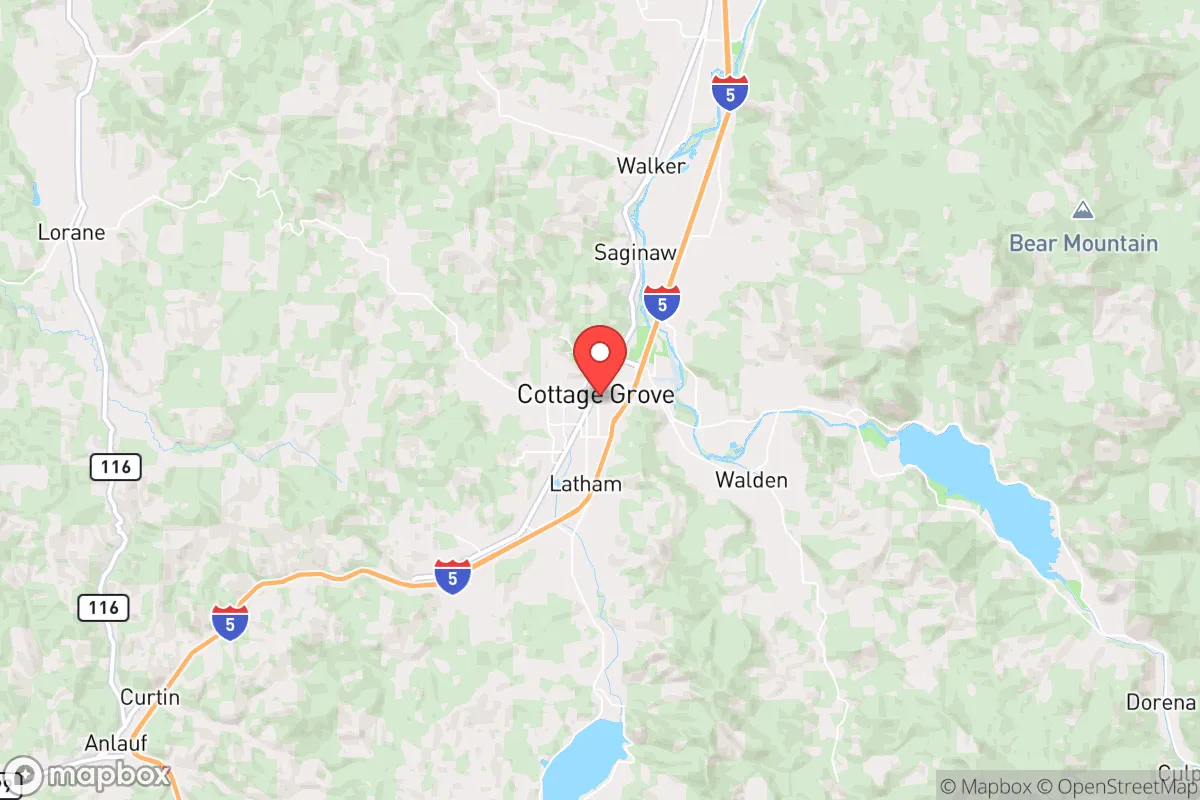
Photo: Wikipedia
Demographics of Cottage Grove, OR
Affluence Level in Cottage Grove, OR
A middle-class area roughly in line with national averages across income, home values, education, and employment.
People of Cottage Grove, OR
The people of Cottage Grove, Oregon, today number roughly 10,630, forming a predominantly white, working-class community with a notably small foreign-born population of just 0.8%. The city’s character is defined by its historic timber and railroad roots, a strong sense of local independence, and a demographic profile that is 78.4% white, with a Hispanic population of 8.1% and a small but distinct Indian-subcontinent community at 2.0%. With only 20.7% of adults holding a college degree, the population leans practical and trade-oriented, reflecting a place where family history and local industry still shape daily life more than new migration.
How the city was settled and grew
Cottage Grove’s human history begins with the Kalapuya people, who used the area as seasonal hunting grounds along the Coast Fork Willamette River. Permanent white settlement began in the 1850s, driven by the Donation Land Claim Act, which drew farmers to the fertile valley floor. The real population boom came with the arrival of the Oregon & California Railroad in the 1870s, which turned the town into a timber and agricultural shipping hub. The original settlers—mostly Anglo-American farmers and loggers from the Midwest and Upper South—built their homes in what is now the Historic Downtown District, centered on Main Street and the nearby railroad depot. A second wave of mill workers and railroad laborers, including a small number of Chinese and Irish immigrants, settled in the Bohemia Park area and along the riverfront, where boarding houses and modest cottages lined the streets. By the early 1900s, the town’s population had grown to around 1,500, with the South Gateway neighborhood emerging as a working-class enclave for mill families. The timber industry dominated through the mid-20th century, with the Weyerhaeuser mill and smaller logging operations drawing successive generations of white, rural Oregonians to the area.
Modern era (post-1965)
After the 1965 Hart-Cellar Act, Cottage Grove saw very little international immigration compared to larger Oregon cities. The foreign-born share remained below 1% through the 2020s, meaning the city’s demographic changes came almost entirely from domestic migration. The most notable shift was the growth of the Hispanic population, which rose from negligible levels in the 1970s to 8.1% by the 2020s, largely driven by families moving from California and the Southwest for work in the timber industry, nurseries, and construction. These families concentrated in the North Cottage Grove area, near the industrial parks and along Highway 99, where affordable housing and proximity to labor markets made settlement practical. The Indian-subcontinent community, now at 2.0%, is a more recent arrival, primarily professionals and small business owners who moved into the Lions Park and Row River neighborhoods, drawn by lower housing costs and the area’s quiet, family-oriented reputation. The East/Southeast Asian population (1.6%) is a mix of longer-established families and newer arrivals, scattered across the city without a single ethnic enclave. The white population, while still the overwhelming majority, has aged slightly, with many younger adults leaving for college or jobs in Eugene and Portland, contributing to a relatively stable but slowly diversifying demographic base.
The future
The population of Cottage Grove is projected to grow modestly, likely reaching 11,500–12,000 by 2040, driven by domestic in-migration from California and the Portland metro area. The city is becoming slightly more diverse, with the Hispanic share expected to rise to 12–14% and the Indian-subcontinent community to grow to 3–4%, as professionals and remote workers seek affordable housing in the South Gateway and Historic Downtown areas. The white share will decline gradually but remain above 70%, and the foreign-born population will likely stay below 3%. New development is concentrating in the North Cottage Grove corridor, where annexations and new subdivisions are planned, and along the Row River Trail, which is attracting retirees and outdoor enthusiasts. The city’s cultural identity is evolving from a purely timber-and-railroad town to a more mixed economy of small manufacturing, tourism, and remote work, though the conservative, self-reliant character remains strong. The next 10–20 years will likely see a slow, steady diversification without dramatic cultural disruption, as new residents integrate into existing neighborhoods rather than forming separate enclaves.
For someone moving in now, Cottage Grove is a place where the old and new are quietly blending: a historically white, working-class community that is gradually welcoming a small but growing Hispanic and Indian-subcontinent population, while retaining its independent, family-oriented character. The city offers affordable housing and a slower pace of life, but newcomers should expect a population that values tradition and self-sufficiency over rapid change. It is becoming a more diverse, slightly more educated place, but the transformation is incremental, not revolutionary.

* Values derived from national, state, county, city and local statistics and may differ in a specific area. Last updated: 2026-10-10T16:27:13.000Z
Narrative content on this page is AI-generated and may contain mistakes. Verify any details that matter before acting on them.
ReloMaps may earn a commission from affiliate links at no extra cost to you.

