
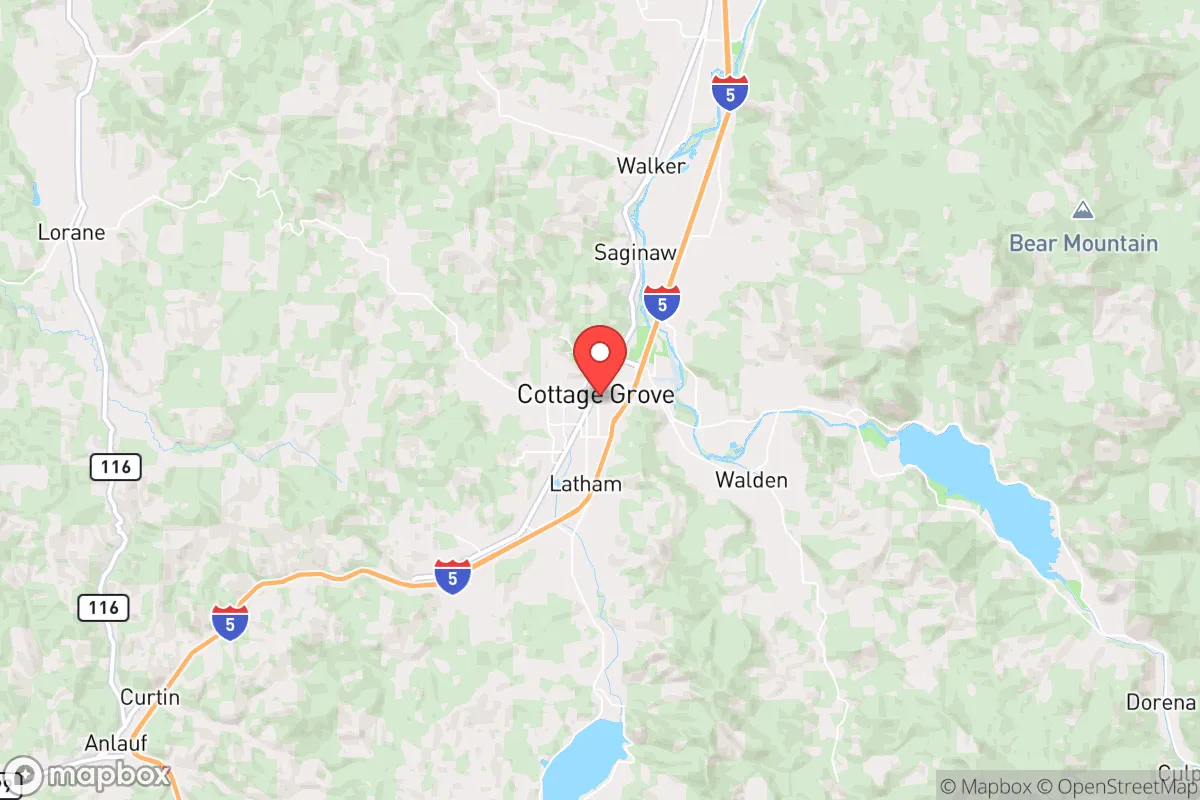
Photo: Wikipedia
Personal Sovereignty in Cottage Grove, OR
Viable for self-reliance. Generally workable, though some barriers may limit total independence.
What does Personal Sovereignty tell us?
Personal Sovereignty measures your capacity for self-reliance and independence with minimal government friction. Higher scores mean fewer barriers between you and the way you want to live... but it assumes you have the space you need and good neighbors.
What does this tell us?
Personal Sovereignty measures your capacity for self-reliance and independence with minimal government friction. Higher scores mean fewer barriers between you and the way you want to live... but it assumes you have the space you need and good neighbors.
State Policy
Energy independence: Importer (35% of energy produced in-state)
Personal Liberty
Homesteading

Personal Liberty Analysis
Cottage Grove, Oregon, offers a notably high degree of personal sovereignty relative to many other parts of the Pacific Northwest, largely due to its location in Lane County and the state's unique legal framework. While Oregon is often perceived as a high-regulation state, Cottage Grove's rural character and distance from Portland create a practical environment where individual autonomy in daily life is the norm. The city's small-town culture, combined with specific state-level protections for self-defense and property rights, makes it a compelling option for those prioritizing personal freedom and self-reliance.
Tax burden and regulatory posture in Cottage Grove and Lane County
Oregon's tax structure is a mixed bag for those seeking low fiscal burden. The state has no sales tax, which is a significant advantage for residents who make large purchases or buy goods online. However, this is offset by a relatively high state income tax, with rates ranging from 4.75% to 9.9% for top earners. Property taxes in Lane County are moderate, with an effective rate around 1.0% of assessed value, which is lower than many states in the Northeast but higher than some Western states like Arizona. Cottage Grove itself does not impose a city income tax, keeping the local tax burden limited to property and utility fees. The regulatory posture in Cottage Grove is light-touch for a city of its size. Zoning is straightforward, with most residential areas allowing for accessory dwelling units and home-based businesses without excessive red tape. The city's planning department is known for being responsive and practical, not adversarial. Lane County's building codes are standard for Oregon, but enforcement is less aggressive in rural areas than in Eugene or Portland. For a single individual or family, the overall tax and regulatory environment is manageable, with the lack of sales tax being a tangible daily benefit.
Self-defense and gun law specifics in Cottage Grove and Oregon
Oregon is a "shall-issue" state for concealed handgun licenses, meaning that if you meet the basic requirements—age 21, no felony record, completion of a safety course—the county sheriff must issue the permit. Lane County's sheriff's office processes these applications efficiently, with typical wait times of 30-60 days. Cottage Grove residents benefit from this state-level framework, which provides a clear path to carrying a concealed firearm for self-defense. Oregon does not have a "stand your ground" law in the same form as states like Texas or Florida, but it does have a "castle doctrine" that presumes a reasonable fear of death or serious injury when using deadly force against an intruder in your home. Outside the home, Oregon law requires a duty to retreat if safely possible before using deadly force, which is a notable limitation for those accustomed to more permissive states. Open carry is legal in Oregon without a permit, except in certain restricted areas like schools and federal buildings. Magazine capacity is not restricted at the state level, and there is no state-level assault weapons ban. For a self-defense-minded individual, Cottage Grove offers a solid legal foundation, with the main caveat being the duty to retreat outside the home. The local culture is strongly pro-Second Amendment, and gun ranges and training facilities are readily available in the surrounding area.
Self-reliance and homesteading viability: lot sizes, zoning, and off-grid feasibility
Cottage Grove is a strong location for those pursuing self-reliance and homesteading. The city's zoning code allows for residential lots as small as 5,000 square feet in standard subdivisions, but many properties on the outskirts of town offer acreage. In the unincorporated areas of Lane County surrounding Cottage Grove, minimum lot sizes for rural residential zoning are typically 5 to 10 acres, which is ideal for small-scale farming, keeping livestock, or establishing a substantial garden. The city itself has a "urban growth boundary" that limits sprawl, but properties within the boundary still often have enough land for a large garden, a few chickens, or even a goat. Off-grid living is feasible but requires navigating Oregon's building codes. The state requires a permit for any permanent dwelling, and that permit typically mandates connection to the electrical grid or an approved alternative energy system. Solar panels with battery storage are common and accepted, but a fully off-grid home with no utility connection at all may face hurdles with the county building department. Rainwater collection is legal and encouraged for non-potable uses, but potable water from a well requires a permit and testing. Composting toilets are allowed under state code for alternative systems. For a family wanting to grow their own food, raise animals, and reduce reliance on external systems, Cottage Grove's rural fringe offers a practical and legally permissible path, with the main regulatory friction being the building permit process for new construction.
Personal liberties: parental rights, medical autonomy, speech, and property
Oregon's legal landscape for personal liberties is a complex mix. On parental rights, Oregon law generally respects parental authority in education and healthcare decisions, but the state has some of the most progressive laws in the nation regarding minors' access to reproductive health services without parental consent. This is a significant consideration for families who prioritize traditional parental control. Medical autonomy is broad for adults, with Oregon being one of the first states to legalize physician-assisted suicide (Death with Dignity Act) and having a robust medical marijuana program. Recreational cannabis is also legal and widely available. For those who prefer to avoid pharmaceutical medicine, the state has a strong network of naturopathic doctors and alternative health practitioners. Free speech is protected under the Oregon Constitution, which has been interpreted by state courts to provide even broader protections than the First Amendment in some areas, particularly regarding public property and expressive conduct. Property rights are generally strong, but Oregon's land use laws, including the statewide urban growth boundary system, can limit what you can do with your land compared to states like Texas or Idaho. For example, you cannot simply build a new house on rural land without going through a lengthy permitting process that considers agricultural and forestland protections. The state also has a "right to farm" law that protects agricultural operations from nuisance lawsuits, which benefits homesteaders but can also mean you have little recourse if a neighbor starts a noisy livestock operation. Overall, personal liberties in Cottage Grove are robust for speech and property use within the existing regulatory framework, but parental rights and medical autonomy are areas where Oregon's state-level policies may conflict with more traditional values.
Compared to other areas in the Pacific Northwest, Cottage Grove stands out as a place where personal sovereignty is practically achievable, not just theoretically protected. The lack of sales tax, the shall-issue concealed carry system, and the availability of rural acreage for homesteading create a tangible environment of self-reliance. The main trade-offs are Oregon's income tax and the state's progressive stance on certain social issues, particularly parental rights and medical autonomy for minors. For a single individual or family who values the ability to defend themselves, grow their own food, and keep more of their earnings from sales tax, Cottage Grove offers a strong balance of freedom and practicality. It is not a libertarian paradise—the building codes and land use regulations are real—but it is a place where a determined person can live a largely self-directed life with minimal interference from local government.

* Values derived from national, state, county, city and local statistics and may differ in a specific area. Last updated: 2026-10-10T16:27:13.000Z
Narrative content on this page is AI-generated and may contain mistakes. Verify any details that matter before acting on them.
ReloMaps may earn a commission from affiliate links at no extra cost to you.

