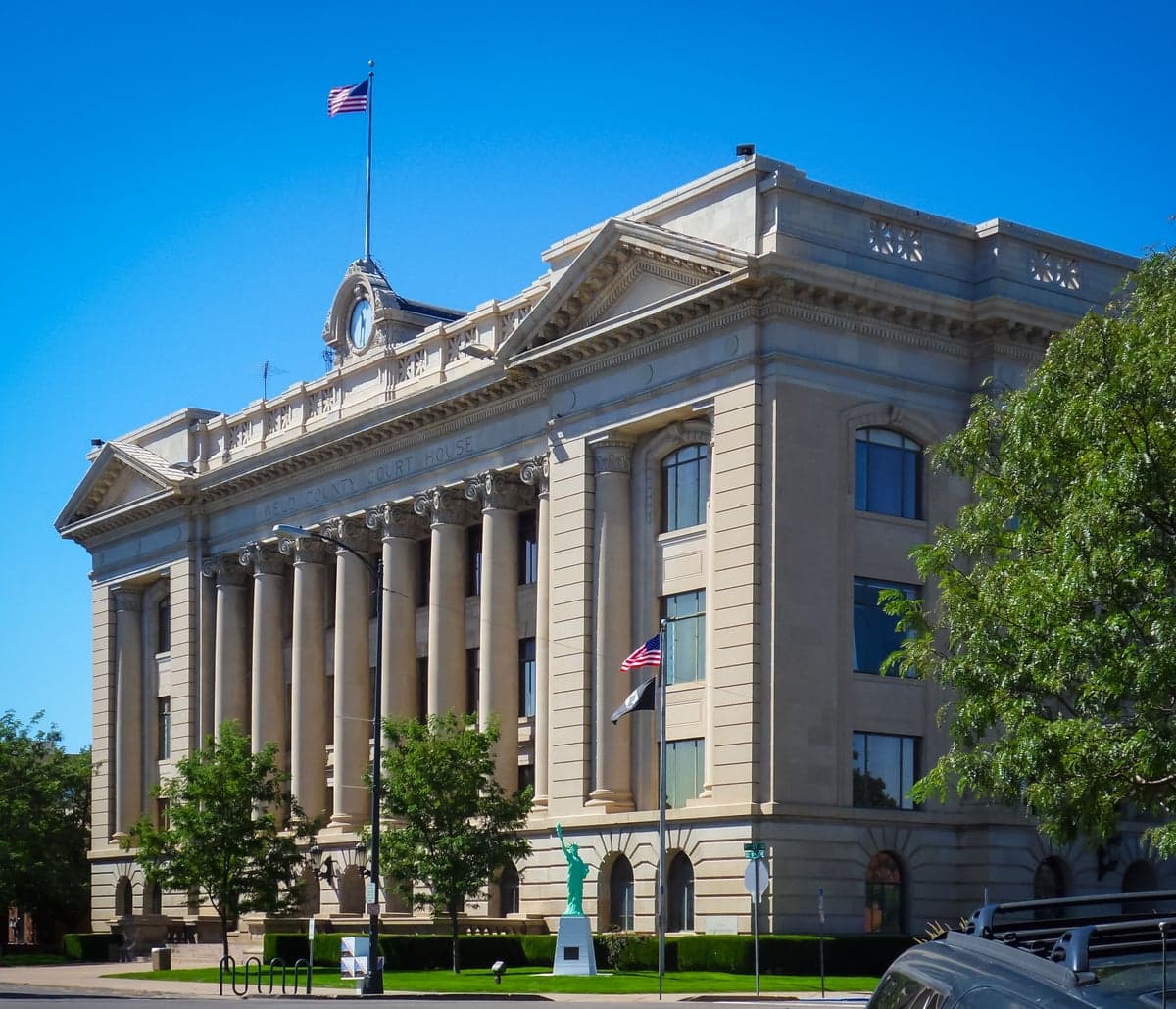
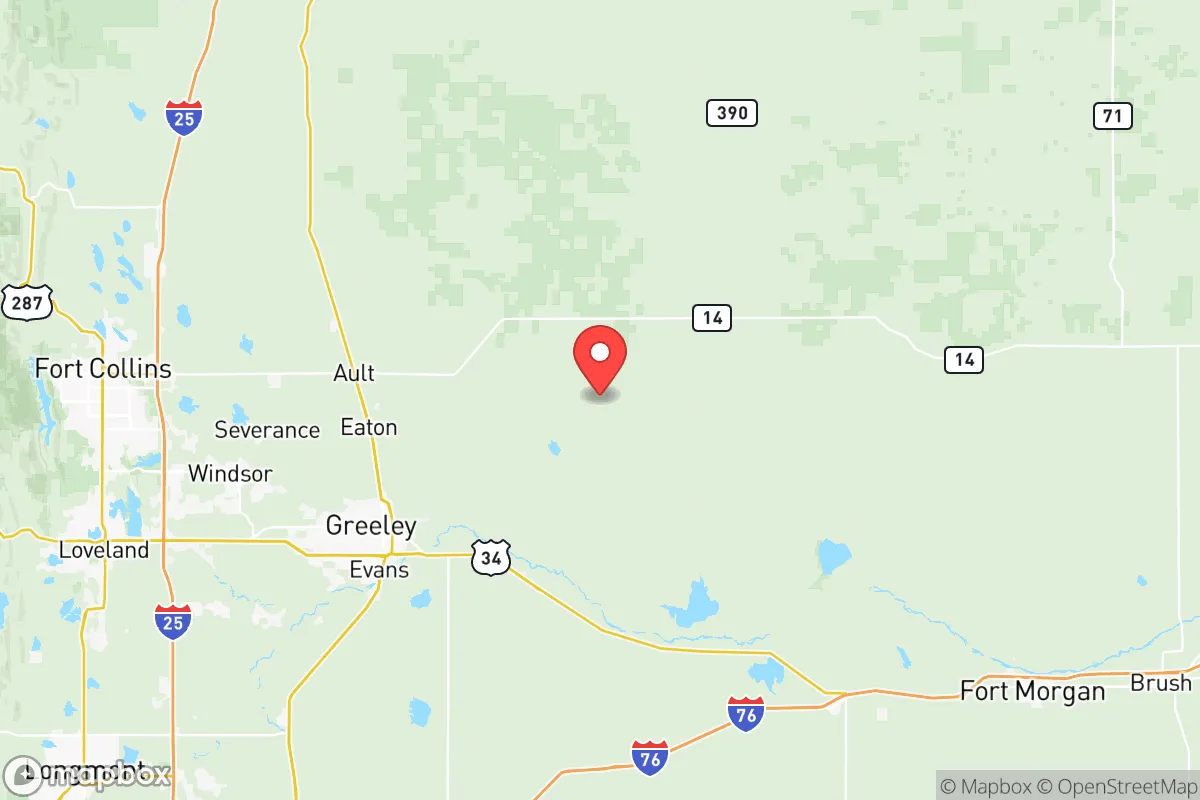
Photo: Wikipedia
Political ClimatePolitical Climate in Weld County
Showing district-level results — no local-only data available.
Local Political AnalysisPolitical Analysis of Weld County
Weld County, Colorado, is one of the most reliably Republican counties in the state, carrying a Cook Partisan Voting Index (PVI) of R+9, meaning it votes about nine points more Republican than the national average. This stands in stark contrast to Colorado as a whole, which has a PVI of D+6, reflecting a statewide shift to the left over the past two decades. While the county has long been a GOP stronghold, its political trajectory is not static — rapid population growth, particularly in the southern end near the Denver metro area, is slowly introducing more competitive dynamics, especially in precincts around towns like Greeley, Windsor, and Severance.
How it compares
The gap between Weld County and Colorado is a 15-point partisan swing, one of the widest county-to-state divides in the nation. While Colorado has trended blue — driven by Denver, Boulder, and suburban Jefferson County — Weld has held firm. In the 2020 presidential election, Donald Trump won Weld County with 58% of the vote, while Joe Biden carried Colorado by 13 points. That said, the county is not a monolith. Greeley, the county seat and largest city, has a more moderate-to-liberal core, particularly around the University of Northern Colorado campus, where precincts have voted Democratic in recent cycles. Meanwhile, Windsor and Severance are reliably conservative, though new housing developments are bringing in younger families from the Front Range who may lean more centrist. Longmont spills into the southwestern corner of the county and is a blue island, while Fort Lupton and Evans show more mixed results, often swinging based on turnout. The rural eastern plains — towns like Briggsdale, New Raymer, and Grover — remain deeply red, with Republican margins often exceeding 70%.
What this means for residents
For conservative residents, Weld County offers a political environment where their views are the norm. Local offices — from county commissioners to school boards — are overwhelmingly held by Republicans, and policy tends to reflect limited government, strong property rights, and support for agriculture and energy. For liberal residents, the picture is more mixed. While they are a clear minority, they are not invisible. Greeley’s city council has seen progressive voices elected, and the county’s Democratic Party is active, if outmatched. The practical effect is that liberal residents may feel politically isolated in rural areas but can find community in Greeley or the Longmont spillover zone. The county’s rapid growth — Weld added over 50,000 residents between 2010 and 2020 — is slowly shifting the electorate. New arrivals from Denver and Boulder often bring more moderate or liberal leanings, and precincts in fast-growing areas like Johnstown and Mead are becoming more competitive. Long-term, if growth continues at this pace, Weld could shift from solid red to lean red within a decade, though it remains far from purple.
Culturally, Weld County is defined by its agricultural roots and energy industry presence, which reinforce its conservative character. The county is a national leader in cattle feeding and dairy production, and oil and gas extraction is a major economic driver. This creates a policy environment where regulations on farming and drilling are generally opposed, and where local government often clashes with state-level environmental initiatives from Denver. The result is a palpable cultural divide: residents in Weld often feel overlooked or even targeted by state policy, while those in the metro area see Weld as a holdout of a bygone Colorado. For anyone moving here, understanding this tension is key — it shapes everything from land use debates to school curriculum fights. Whether you lean left or right, Weld County offers a clear, unapologetic political identity, and that clarity is something many residents value, even if they disagree with it.

State Political ClimatePolitical Climate in Colorado
State Political AnalysisPolitical Environment in the State
Colorado is a solidly Democratic state at the presidential level, with a Cook PVI of D+6, but that label masks a deeply divided political landscape that has shifted dramatically over the past two decades. The state was a quintessential swing state in the 1990s and early 2000s, voting for Bob Dole in 1996 and George W. Bush in 2000 and 2004, but a massive influx of new residents and a realignment of suburban voters has pushed it decisively blue. Today, the Democratic coalition is anchored by the Denver-Boulder-Aurora metroplex, while the rest of the state—particularly the Eastern Plains, the Western Slope, and the southern mountain valleys—remains deeply conservative, creating one of the sharpest urban-rural divides in the country.
Urban vs. rural divide
The political map of Colorado is a story of two states. The Front Range urban corridor, from Fort Collins down through Denver and Boulder to Colorado Springs, holds the vast majority of the state's population and drives its Democratic lean. Denver and Boulder are among the most liberal cities in the Mountain West, routinely voting 75-80% Democratic. The suburbs that ring Denver, like Aurora, Lakewood, and Westminster, have shifted left rapidly since 2016, driven by college-educated professionals and younger families. Colorado Springs, home to the Air Force Academy and a massive evangelical Christian population, remains a Republican stronghold and the largest conservative city in the state, but its influence is diluted by the sheer population weight of the Denver metro. Outside the Front Range, the Eastern Plains—places like Yuma, Burlington, and Lamar—vote Republican by margins of 70-80%, as do the Western Slope counties like Mesa (Grand Junction) and Montrose. The mountain resort counties, like Pitkin (Aspen) and Summit (Breckenridge), are liberal enclaves, but they are small in population. The net result is a state where Democrats win statewide by running up the score in Denver and the inner suburbs, while Republicans hold vast geographic territory but lack the numbers.
Policy environment
Colorado's policy environment reflects its divided government in recent years. The state has a flat income tax rate of 4.4%, set by the Taxpayer's Bill of Rights (TABOR), which requires voter approval for any tax increase and limits revenue growth. This gives Colorado a relatively low-tax posture compared to other blue states, though property taxes are moderate and vary by county. The regulatory posture is mixed: the state has aggressive environmental regulations, including a mandate for 100% renewable energy by 2040, but it remains business-friendly in many sectors, particularly tech and aerospace. Education policy is a flashpoint: Colorado uses a school funding formula that relies heavily on local property taxes, creating wide disparities between wealthy and poor districts. The state has also seen fierce battles over school choice, with charter schools and open enrollment widely available. Healthcare is dominated by the state-run Connect for Health Colorado exchange, and the state expanded Medicaid under the Affordable Care Act. Election laws are among the most accessible in the country: Colorado conducts all-mail-in voting, with same-day registration and automatic voter registration through the DMV. This has been a major driver of Democratic turnout, but it also means high participation rates across the board.
Recent policy direction
Colorado's recent legislative sessions have pushed the state decisively leftward on a range of issues that matter to relocators. On gun law, the state passed a red flag law in 2019, a ban on high-capacity magazines in 2022, and a sweeping 2024 law raising the purchase age for all firearms to 21 and imposing a three-day waiting period. Self-defense law is governed by a "make my day" statute that provides broad immunity for use of force in the home, but the state does not have permitless carry. On parental and education rights, Colorado has been a battleground: the state passed a law in 2023 requiring schools to notify parents of curriculum changes, but also expanded protections for LGBTQ+ students, creating ongoing tension. Speech is broadly protected under the state constitution, but there have been controversies over library book challenges and school board meetings. Privacy and surveillance law is relatively strong: Colorado passed one of the nation's first comprehensive data privacy laws in 2021, giving residents the right to access and delete personal data held by companies. On medical and bodily autonomy, the state has codified abortion rights into law and passed a 2024 amendment to the state constitution protecting reproductive freedom. Property rights are generally strong, but the state has imposed strict land-use regulations on oil and gas development, including a 2020 law requiring 2,000-foot setbacks from homes and schools. Taxation remains constrained by TABOR, but Democrats have used fees and exemptions to raise revenue without a direct vote. Voting access has been expanded further, with automatic voter registration and universal mail-in ballots now the norm.
Civil unrest & political movements
Colorado has seen its share of political flashpoints. The 2020 protests in Denver over the murder of George Floyd were large and occasionally violent, leading to property damage and a lasting debate over policing. The state has a strong sanctuary movement: Denver and Boulder County have declared themselves sanctuary jurisdictions, limiting cooperation with federal immigration enforcement, which has been a major point of contention with the state's conservative rural areas. There have been persistent calls for secession from the Eastern Plains, with several counties voting to explore forming a separate state of "North Colorado" in 2013, though the movement has since stalled. Election integrity has been a hot topic: Colorado's all-mail-in system has been praised for high turnout but criticized by conservatives for potential fraud, though no widespread issues have been found. The state has also seen organized activist movements on both sides, from the left-leaning Colorado Immigrant Rights Coalition to the right-leaning Rocky Mountain Gun Owners, which has successfully sued to block some gun restrictions. A new resident would notice the stark cultural divide between the liberal Front Range and the conservative rural areas, with political yard signs and bumper stickers common in both regions.
Projection
Over the next 5-10 years, Colorado is likely to become more Democratic, not less. In-migration from California, Texas, and other states continues to fuel growth in the Denver metro and the Front Range, and these new residents tend to be younger, more diverse, and more liberal. The state's rural population is shrinking or stagnant, meaning the political weight of conservative areas will continue to decline. The Democratic trifecta in state government is likely to persist, with the party controlling the governorship and both legislative chambers for the foreseeable future. This means further leftward movement on gun control, environmental regulation, and social policy is probable. However, TABOR remains a powerful check on tax increases, and the state's business-friendly reputation in tech and aerospace is unlikely to change dramatically. A relocator moving in now should expect to find a state where the political culture is increasingly liberal in the urban centers, but where conservative communities remain vibrant and politically active in the rural areas and Colorado Springs. The divide will likely deepen, but the overall trajectory is blue.
For a new resident, the bottom line is that Colorado offers a mixed political environment depending on where you live. If you are conservative, you will find like-minded communities in Colorado Springs, Grand Junction, or the Eastern Plains, but you will be living in a state where state-level policy is increasingly liberal. If you are liberal, you will feel at home in Denver, Boulder, or the mountain resort towns, but you will encounter sharp cultural resistance outside the Front Range. The state's tax structure is relatively favorable compared to other blue states, and the outdoor lifestyle is a major draw across the political spectrum. The key is to choose your location carefully and understand that Colorado's political reality is not monolithic—it is a state of two very different worlds.
* Values derived from national, state, county, city and local statistics and may differ in a specific area. Last updated: 2026-06-23T19:19:41.000Z
Narrative content on this page is AI-generated and may contain mistakes. Verify any details that matter before acting on them.
ReloMaps may earn a commission from affiliate links at no extra cost to you.

