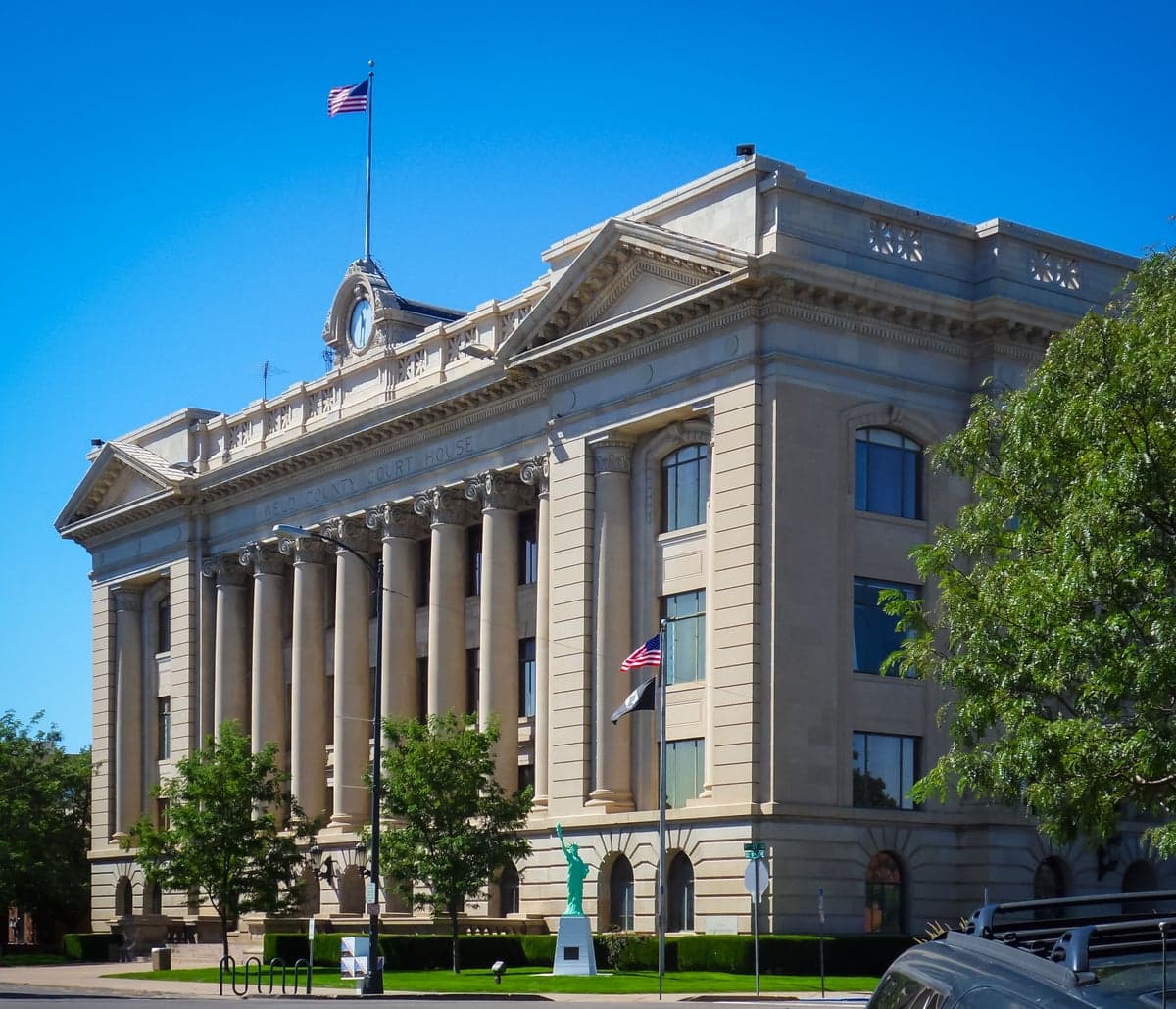
Photo: Wikipedia
Demographics of Weld County
Affluence Level in Weld County
A middle-class area roughly in line with national averages across income, home values, education, and employment.
People of Weld County
Weld County, Colorado, is home to 340,711 residents who blend a deep agricultural heritage with rapid suburban expansion, creating a population that is 63.0% White and 30.5% Hispanic, with a foreign-born share of just 5.4%. The county's identity is rooted in its working-class ranching and farming history, now increasingly shaped by commuters to the Denver-Boulder corridor and a growing energy sector workforce. This is a region where conservative values and a strong sense of local community persist, even as Greeley, Evans, and Windsor absorb new arrivals from across the country. The people of Weld County are defined by this tension between a traditional, land-based past and a diversifying, suburbanizing future.
Settlement & growth (pre-1960)
Before American settlement, the area now known as Weld County was home to the Arapaho and Cheyenne nations, who followed bison herds across the shortgrass prairie. The 1851 Treaty of Fort Laramie recognized their claim to this territory, but the Colorado Gold Rush of 1858–59 and the subsequent Homestead Act of 1862 brought a flood of Anglo-American settlers. The U.S. government forcibly removed the Native nations to reservations in Oklahoma and Wyoming by the 1870s, opening the land for agricultural development.
The first major wave of American settlers were farmers and ranchers from the Midwest and Upper South, arriving in the 1860s and 1870s. They founded the county's earliest towns, including Greeley (established 1869 as a utopian temperance colony by Nathan Meeker), Evans, and Fort Lupton. These settlers were predominantly of English, German, and Scots-Irish stock, drawn by the promise of irrigated farmland along the South Platte River. The Union Colony, which founded Greeley, specifically recruited "industrious, moral" families, establishing a conservative, Protestant character that still echoes in local politics.
A second, distinct wave arrived in the early 1900s: German-speaking Mennonites and Volga Germans from Russia, who settled in and around Greeley, Windsor, and Milliken. They brought expertise in dryland wheat farming and sugar beet cultivation, which became the backbone of the local economy. The Great Western Sugar Company, headquartered in Greeley, employed many of these families, and their descendants remain a visible cultural presence in the county's northern towns. Smaller numbers of Italian and Mexican laborers came to work the beet fields in the 1910s and 1920s, forming the first Hispanic enclaves in Greeley and Fort Lupton.
The Dust Bowl and Great Depression of the 1930s pushed a third wave of domestic migrants into Weld County: "Okies" and "Arkies" from Oklahoma, Arkansas, and the Texas Panhandle. They arrived as displaced tenant farmers, seeking work in the sugar beet fields and on the region's large cattle ranches. Many settled in Greeley and Eaton, adding a Southern, rural Protestant layer to the county's cultural mix. By 1950, Weld County's population was roughly 85% non-Hispanic White, with a small but established Hispanic minority of about 10%, concentrated in agricultural labor.
Modern era (post-1965)
The 1965 Hart-Cellar Act did not dramatically reshape Weld County's immigration patterns, as the region lacked the industrial or service-sector magnets that drew large numbers of new immigrants to coastal cities. Instead, the county's modern demographic story is one of domestic migration and natural increase among its existing Hispanic population. The foreign-born share remains low at 5.4%, and the largest immigrant group is from Mexico, with smaller numbers from Central America and Southeast Asia. These newer arrivals have settled primarily in Greeley and Fort Lupton, where existing Hispanic communities provide social and economic networks.
The most significant post-1965 shift has been the growth of the Hispanic population through higher birth rates and continued migration, rising from roughly 10% in 1970 to 30.5% today. This growth is concentrated in Greeley, Evans, and Fort Lupton, where Hispanic residents now form a majority or near-majority in several neighborhoods. Meanwhile, the non-Hispanic White share has declined from over 85% in 1970 to 63.0% today, though Whites remain the largest single group and dominate the county's rural areas and smaller towns like Ault, Pierce, and Kersey.
Domestic migration since the 1990s has brought a new wave of residents from the Front Range's urban core and from other states. The oil and gas boom in the Wattenberg Field, centered near Greeley and Dacono, attracted workers from Texas, Oklahoma, and the Mountain West, many of whom are White and politically conservative. At the same time, suburban spillover from the Denver-Boulder area has pushed families into Windsor, Severance, and Johnstown, towns that have seen rapid housing development and an influx of college-educated professionals. The county's college-educated share now stands at 32.0%, reflecting this suburbanization trend.
East and Southeast Asian residents make up 1.3% of the population, a small but growing presence concentrated in Greeley and Windsor, often employed in the University of Northern Colorado and the region's healthcare sector. Indian subcontinent residents account for just 0.2%, and Black residents 1.2%, both groups too small to form distinct enclaves. The county remains overwhelmingly White and Hispanic, with limited racial diversity beyond these two groups.
The future
Weld County's population is projected to continue growing, driven by suburban expansion from the Denver metro area and the energy sector's cyclical demand for workers. The Hispanic share is expected to rise gradually, potentially reaching 35–38% by 2040, as younger Hispanic families have higher birth rates and as continued domestic migration brings more non-Hispanic Whites into the county's new subdivisions. The non-Hispanic White share will likely decline further, but Whites will remain the largest group for the foreseeable future.
New communities are concentrating in the county's western and southern edges, particularly in Windsor, Severance, and Johnstown, where master-planned subdivisions are attracting families from Boulder and Denver. These areas are predominantly White and more college-educated, creating a cultural and political divide with the older, more Hispanic agricultural towns in the county's eastern and northern reaches. Greeley itself is becoming more diverse and urban, with a growing Hispanic majority and a small but visible East/Southeast Asian and Indian presence tied to the university and hospitals.
The county's cultural identity is evolving from a purely agricultural, ranching community into a hybrid of working-class energy towns and suburban bedroom communities. Political conservatism remains strong, but the influx of suburban professionals may moderate some social attitudes over time. The Hispanic population, long a labor force for agriculture, is increasingly integrated into local government, business, and education, though economic disparities persist.
For someone moving to Weld County now, the region offers a choice: the traditional, slower-paced life of a farming town like Ault or Kersey, or the newer, more amenity-rich suburban environment of Windsor or Severance. The population is becoming more diverse, more suburban, and more connected to the Denver metro area, but the county's core identity as a place of conservative values, open space, and agricultural roots remains intact. This is a region in transition, where the past and future coexist uneasily but productively.

* Values derived from national, state, county, city and local statistics and may differ in a specific area. Last updated: 2026-06-23T19:19:41.000Z
Narrative content on this page is AI-generated and may contain mistakes. Verify any details that matter before acting on them.
ReloMaps may earn a commission from affiliate links at no extra cost to you.

