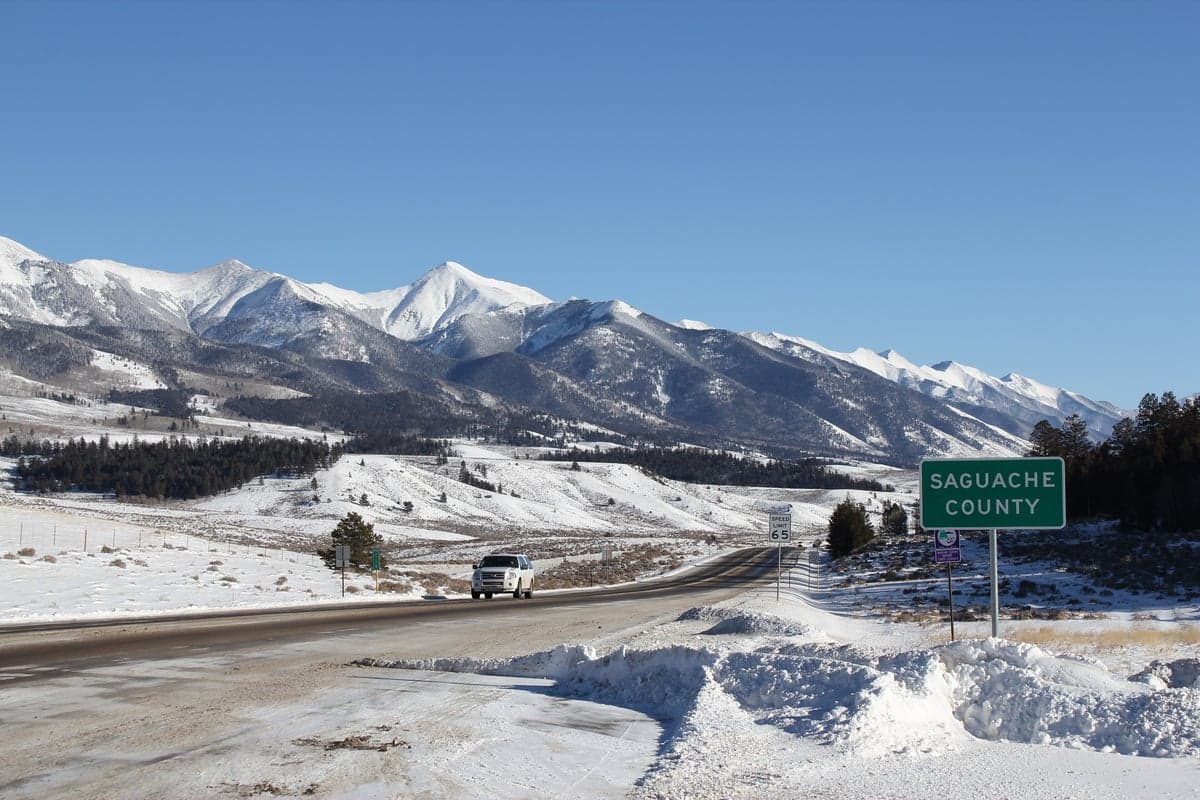
Photo: Wikipedia
Political ClimatePolitical Climate in Saguache County
Showing district-level results — no local-only data available.
Local Political AnalysisPolitical Analysis of Saguache County
Saguache County is a political outlier in Colorado, a rural island of red in a state that has shifted decisively blue. While Colorado as a whole carries a Cook PVI of D+6, Saguache County sits at R+5, a gap of 11 points that reflects a deep cultural and economic divide between this high-elevation valley and the Front Range. The county has been reliably Republican for decades, but the margins have tightened in recent presidential cycles as the broader state's leftward drift has pulled some of its more transient populations—especially in and around the tourist-adjacent town of Crestone—toward Democratic candidates. Still, the county's rural character and agricultural base keep it solidly in the red column, even as neighboring counties like Chaffee (D+2) and Alamosa (D+1) have flipped or become competitive.
How it compares
Colorado's D+6 PVI is driven by the heavily populated Denver-Boulder corridor, which votes overwhelmingly Democratic. Saguache County's R+5 puts it in the same league as other rural, ranching-dependent counties in the San Luis Valley, like Rio Grande (R+7) and Conejos (R+9). But the county is not a monolith. The town of Crestone—a small, spiritually oriented community at the base of the Sangre de Cristo Mountains—is the county's most notable blue pocket, often voting Democratic by 10-15 points in presidential elections. In contrast, the county seat of Saguache (pronounced "suh-watch") and the smaller community of Center lean heavily Republican, with precincts routinely going +20 to +30 for GOP candidates. The swing precincts are in the unincorporated areas around Moffat and Villa Grove, where independent and unaffiliated voters—now the largest voting bloc in the county—can tip a local race. This internal variation means that while the county's overall PVI is R+5, the lived political reality depends heavily on which side of the valley you're on.
What this means for residents
For conservative residents, Saguache County feels like a refuge from the state's progressive policies. Local offices—county commissioners, sheriff, school board—are reliably held by Republicans, and the county has resisted state-level mandates on land use, energy development, and public health. Gun rights are broadly supported, and the county's low population density means that most residents feel little direct pressure from state government. For liberal residents, especially in Crestone, the county can feel isolating politically, but the small scale of local government means that community relationships often transcend party lines. The real tension isn't between neighbors—it's between the county and the state. Saguache County frequently joins lawsuits against Colorado's Democratic leadership, particularly over oil and gas regulations and water rights, which are existential issues in the arid San Luis Valley. This dynamic creates a sense of "us versus Denver" that unites many residents across party lines, even as they disagree on national politics.
Culturally, Saguache County is defined by its ranching heritage and its growing spiritual tourism in Crestone. The county's policy distinctions are most visible in its approach to land use: it has minimal zoning compared to Front Range counties, and it has actively opposed renewable energy projects that would require large-scale transmission lines across the valley. For newcomers, the biggest adjustment is the pace of life and the expectation of self-reliance—the county government is small, services are limited, and political debates are often settled at the county commission meeting, not in the statehouse. Whether you lean red or blue, living here means accepting that your vote carries more weight locally than it does in statewide elections, and that the county's R+5 label is less a statement of ideology than a reflection of its deep-rooted independence from the Front Range.

State Political ClimatePolitical Climate in Colorado
State Political AnalysisPolitical Environment in the State
Colorado has shifted from a quintessential purple state to a solidly blue one over the past two decades, now carrying a Cook Partisan Voting Index of D+6. The Democratic coalition is powered by the booming Front Range urban corridor, while the rural eastern plains and Western Slope remain deeply Republican. This isn’t a sudden flip—it’s a slow, steady migration-driven realignment that began in the early 2000s and accelerated after 2016, leaving conservatives in control of vast geography but outnumbered at the ballot box.
Urban vs. rural divide
The political map of Colorado is a story of two states. The Denver metro area—including Denver proper, Aurora, Lakewood, and the suburban counties of Jefferson and Arapahoe—is the Democratic engine, delivering margins of 20-40 points in statewide races. Boulder County is the bluest of all, routinely voting 70%+ Democratic. The I-25 corridor south to Colorado Springs and north to Fort Collins is more mixed: Colorado Springs (El Paso County) remains a conservative stronghold, home to Focus on the Family and the Air Force Academy, but it’s trending purple as tech and defense workers move in. Fort Collins and Larimer County have flipped blue in presidential elections since 2016. Meanwhile, the Eastern Plains—towns like Lamar, Burlington, and Sterling—vote 70-80% Republican, as do the Western Slope communities of Grand Junction, Montrose, and Delta. The mountain resort counties (Pitkin, Summit, Eagle) are blue-leaning due to wealthy second-home owners and service workers, but they’re small in population. The net effect: Democrats win statewide by piling up votes in Denver and its inner suburbs, while Republicans dominate the landmass.
Policy environment
Colorado’s policy landscape reflects its purple-turned-blue trajectory. The state income tax is a flat 4.4%, low by national standards, and property taxes are among the lowest in the country thanks to the Gallagher Amendment (repealed in 2020) and TABOR (Taxpayer Bill of Rights), which still caps revenue growth. Sales taxes vary widely by locality—Denver’s combined rate is around 8.8%, while rural towns often sit near 7%. Education policy is a flashpoint: the state funds schools primarily through local property taxes, leading to wide disparities between wealthy Front Range districts and poor rural ones. School choice is robust, with charter schools and open enrollment widely available. Healthcare is dominated by a heavily regulated insurance market; Colorado’s state-run reinsurance program has stabilized premiums somewhat, but costs remain above the national average. Election laws are among the most accessible in the country: universal mail-in ballots, same-day registration, and automatic voter registration have driven turnout to near 80% in presidential years. Voter ID is required but easily satisfied (any document with name and address).
Recent policy direction
The last five years have seen Colorado move decisively left on several fronts. On guns, the state passed a 2023 law banning the sale of certain semi-automatic firearms (the “assault weapons” ban) and raising the purchase age to 21, plus a 2024 law imposing a waiting period and requiring safe storage. Self-defense law remains relatively permissive—Colorado is a “stand your ground” state with a shall-issue concealed carry system—but the political trend is toward restriction. On education, the 2019 “Healthy Youth” law expanded access to contraception and abortion in school-based health centers, while a 2023 law banned conversion therapy for minors. Parental rights have been a battleground: a 2023 law requires schools to notify parents of curriculum changes, but a 2024 law prohibits schools from outing transgender students to parents without their consent. On privacy, Colorado passed one of the nation’s strongest data privacy laws (CPA) in 2021, and a 2024 law restricts law enforcement use of facial recognition. Medical and bodily autonomy: abortion is protected up to viability under a 2022 law, and the state has a “shield law” protecting providers who serve out-of-state patients. Property rights are generally strong, but local zoning battles are intense—Denver’s 2024 “expanding housing” law allows duplexes and triplexes in single-family zones, a move that has angered homeowners. Voting access continues to expand: automatic voter registration was tied to driver’s license issuance in 2023.
Civil unrest & political movements
Colorado has seen its share of visible political flashpoints. The 2020 protests in Denver over George Floyd’s death were large and occasionally violent, leading to a $14 million settlement for excessive force claims. The state’s sanctuary policies are moderate: Denver and Boulder limit cooperation with ICE, but state law does not prohibit it. Immigration politics flared in 2023 when Denver’s shelter system was overwhelmed by migrants bused from Texas, prompting a state emergency declaration. On the right, the “Colorado Project” and local GOP factions have pushed for election integrity audits, but no major fraud has been found. The 2022 election saw a failed recall attempt against Denver District Attorney Beth McCann over progressive policies. Rural secession rhetoric is common—the “State of Jefferson” movement has supporters in the Eastern Plains and Western Slope, but it remains symbolic. A new resident in Denver would notice occasional protests at the state capitol, while in Colorado Springs, the dominant political energy comes from evangelical and military-aligned groups.
Projection
Over the next 5-10 years, Colorado’s blue lean is likely to deepen, but not uniformly. In-migration from California and Texas continues to favor the Front Range, and younger voters are overwhelmingly Democratic. The state’s population is projected to grow by 1-2% annually, with most growth in Denver’s suburbs and the I-25 corridor. This will likely push El Paso County (Colorado Springs) from purple-leaning-red to a true swing county by 2030. Rural areas will continue to lose population and political influence. The policy direction will probably accelerate: expect further gun restrictions, a potential move to a graduated income tax (already proposed), and more housing density mandates. The wild card is water—if drought intensifies, it could strain the Front Range’s growth and shift political priorities. For a conservative relocator, the state will remain a place where your vote counts less in statewide races but your local voice matters in county and city elections. For a liberal relocator, Colorado will feel increasingly aligned with your values, especially on environmental and social issues.
Bottom line for a new resident: Colorado is a blue state with a strong libertarian streak, low taxes, and high engagement. Conservatives will find a welcoming home in Colorado Springs, the Eastern Plains, or the Western Slope, but they should expect to lose most statewide elections. Liberals will feel at home in Denver, Boulder, and the resort towns. The practical takeaway: your quality of life depends more on your local community than the state government. If you value outdoor access, moderate taxes, and a politically active populace, Colorado delivers—just know which side of the divide you’re settling on.
* Values derived from national, state, county, city and local statistics and may differ in a specific area. Last updated: 2026-07-20T00:50:21.000Z
Narrative content on this page is AI-generated and may contain mistakes. Verify any details that matter before acting on them.
ReloMaps may earn a commission from affiliate links at no extra cost to you.

