Photo: Wikipedia
Demographics of Saguache County
Affluence Level in Saguache County
A middle-class area roughly in line with national averages across income, home values, education, and employment.
People of Saguache County
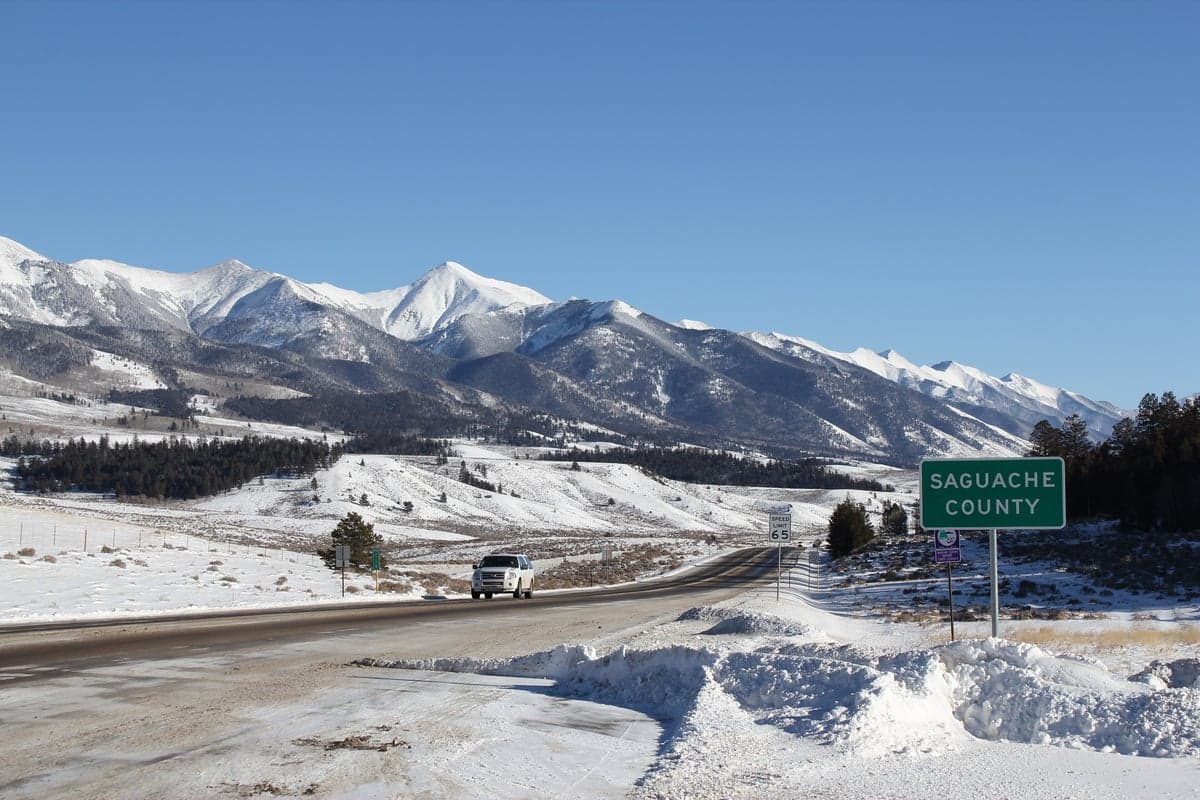
Saguache County, Colorado, is home to roughly 6,511 residents, a population defined by its rural character, deep Hispanic heritage, and a quiet, independent streak that has persisted since the 19th century. The county’s people are spread across a vast, high-elevation landscape, with the largest concentrations in the towns of Saguache (the county seat), Crestone, Center, and Moffat. Today, the population is 56.1% White and 36.9% Hispanic, with a very small foreign-born share of 3.2%, reflecting a community shaped more by long-term settlement and domestic migration than by recent international immigration.
Settlement & growth (pre-1960)
Long before European or American settlement, the San Luis Valley—of which Saguache County forms the northern edge—was home to the Ute people, particularly the Capote and Muache bands. These nomadic hunter-gatherers used the valley’s abundant game and seasonal water sources, leaving behind traces of their presence in the form of tipi rings and stone tools. The Ute name for the area, “Saguache,” meaning “blue earth” or “water at the blue earth,” survives as the county’s name. Spanish explorers and traders passed through as early as the 1700s, but no permanent Spanish settlements took root within the county’s current boundaries.
The first major wave of non-Native settlement began after the 1850s, following the U.S. acquisition of the region through the Treaty of Guadalupe Hidalgo (1848) and subsequent land cessions by the Ute tribes. The discovery of gold in the nearby San Juan Mountains in the 1860s drew prospectors, but the county’s true economic foundation became agriculture and ranching. The town of Saguache was founded in 1866 as a supply center for miners and ranchers, and it quickly became a hub for the region’s growing livestock industry. By the 1870s, the Denver & Rio Grande Railroad reached the valley, connecting Saguache County to broader markets and spurring the founding of Moffat (1889) and Center (1901) as agricultural service towns.
The settlers of this era were overwhelmingly Anglo-American migrants from the Midwest and Upper South, drawn by cheap land under the Homestead Act and the promise of a new start. They were joined by a smaller but significant number of Hispanic families who had been living in the southern San Luis Valley for generations, descendants of Spanish colonial settlers from New Mexico. These Hispanic residents, often called “Hispanos,” brought with them a distinct culture, language, and land-grant tradition that predated American rule. By the early 1900s, the county’s population was a mix of Anglo ranchers and farmers, Hispanic laborers, and a handful of European immigrants—mostly German and Irish—who worked on the railroads or in the mines.
The Dust Bowl and Great Depression of the 1930s hit Saguache County hard, causing a population decline as families left for California and other states. However, the post-World War II era brought a modest revival, driven by the expansion of irrigation projects that made the valley’s dryland farming more productive. The town of Crestone, originally a small mining settlement, began to attract attention in the 1950s as a quiet, remote place for those seeking solitude. By 1960, the county’s population stood at roughly 4,800, a figure that would remain relatively stable for decades.
Modern era (post-1965)
The 1965 Hart-Cellar Act, which reshaped U.S. immigration, had little direct impact on Saguache County. The foreign-born population remains just 3.2% today, far below the national average, and the county did not experience the large-scale immigration from Asia or Latin America that transformed many other parts of Colorado. Instead, the demographic changes of the post-1965 era have been driven by domestic migration and natural increase among the existing Hispanic population.
The most significant shift has been the steady growth of the Hispanic share of the population, rising from roughly 25% in 1970 to 36.9% today. This growth is largely due to higher birth rates among Hispanic families and the continued in-migration of Hispanic workers from southern Colorado and northern New Mexico, drawn by agricultural jobs in the valley’s potato, barley, and alfalfa fields. The town of Center, in particular, has become a focal point for the Hispanic community, with a population that is now majority Hispanic and a strong sense of cultural identity tied to the land and the Catholic Church.
At the same time, the county has seen a small but notable influx of spiritual seekers and countercultural migrants to Crestone since the 1970s. Attracted by the area’s dramatic mountain scenery and low land prices, these newcomers—often White, college-educated, and from coastal states—established a series of Buddhist, Hindu, and interfaith retreat centers. This wave has given Crestone a unique character as a spiritual hub, but it has not fundamentally altered the county’s overall demographics. The East/Southeast Asian population (0.8%) and Indian subcontinent population (0.0%) remain negligible, and the Black population (0.7%) is similarly tiny.
Suburbanization has largely passed Saguache County by. There are no major suburbs or exurbs here; the county’s towns remain small, with the largest—Saguache—having fewer than 500 residents. The county’s population has actually declined slightly from its peak of around 7,000 in the 1990s, as younger residents leave for job opportunities in the Front Range cities of Denver, Colorado Springs, and Pueblo. The college-educated share of the population is 30.7%, a figure that is pulled up by the Crestone spiritual community but remains below the state average.
The future
The population of Saguache County is likely to continue its slow decline or stagnation over the next 10–20 years. The county’s economy, heavily dependent on agriculture and a small amount of tourism, offers limited opportunities for young adults, and the lack of major employers or housing development means that out-migration will likely persist. The Hispanic share of the population is expected to continue its gradual increase, potentially approaching 45–50% by 2040, due to higher birth rates and the aging of the White population.
Diversity is unlikely to increase significantly. The county’s remote location, cold winters, and lack of urban amenities make it unattractive to most international immigrants, and the small Asian and Black populations are not expected to grow. The Crestone spiritual community may continue to attract a trickle of new residents, but it will remain a niche phenomenon. The county’s cultural identity will likely remain a blend of rural Anglo ranching traditions and deep-rooted Hispanic heritage, with little outside influence.
For someone moving in now, Saguache County offers a place where the past is still very much present. The population is stable, homogeneous in its rural character, and shaped by generations of families who have worked the same land. Newcomers will find a community that values self-reliance, neighborliness, and a slower pace of life, but they should also expect limited services, few job opportunities, and a population that is slowly aging and shrinking. It is a place for those who seek solitude and a connection to the land, not for those looking for growth or diversity.

* Values derived from national, state, county, city and local statistics and may differ in a specific area. Last updated: 2026-07-20T00:50:21.000Z
Narrative content on this page is AI-generated and may contain mistakes. Verify any details that matter before acting on them.
ReloMaps may earn a commission from affiliate links at no extra cost to you.

