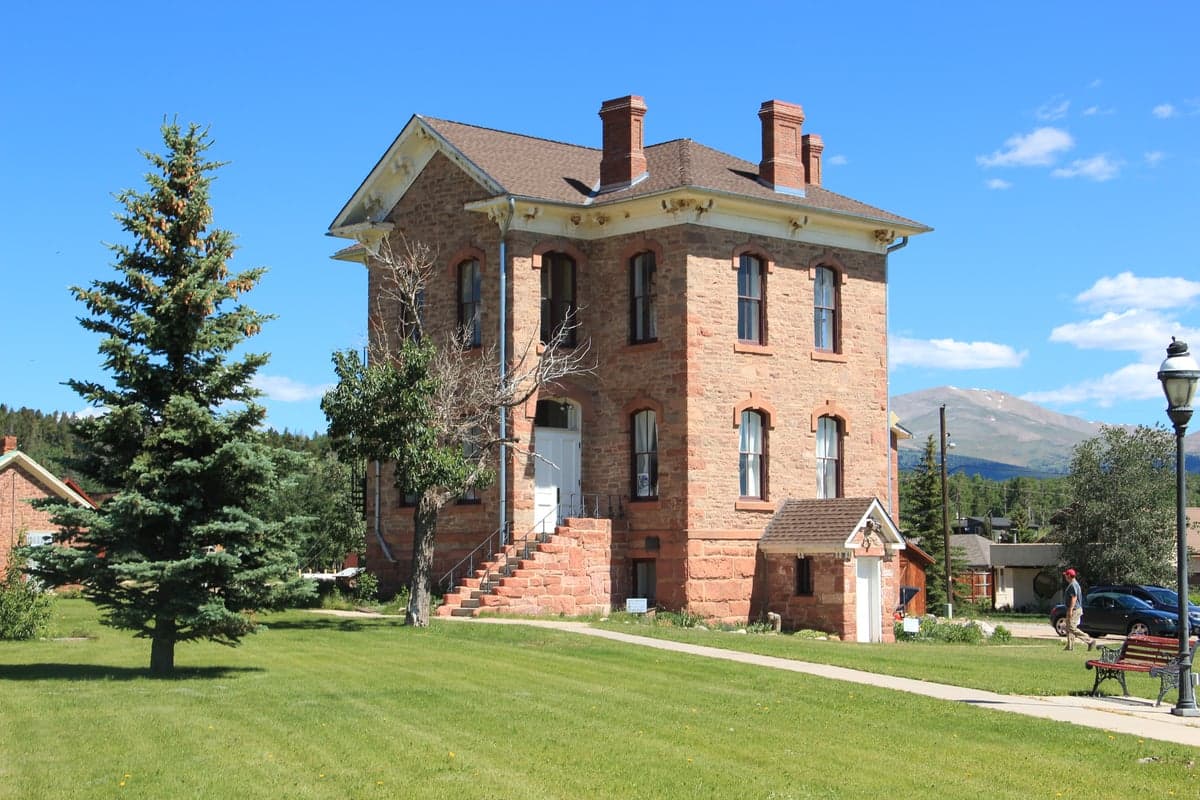
Photo: Wikipedia
Demographics of Park County
Affluence Level in Park County
An upper-middle-class area. Household wealth, education levels, and homeownership run ahead of national benchmarks.
People of Park County
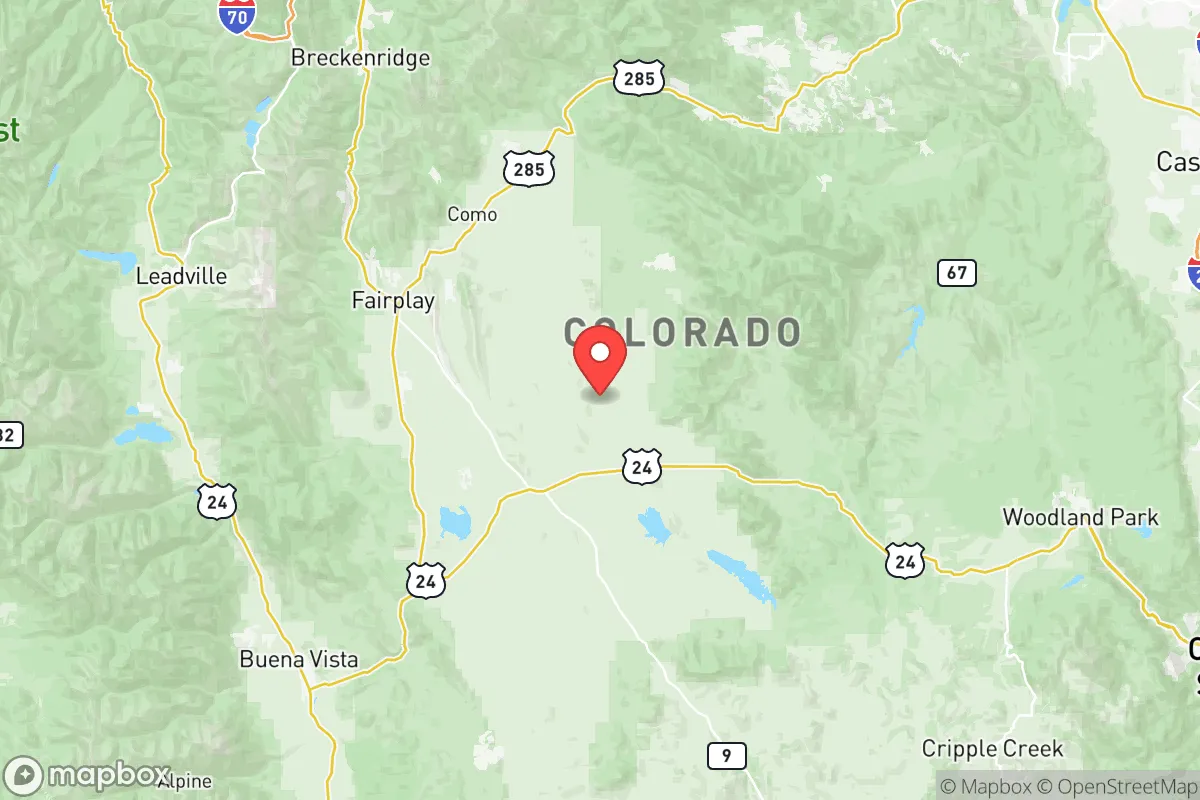
Park County, Colorado's 17,739 residents are among the most ethnically homogeneous in the state: 86.8% White and only 0.6% foreign-born. Scattered across the high mountain valleys and pine forests of the South Park basin, the population centers on historic mining towns turned recreation hubs like Fairplay and Alma, with a pronounced libertarian-conservative lean and a culture shaped by ranching, mining heritage, and outdoor recreation. The county's high college attainment (38.8%) reflects an influx of educated remote workers and second-home owners, while the Hispanic minority (7.4%) is the only significant ethnic group outside the White majority.
Settlement & growth (pre-1960)
The South Park region was originally inhabited by the Ute people, who used the broad, grassy valley for summer hunting camps along the headwaters of the South Platte River. The Ute presence was never dense—seasonal, mobile bands—and they ceded the area to the U.S. government through the 1868 Treaty of Fort Laramie, which pushed them west onto reservations within a decade of the first serious American influx.
The first major population wave arrived with the Pike's Peak Gold Rush of 1859. Prospectors mostly from the Missouri Valley, Ohio, and New England poured into the South Park basin after gold was discovered in Tarryall Creek. The Tarryall diggings boomed in 1859, but claim-jumping soon prompted a group to leave and found a "fair" camp downstream—Fairplay—which became the county seat in 1862. Satellite camps like Buckskin Joe (1861) and later Montgomery (1870s) sprang up along the gold-bearing gulches. Within a decade, these camps held several thousand men, mostly young, transient, and Anglo-American, with a sprinkling of German and Irish miners.
The mining economy diversified as silver and lead were discovered in the Mosquito Range above Alma, which incorporated in 1873 and grew into the county's second-largest town by the 1880s. The Denver, South Park and Pacific Railroad reached Como in 1879, turning that tiny settlement into a locomotive maintenance and cattle-shipping point. Ranching families—many from Texas and the Great Plains—moved into the valley floor from the 1870s onward, establishing the cowboy-and-ranch culture that still marks towns like Hartsel and Guffey. These ranching homesteaders were almost entirely native-born White, largely of English, Scots-Irish, and German stock.
After the mining bust of the 1890s, most camps emptied. Tarryall and Buckskin Joe became ghost towns; Montgomery survived only as a tiny cluster. The county population dropped from roughly 7,000 in 1880 to fewer than 2,000 by 1930. The people who stayed were mostly ranchers and a few year-round miners. No significant Dust Bowl migration or other wave arrived—Park County was too rugged and cold for farming. Between 1930 and 1960, the population remained flat at around 1,500 residents, almost all White and native-born, living in scattered ranches and the small clusters of Fairplay, Alma, Como, and Jefferson.
Modern era (post-1965)
Park County's population began rising in the 1970s when second-home development and recreation seekers from Denver and Colorado Springs discovered the South Park valley. The 1965 Hart-Cellar Act had little direct effect here—the county's foreign-born share remains negligible—but the broader trend of domestic migration from urban to rural mountain areas reshaped the population. Families and retirees bought cabins near Bailey and Lake George along the county's eastern edge, and Fairplay developed a small service economy of lodging, real estate, and construction. The population grew from about 2,800 in 1970 to over 14,500 by 2000.
The Hispanic share (now 7.4%) began rising in the 1980s and 1990s as construction crews, ranch hands, and hospitality workers moved in from Colorado's larger Hispanic communities in the San Luis Valley and along the Front Range. They settled mostly in Fairplay and Alma, often in rental housing near the ski shuttle and summer-tourism strip. The small East/Southeast Asian population (1.1%) is composed mostly of Chinese and Filipino professionals working in remote roles or in the few health-care service jobs; they are scattered, with no visible enclave.
Domestic in-migration accelerated after 2010 with the rise of remote work. The college-educated share hit 38.8%, well above the national average, as telecommuters and entrepreneurs bought homes in Bailey, Grant, and Jefferson. These newcomers tend to be politically conservative but culturally suburban, clashing at times with the traditional ranching population over land-use and development issues. The Black population (0.8%) remains very small, with no significant historic or recent growth.
The future
Park County is not tribalizing into distinct enclaves; its small size and low density prevent the kind of ethnic clustering seen in larger metro counties. The White majority remains above 86% and is likely to stay high through natural population dynamics and selective in-migration. The Hispanic minority is growing slowly, driven by family formation rather than new immigration, and may reach 9–10% by 2035. The East/Southeast Asian share will probably rise slightly as more tech remote workers arrive but will stay below 3%.
The most significant demographic change is likely an internal cultural divide between long-time ranching families and recent amenity migrants. The county's fundamental identity—White, native-born, conservative, self-reliant—is not at

* Values derived from national, state, county, city and local statistics and may differ in a specific area. Last updated: 2026-06-04T04:18:23.000Z
Narrative content on this page is AI-generated and may contain mistakes. Verify any details that matter before acting on them.
ReloMaps may earn a commission from affiliate links at no extra cost to you.

