Photo: Wikipedia
Political ClimatePolitical Climate in Chagrin Falls, OH
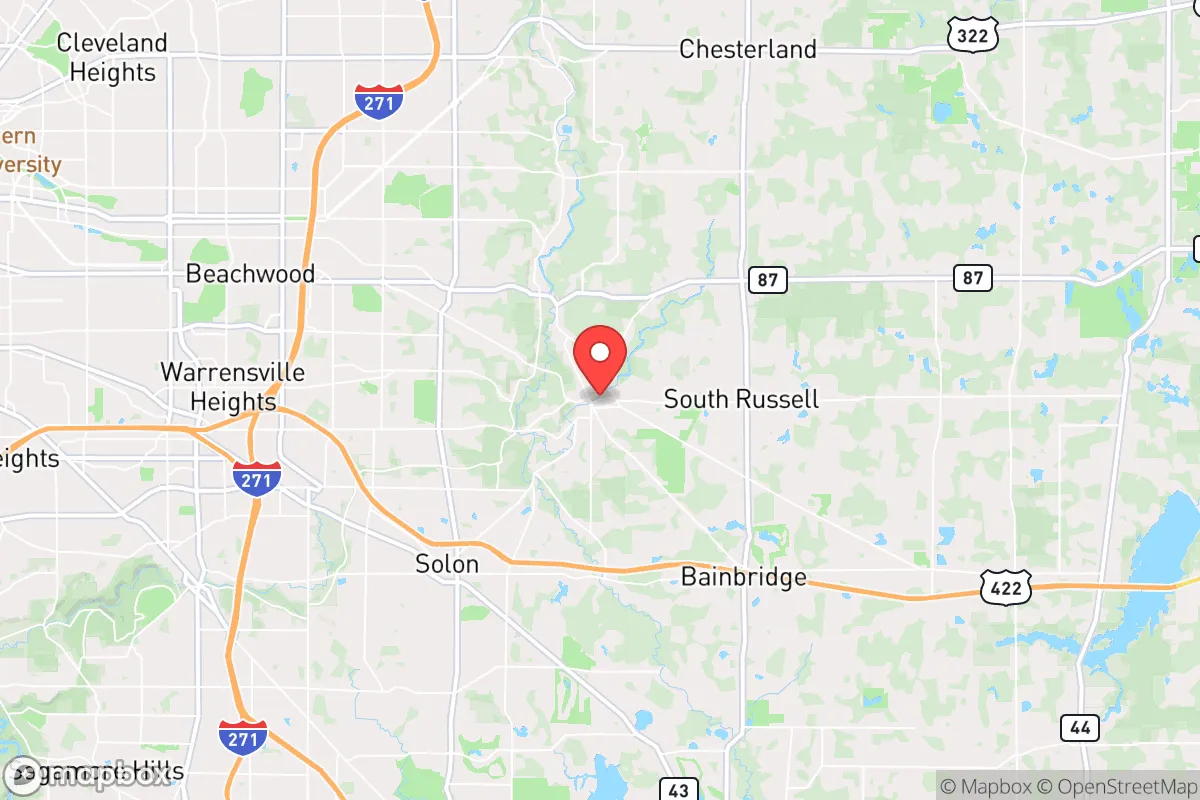
District shown is the primary district for this city’s centroid. Cities may span multiple districts.
Local Political AnalysisPolitical Analysis of Chagrin Falls, OH
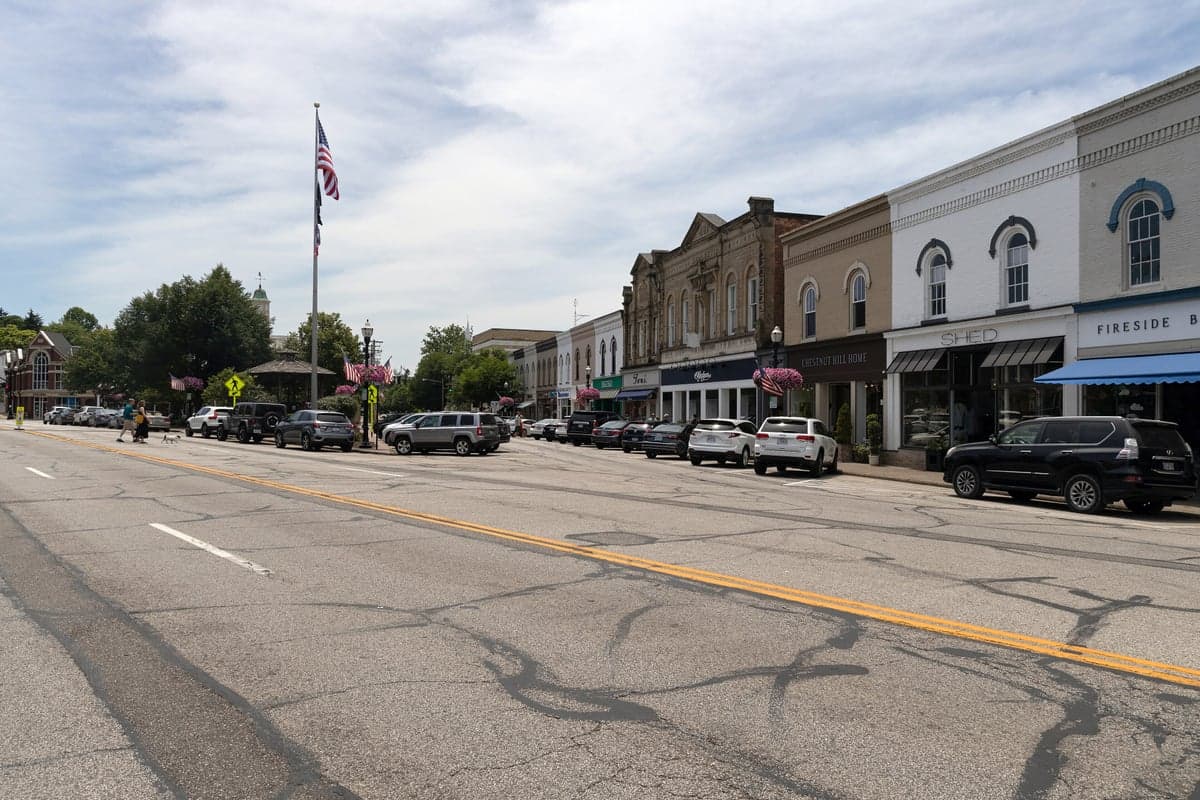
Chagrin Falls is a deep blue island in a red state. With a Cook Partisan Voting Index of D+28, this village is one of the most reliably Democratic communities in all of Ohio—a state that sits at R+5. That 33-point gap isn't just a statistic; it's the defining feature of local politics here. You'll see yard signs for Democratic candidates in every ward, and the village council tends to lean progressive, though with a pragmatic, small-town sensibility. The trajectory has been steadily blue for decades, and if anything, it's getting bluer as younger families move in from the East Side and Cleveland proper, drawn by the schools and the walkable downtown.
How it compares
Drive ten minutes in almost any direction and the political landscape flips. Neighboring Bainbridge Township and Aurora lean Republican, while Solon to the west is a swing area that's been trending right. The contrast is starkest in a presidential election year: Chagrin Falls precincts routinely deliver 70-80% of the vote for Democratic candidates, while surrounding Geauga and Portage counties vote comfortably red. This makes the village a political outlier—a place where national Democratic politics feel normal, even as the rest of the region votes the other way. For context, the D+28 PVI is comparable to precincts in inner-ring Cleveland suburbs like Shaker Heights or Cleveland Heights, but Chagrin Falls is smaller and more insular, which gives its liberalism a distinct, locally-owned flavor.
What this means for residents
For liberal residents, Chagrin Falls is a comfortable place to live without feeling like you're in a political bubble. You'll find like-minded neighbors, a local Democratic club that's active but not strident, and a general civic culture that values environmental stewardship and public education. Conservative residents aren't a majority, but they're not invisible either. There's a quiet but present Republican minority, especially among longer-term residents and those involved in local business or the equestrian community. The village's small size means most political disagreements stay civil—you're more likely to debate school funding or leaf pickup than national culture wars. That said, the national divide does seep in. During the 2020 election, some residents reported tension around yard signs and social media posts, but nothing that fundamentally disrupted the village's social fabric.
One practical distinction: Chagrin Falls has its own municipal income tax (1.5% for residents, 1.0% for non-residents who work here), which funds local services and schools. This is a policy choice that reflects the community's willingness to invest in public goods—a value that aligns with its Democratic lean. Meanwhile, surrounding towns with more conservative electorates tend to rely more on property taxes and have been slower to adopt local income taxes. If you're moving here, expect a community that takes local governance seriously, votes in high numbers, and expects its officials to be responsive. The politics are real, but they're also local—and that makes all the difference.

State Political ClimatePolitical Climate in Ohio
State Political AnalysisPolitical Environment in the State
Ohio is a classic swing state that has shifted decisively rightward over the past decade, now carrying a Cook PVI of R+5 after voting for Donald Trump by 8 points in both 2016 and 2020 and by a wider margin in 2024. The state’s political center of gravity has moved from the old manufacturing-heavy, union-Democratic model of the 1990s and early 2000s to a more culturally conservative, working-class Republican coalition, driven by the collapse of Democratic margins in rural and exurban areas and a slow but steady rightward drift in the suburbs. For a relocator, this means you’re moving into a state where Republicans control every statewide office, both chambers of the legislature, and the state supreme court, but where local politics can vary wildly from deep red to deep blue depending on which county you land in.
Urban vs. rural divide
The political map of Ohio is a textbook study in the urban-rural split. The three big C’s — Cleveland, Columbus, and Cincinnati — are Democratic strongholds, with Cuyahoga County (Cleveland) delivering 66% for Biden in 2020 and Franklin County (Columbus) hitting 62%. But the rest of the state is overwhelmingly red. The old Democratic strongholds in the Mahoning Valley around Youngstown and the coal country of southeastern Ohio have flipped hard; Mahoning County, which went for Obama by 20 points in 2012, voted for Trump by 4 points in 2024. The suburban ring around Cincinnati, particularly Butler County and Warren County, are among the most reliably Republican suburbs in the Midwest, routinely voting 65-70% Republican. Meanwhile, the rural northwest and west-central counties — places like Mercer County and Auglaize County — are deep red, often hitting 75-80% Republican. The only real political outliers are the college towns: Athens (home to Ohio University) votes heavily Democratic, and Oxford (Miami University) leans left, but neither has enough population to shift the statewide balance.
Policy environment
Ohio’s policy environment is broadly conservative but with some notable wrinkles. The state has a flat income tax rate of 3.5% as of 2025, down from a top rate of nearly 5% a decade ago, and the legislature is actively discussing further cuts. Sales tax is 5.75% at the state level, with local add-ons that can push it to 8% in some cities. Property taxes are moderate but vary significantly by district; the average effective rate is about 1.5% of home value. The state is a right-to-work state in practice if not by law — a 2011 law was repealed by referendum in 2011, but union membership has continued to decline. On education, Ohio has a robust school choice system: it has one of the oldest and largest voucher programs in the country (the EdChoice program), plus a growing network of charter schools. Homeschooling is lightly regulated, requiring only a notification and an annual assessment. Healthcare policy is mixed: the state expanded Medicaid under the Affordable Care Act in 2014, and roughly 3 million Ohioans are on the program, but the legislature has added work requirements for able-bodied adults. Election laws have been tightened in recent years: voter ID is now required (a photo ID, not just a utility bill), early voting is available but not as expansive as in some states, and drop boxes are limited to one per county.
Recent policy direction
The last five years have seen a clear conservative shift across multiple policy fronts. On gun rights, Ohio became a permitless carry state in 2022, meaning anyone 21 or older who can legally possess a firearm can carry it concealed without a license. The state also passed a "stand your ground" law in 2021, removing the duty to retreat before using deadly force in self-defense. On education and parental rights, the legislature passed the "Parents Bill of Rights" in 2023, requiring schools to notify parents of any changes to a student’s health or well-being and banning instruction on sexual orientation and gender identity in grades K-3. On abortion, the picture is more complicated: voters passed a constitutional amendment in 2023 enshrining abortion access up to fetal viability, overriding a 2019 "heartbeat bill" that had banned abortion after six weeks. The legislature has since passed a law requiring parental consent for minors and mandating that abortion facilities meet ambulatory surgical center standards, but the core right remains protected by the state constitution. On property rights, Ohio is a relatively strong property rights state, with no statewide rent control and a relatively straightforward eminent domain process. On privacy and surveillance, the state has no comprehensive data privacy law, though a bill is pending. On voting, the legislature passed a law in 2023 requiring photo ID, eliminating the option to use a utility bill or bank statement, and shortening the absentee ballot application window.
Civil unrest & political movements
Ohio has seen its share of political flashpoints in recent years. The 2020 protests in Columbus and Cincinnati following the murder of George Floyd were large but largely peaceful, though there were instances of property damage and looting in downtown Columbus. The state has a visible and organized pro-life movement that remains active despite the 2023 amendment, particularly in rural areas and in the statehouse, where legislative leaders have explored further restrictions that would pass constitutional muster. On the right, the "election integrity" movement is strong, with activists in counties like Butler and Warren pushing for hand-counting of ballots and more aggressive voter roll purges. Immigration politics are less heated than in border states, but there have been flashpoints in Springfield, where a surge of Haitian immigrants in 2023-2024 led to local tensions and national attention after Trump amplified claims about the community. There is no sanctuary city policy anywhere in Ohio; in fact, state law requires local law enforcement to cooperate with federal immigration authorities. The "secession" or nullification rhetoric you see in some western states is virtually nonexistent here — Ohio is too politically integrated and too central to the national conversation for that kind of talk.
Projection
Over the next 5-10 years, Ohio is likely to remain a solidly Republican state, but the margin may narrow slightly as the Columbus metro continues to grow and diversify. The Columbus area is adding population faster than the rest of the state, and its Democratic lean is becoming more pronounced; if that trend continues, it could shave a point or two off the statewide Republican advantage. However, the rural and exurban areas are not going to flip back — the old union-Democrat model is dead, and the cultural alignment of those voters with the GOP is durable. The biggest wild card is the state’s slow population growth overall; Ohio is not a high-in-migration state like Texas or Florida, so the demographic changes will be gradual. For a new resident, the practical takeaway is that the state’s political direction is stable and conservative, with no signs of a major shift. If you’re moving to a red county, you’ll find a government that reflects your values; if you’re moving to a blue city, you’ll find a local government that pushes back against state policy on things like housing, policing, and environmental regulation, but within the limits set by Columbus.
For a relocator, the bottom line is that Ohio offers a predictable, conservative-leaning policy environment at the state level, with significant local variation. If you value low taxes, school choice, gun rights, and a business-friendly regulatory climate, you’ll find the statehouse on your side. If you prefer a more progressive local government on social issues, you can find that in the major cities and college towns. The state is not a political battleground in the way it was 20 years ago — it’s now a reliably red state with blue islands, and that reality shapes everything from tax policy to school funding to the feel of daily life. Choose your county carefully, and you’ll likely find a community that fits your politics.
* Values derived from national, state, county, city and local statistics and may differ in a specific area. Last updated: 2026-08-10T17:45:38.000Z
Narrative content on this page is AI-generated and may contain mistakes. Verify any details that matter before acting on them.
ReloMaps may earn a commission from affiliate links at no extra cost to you.

