Photo: Wikipedia
Political ClimatePolitical Climate in Castle Pines, CO
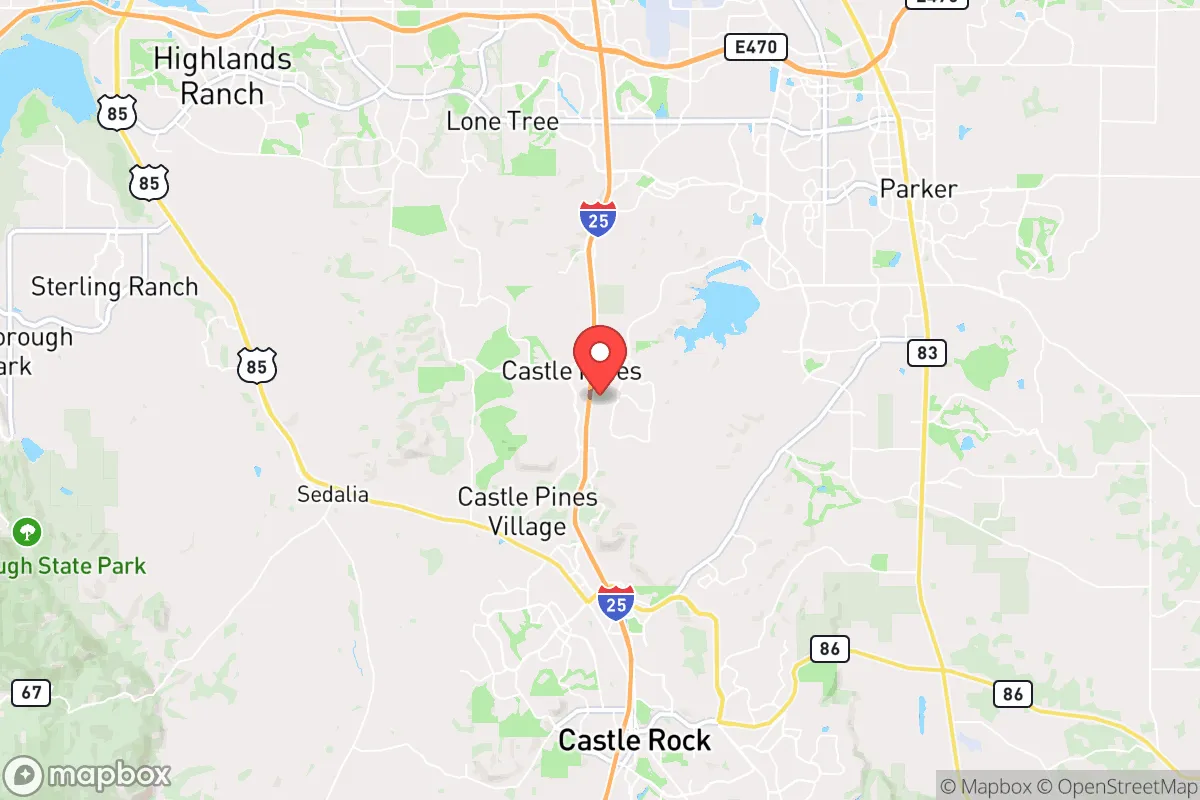
District shown is the primary district for this city’s centroid. Cities may span multiple districts.
Local Political AnalysisPolitical Analysis of Castle Pines, CO
Castle Pines has long been a solidly conservative stronghold, and that hasn't changed much despite the rapid growth pushing south from Denver. The area's Cook PVI of R+9 tells the real story—this isn't a purple suburb hedging its bets; it's a place where folks vote their values, and those values lean heavily toward limited government, personal responsibility, and keeping the tax man at bay. If you look at the voting patterns over the last decade, you'll see Castle Pines consistently backing Republican candidates by comfortable margins, even as neighboring Douglas County has seen some of its more urban pockets drift leftward. The trajectory here is one of cautious stability—new residents tend to be families and professionals who moved specifically to escape the progressive policies creeping into places like Denver and Boulder, and they're not shy about keeping things that way.
How it compares
Drive ten minutes north to Lone Tree or fifteen minutes east to Parker, and you'll start to feel the political temperature shift. Lone Tree, with its newer high-rises and transit-oriented development, has a noticeable libertarian-leaning streak but also attracts a younger, more moderate crowd that's less reflexively conservative. Parker is a mixed bag—still red overall, but you'll find more yard signs for moderate Democrats in certain neighborhoods than you'd ever see in Castle Pines. Head west toward the mountains into Jefferson County, and the contrast sharpens: places like Evergreen and Conifer are more libertarian than Republican, with a live-and-let-live attitude that sometimes votes against gun rights or property rights. Castle Pines, by contrast, remains reliably conservative—not just in presidential elections, but down-ballot too. School board races, county commissioner seats, even local water board elections tend to go the conservative way here. That consistency matters because it means the local government isn't suddenly going to impose new mandates or zoning rules that trample on how you want to live your life.
What this means for residents
For someone moving here, the political climate translates directly into daily life. You won't see mask mandates or business shutdowns being debated at city council meetings—Castle Pines largely told the state to pound sand during the worst of the overreach in 2020 and 2021. Property taxes stay relatively low because the local government isn't chasing every progressive pet project. The schools, part of the Douglas County School District, have been a battleground for years between traditionalists and those pushing critical theory or gender ideology in the classroom, but Castle Pines parents have consistently voted for board members who prioritize academics over activism. If you're worried about government creeping into your garage, your child's education, or your paycheck, this is a place where that fight is still being fought—and mostly won. The downside? If you're hoping for light rail or dense urban amenities, you'll be disappointed. The trade-off for limited government is limited services, and that's exactly how most residents want it.
Culturally, Castle Pines is defined by a few distinct policy distinctions that set it apart from the Denver metro area. The city has no municipal income tax, no rent control ordinances, and a strong property rights ethos that makes it hard for the county to impose restrictive land-use regulations. You'll also notice a heavy emphasis on Second Amendment culture—there are multiple gun ranges and sporting goods stores within a ten-minute drive, and open carry is common and uncontroversial. The biggest concern among long-time residents right now is the slow creep of state-level policies from the capitol in Denver. The state legislature has been pushing electric vehicle mandates, energy regulations that drive up utility costs, and housing bills that could override local zoning. Castle Pines fights back through its representation in the state house and senate, but the worry is real: if the state keeps tightening the screws, even a solidly conservative town can only hold the line for so long. For now, though, it remains one of the last places in the Front Range where you can still feel like the government trusts you to run your own life.

State Political ClimatePolitical Climate in Colorado
State Political AnalysisPolitical Environment in the State
Colorado has shifted from a classic purple swing state to a solidly blue-leaning state over the past two decades, with Democrats now controlling the governorship, both U.S. Senate seats, and both chambers of the state legislature. The state voted for Hillary Clinton by 5 points in 2016, Joe Biden by 13 points in 2020, and Kamala Harris by roughly 11 points in 2024, reflecting a durable leftward tilt driven primarily by explosive growth in the Denver metro area and along the Front Range. While rural and mountain counties remain deeply Republican, their electoral weight has been steadily diluted by the influx of out-of-state transplants, particularly from California and the Northeast, who have transformed once-competitive suburbs into Democratic strongholds.
Urban vs. rural divide
The political map of Colorado is a tale of two states. The Denver-Boulder corridor, including Denver, Boulder, Aurora, and Lakewood, is the engine of Democratic dominance, routinely delivering 65-75% of the vote for statewide Democrats. Boulder County is among the most liberal jurisdictions in the nation, while Denver County has become a one-party enclave. The suburbs that once leaned purple—places like Jefferson County (Golden, Lakewood) and Arapahoe County (Centennial, Littleton)—have flipped decisively blue since 2016, driven by college-educated professionals and younger families. Meanwhile, the Eastern Plains, the Western Slope, and the San Luis Valley remain solidly Republican. El Paso County (Colorado Springs) is the state’s largest conservative stronghold, voting +15 R in 2024, and Weld County (Greeley) remains deeply red. The rural-urban divide is stark: in 2024, Hinsdale County (population ~800) voted +50 R, while Denver County voted +60 D. The key battlegrounds that decide statewide elections are the fast-growing exurban counties like Douglas County (Castle Rock, Parker), which voted +4 R in 2024—a significant shift from +17 R in 2016, signaling that even once-reliable conservative suburbs are trending left.
Policy environment
Colorado’s policy environment has become increasingly progressive, with a tax and regulatory posture that many conservatives find concerning. The state income tax rate was cut from 4.55% to 4.4% in 2024 under the Taxpayer’s Bill of Rights (TABOR) surplus refund mechanism, but overall state spending has grown dramatically—up over 40% since 2019. Property taxes have become a flashpoint, with voters approving Proposition HH in 2023 to slow assessment growth, though many conservatives argue it merely delays inevitable increases. On education, Colorado has embraced universal school choice through the 2024 Colorado Option, which expanded charter schools and open enrollment, but the state also mandates comprehensive sex education and has adopted social-emotional learning standards that some parents view as ideological. Healthcare is dominated by the state-run Connect for Health Colorado exchange, and the state has expanded Medicaid under the Affordable Care Act. Election laws have been significantly tightened by Democrats: Colorado now has universal mail-in voting, same-day registration, and automatic voter registration, which conservatives argue erodes ballot security. The state also enacted the 2021 Election Reform Bill (SB21-250), which banned private funding of election administration but also expanded mail ballot drop boxes—a mixed bag that has not satisfied either side.
Trajectory & freedom
Colorado’s trajectory on personal freedom is decidedly mixed, with notable expansions of government control in several key areas. On gun rights, the state has become a national leader in restrictions: the 2013 magazine capacity ban (15 rounds) was followed by the 2024 “red flag” law (HB24-1173), which allows courts to temporarily seize firearms from individuals deemed a risk, and the 2024 “safe storage” law (HB24-1348) requiring firearms to be locked up or face criminal penalties. These laws have sparked a massive exodus of gun owners to Wyoming and Texas. On parental rights, the 2023 “Gender-Affirming Care” law (SB23-188) prohibits conversion therapy for minors and protects access to puberty blockers and hormone therapy, overriding parental consent requirements in some cases—a major red flag for conservative families. Medical autonomy took a hit with the 2024 “Right to Health” amendment (Proposition 131), which enshrined abortion access in the state constitution up to viability, with no parental notification requirement for minors. On property rights, the 2023 “Land Use” bill (SB23-213) preempted local zoning to force higher-density housing near transit, overriding local control in suburban communities like Centennial and Highlands Ranch. Taxation remains a bright spot due to TABOR, which caps revenue growth and requires voter approval for tax increases, but Democrats have repeatedly found workarounds, including the 2023 “Hospital Provider Fee” reclassification that freed up $500 million in spending without a vote.
Civil unrest & political movements
Colorado has seen its share of political flashpoints. The 2020 George Floyd protests in Denver turned violent, with over $2 million in property damage and the temporary occupation of the Denver Police Department’s downtown precinct. The “Defund the Police” movement gained traction in Denver, leading to a 2021 budget cut of $8.4 million, though most was restored after a crime spike. On the right, the “Colorado Project” and “Moms for Liberty” chapters have organized around school board races, particularly in Douglas County and El Paso County, where conservative slates won control in 2023. Immigration politics are contentious: Colorado is a “sanctuary state” under the 2019 “Trust Act” (SB19-242), which limits local law enforcement cooperation with ICE. This has led to tensions in Aurora, where a 2024 gang-related shooting involving Venezuelan migrants made national headlines. Election integrity remains a hot-button issue: the 2020 election saw no major fraud, but the 2022 “Election Integrity” ballot measure (Proposition 129) that would have required voter ID for mail ballots was defeated by a 2-1 margin. Secession rhetoric is alive in rural areas: the “State of Jefferson” movement has pockets in the Eastern Plains, and Weld County commissioners voted in 2023 to explore secession from Colorado, citing Denver’s dominance. A new resident would notice the stark contrast between the “Colorado for All” bumper stickers in Boulder and the “Don’t California My Colorado” signs on pickup trucks in Pueblo.
Projection
Over the next 5-10 years, Colorado is likely to continue its leftward drift, though at a slower pace. The state’s population growth is concentrated in the Front Range, with Weld County and El Paso County growing fastest, but these areas are also seeing an influx of younger, more diverse residents who lean Democratic. The 2030 census redistricting will likely cost rural areas another congressional seat, further diluting conservative influence. However, there are countervailing forces: the high cost of living (Denver metro home prices are up 60% since 2020) is driving some transplants to cheaper states, and the 2024 election saw a slight rightward shift in Jefferson County and Arapahoe County, suggesting the blue wave may be cresting. The biggest wildcard is the state’s water crisis: the Colorado River compact negotiations could force drastic cuts to Front Range development, potentially slowing the demographic engine of Democratic growth. A conservative moving in now should expect a state where the legislature and governor will continue to push progressive policies on guns, education, and healthcare, but where local control in conservative counties like Douglas and El Paso offers some buffer. The state’s economic dynamism and natural beauty will remain draws, but the political environment will feel increasingly hostile to traditional values.
For a conservative considering relocation, Colorado offers a mixed bag: world-class outdoor recreation, a strong economy, and TABOR’s tax protections, but a state government that is actively expanding its reach into personal freedoms, particularly on guns, parental rights, and medical autonomy. The best bet for a conservative is to target Colorado Springs or Douglas County, where local governance provides a partial firewall against Denver’s progressive agenda. But be prepared: the culture war is real here, and the state’s trajectory suggests it will become more, not less, challenging for those who value limited government and individual liberty. If you’re looking for a state that’s trending in the right direction, Colorado is not it—but if you’re willing to fight for your values in a beautiful setting, there are still communities where you can make a stand.
* Values derived from national, state, county, city and local statistics and may differ in a specific area. Last updated: 2026-04-28T23:51:10.000Z
Narrative content on this page is AI-generated and may contain mistakes. Verify any details that matter before acting on them.
ReloMaps may earn a commission from affiliate links at no extra cost to you.

