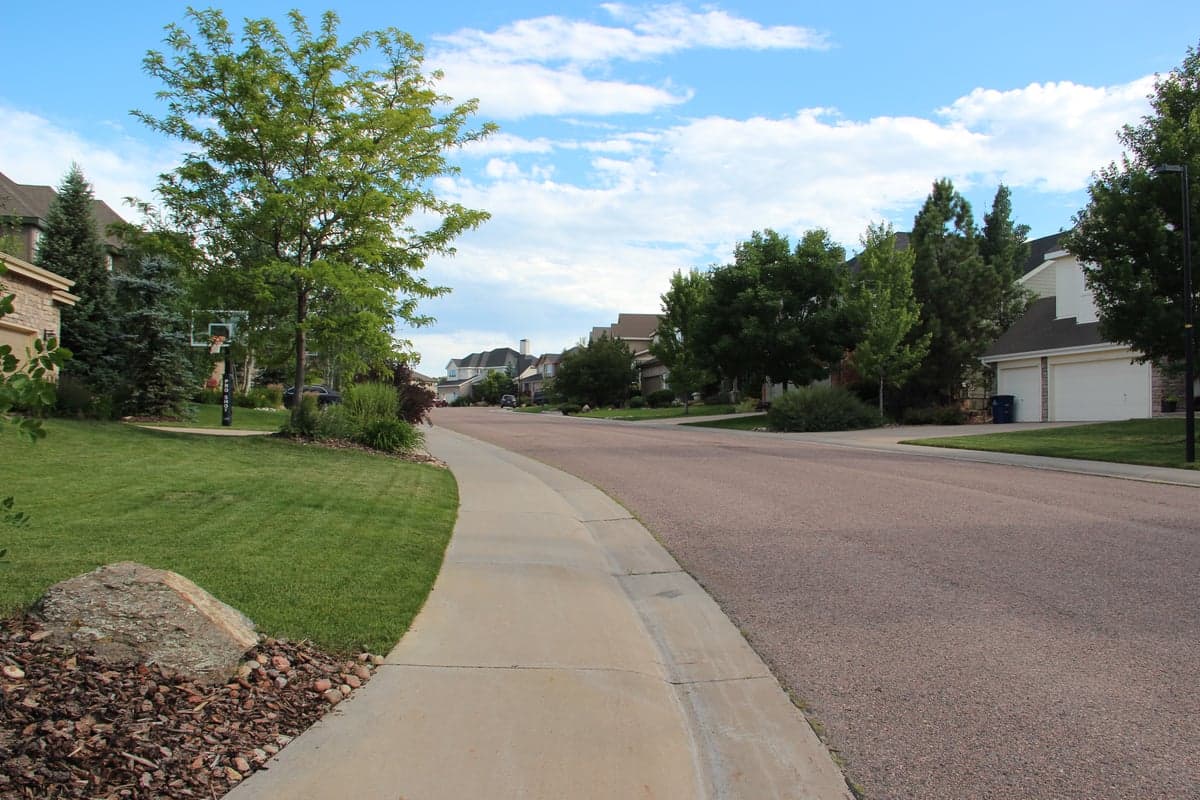
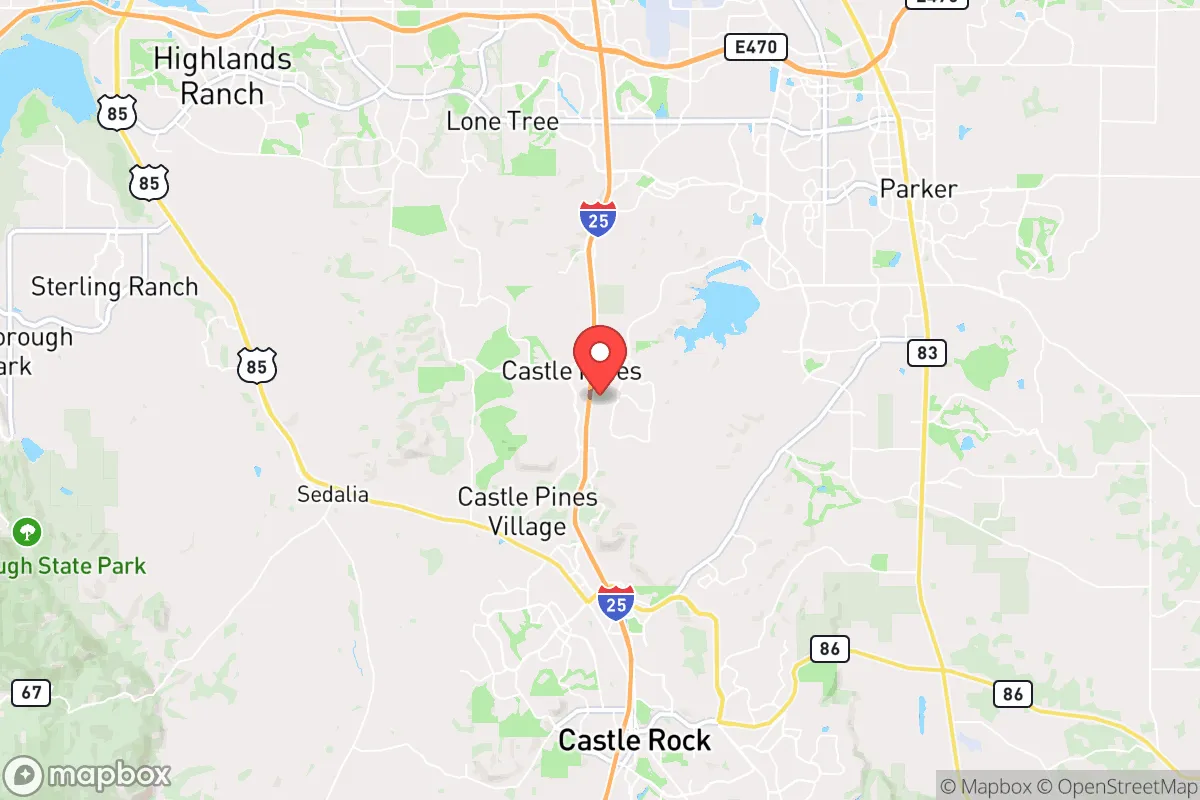
Photo: Wikipedia
Personal Sovereignty in Castle Pines, CO
Viable for self-reliance. Generally workable, though some barriers may limit total independence.
What does Personal Sovereignty tell us?
Personal Sovereignty measures your capacity for self-reliance and independence with minimal government friction. Higher scores mean fewer barriers between you and the way you want to live... but it assumes you have the space you need and good neighbors.
What does this tell us?
Personal Sovereignty measures your capacity for self-reliance and independence with minimal government friction. Higher scores mean fewer barriers between you and the way you want to live... but it assumes you have the space you need and good neighbors.
State Policy
Energy independence: Net exporter (110% of energy produced in-state)
Personal Liberty
Homesteading

Personal Liberty Analysis
Castle Pines, Colorado, offers a notably high degree of personal sovereignty relative to many Front Range communities, largely due to its location in Douglas County—a jurisdiction that consistently pushes back against state-level overreach. While Colorado as a whole has trended left on certain issues, Castle Pines sits in a pocket where local governance, tax policy, and community culture still prioritize individual autonomy. For those concerned with preserving the ability to live, defend, and provide for themselves without excessive government interference, this area presents a strategic balance of proximity to urban resources and a more self-reliant, less regulated environment.
Tax burden and regulatory posture: how Castle Pines compares to the state
Douglas County maintains one of the lowest property tax rates in Colorado, with the 2024 mill levy for Castle Pines hovering around 0.65% of assessed value—roughly half the rate found in neighboring Denver or Boulder counties. This is not accidental; the county has a long-standing policy of resisting property tax increases and has not raised the general fund mill levy since 1982. The state's income tax is a flat 4.4%, but there is no local income tax in Castle Pines, and the city does not impose a business personal property tax on small businesses. Regulatory posture is equally favorable: the city's zoning code is streamlined, with no rent control ordinances, no plastic bag bans, and no mandatory paid leave mandates beyond state minimums. For a survivalist or prepper, this means fewer layers of bureaucratic friction when acquiring land, building structures, or running a home-based business. The county's planning department is known for processing permits efficiently, and there is no countywide building moratorium or energy code that would force expensive retrofits on existing homes. Compared to the regulatory thicket of Boulder or Larimer County, Castle Pines feels like a relative free zone for property owners.
Self-defense and gun law specifics: what Castle Pines residents need to know
Colorado is a "shall-issue" state for concealed carry permits, and Douglas County's sheriff's office processes applications with minimal delay—typically under 30 days. Castle Pines itself has no local firearms ordinances beyond state law, meaning no magazine capacity bans, no waiting periods beyond the state's three-day handgun purchase wait, and no restrictions on open carry within city limits. The 2021 state law requiring universal background checks for private firearm transfers remains in effect, but private sales between family members or at gun shows are still legal with a background check. Crucially, Douglas County has declared itself a "Second Amendment Sanctuary County," and the sheriff has publicly stated he will not enforce any state laws he deems unconstitutional, such as the 2013 magazine capacity limit (15 rounds) or the 2024 "red flag" law. For those concerned about government overreach, this local defiance is a significant buffer. The nearest gun ranges and training facilities are within a 15-minute drive, including the Colorado Gun Club in Sedalia and the Douglas County Shooting Range. Castle Pines residents can legally store firearms in vehicles on private property, and there are no restrictions on building a personal armory or storing ammunition in bulk. The practical takeaway: if you want to exercise your right to self-defense without local interference, Castle Pines is one of the safest bets in the state.
Self-reliance and homesteading viability: lot sizes, zoning, and off-grid feasibility
Castle Pines is not a rural homesteading paradise—most residential lots are in planned subdivisions with HOAs—but there are pockets of land that allow for significant self-reliance. The city's zoning code permits accessory dwelling units (ADUs) on lots of 7,000 square feet or larger, and there is no prohibition on keeping chickens, bees, or small livestock within city limits, provided they are not a nuisance. For those seeking true off-grid capability, the unincorporated areas of Douglas County just outside Castle Pines (such as the "Castle Pines Village" area) offer parcels of 2 to 5 acres where well water, septic systems, and solar panels are standard. The county does not require grid-tied electrical connections for new construction, and there are no restrictions on rainwater collection—Colorado legalized it in 2016 for residential use. However, HOAs in the master-planned communities often have covenants that limit visible solar panels, satellite dishes, or backyard gardens, so buyers must carefully review HOA documents before purchasing. The county's zoning code explicitly allows "home occupations" like small-scale food production, woodworking, or firearms repair without a special permit, as long as no employees are on site. For a prepper looking to stockpile supplies, there are no county-level limits on food storage, fuel storage (up to 1,000 gallons of propane without a permit), or ammunition storage. The biggest constraint is water: the area is semi-arid, and well permits are subject to the state's prior appropriation doctrine, so a new well on a small lot may not be feasible. But for those willing to invest in a larger parcel with an existing well, Castle Pines offers a realistic path to partial self-sufficiency within commuting distance of Denver.
Personal liberties: parental rights, medical autonomy, speech, and property
Douglas County has been a battleground for parental rights in education, and Castle Pines sits within the Douglas County School District, which in 2023 adopted a policy requiring parental notification for any changes to a student's mental, emotional, or physical health—including gender identity. The district also allows parents to opt their children out of any curriculum they find objectionable, and it does not teach critical race theory or comprehensive sex education without parental consent. Medical autonomy is similarly protected: Colorado's 2023 law requiring employers to provide paid leave for abortion travel does not apply to small businesses with fewer than 16 employees, and Castle Pines has no local mandate on vaccine requirements for private businesses. Property rights are robust: the city has no rent control, no inclusionary zoning requiring affordable housing set-asides, and no short-term rental bans (though HOAs may restrict them). Free speech is protected by the First Amendment, and there have been no local ordinances targeting political signs, leafleting, or public gatherings. The county sheriff's office does not enforce federal immigration law, but it also does not participate in "sanctuary" policies that would limit cooperation with ICE. For those concerned about government overreach into family decisions, medical choices, or property use, Castle Pines offers a legal environment that leans heavily toward individual discretion rather than state mandates.
In the broader context of Colorado's political trajectory, Castle Pines stands out as a sovereignty-friendly enclave. While the state has enacted red flag laws, magazine capacity limits, and universal background checks, Douglas County's local defiance and the city's own hands-off approach create a buffer that is rare along the Front Range. Compared to areas like Colorado Springs (which has similar gun-friendly policies but higher crime rates) or rural counties like Elbert (which offer more land but fewer services), Castle Pines strikes a practical balance: you get the legal framework for self-reliance, the cultural support for personal liberties, and the infrastructure to actually live that lifestyle without being isolated. For a survivalist or prepper who wants to be within 30 minutes of Denver's medical and supply resources while maintaining maximum personal sovereignty, Castle Pines is arguably the best option in the state.

* Values derived from national, state, county, city and local statistics and may differ in a specific area. Last updated: 2026-04-28T23:51:10.000Z
Narrative content on this page is AI-generated and may contain mistakes. Verify any details that matter before acting on them.
ReloMaps may earn a commission from affiliate links at no extra cost to you.

