
Photo: Wikipedia
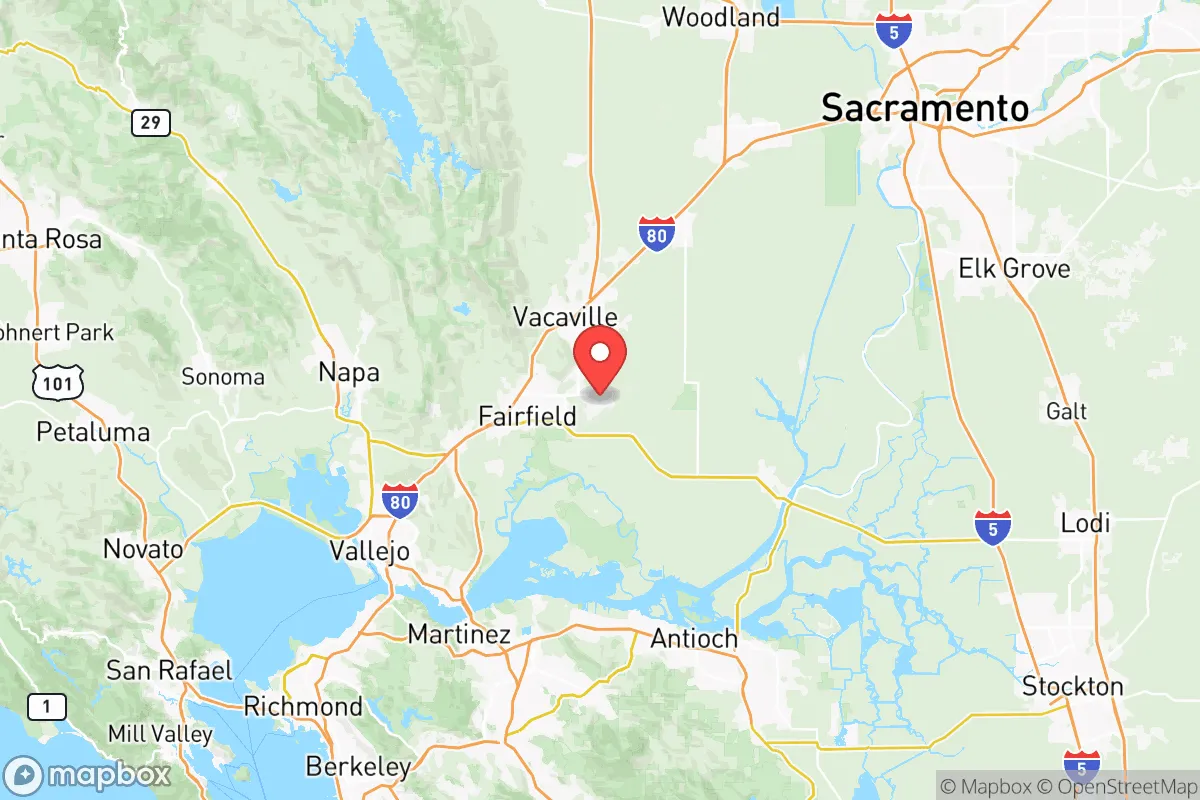
Personal Sovereignty in Solano County
Viable for self-reliance. Generally workable, though some barriers may limit total independence.
What does Personal Sovereignty tell us?
Personal Sovereignty measures your capacity for self-reliance and independence with minimal government friction. Higher scores mean fewer barriers between you and the way you want to live... but it assumes you have the space you need and good neighbors.
What does this tell us?
Personal Sovereignty measures your capacity for self-reliance and independence with minimal government friction. Higher scores mean fewer barriers between you and the way you want to live... but it assumes you have the space you need and good neighbors.
State Policy
Energy independence: Importer (25% of energy produced in-state)
Personal Liberty
Homesteading

Personal Liberty Analysis
Solano County offers a mixed personal sovereignty environment that leans more permissive than neighboring Bay Area counties but remains subject to California's statewide regulatory framework. Residents in cities like Fairfield, Vacaville, and Dixon experience notably lighter local governance than those in Benicia or Vallejo, where municipal codes and zoning are denser. For a relocation audience valuing autonomy, the county's agricultural roots and inland character provide meaningful room for self-reliance, though state-level constraints on firearms, taxes, and land use remain significant factors to weigh.
Tax burden and regulatory posture across Solano County cities
California's state income tax (top marginal rate of 13.3%) and sales tax (base 7.25%, plus local add-ons) apply uniformly, but Solano County's property tax environment is relatively favorable. Under Proposition 13, annual increases are capped at 2%, and the county's effective property tax rate averages roughly 1.1% of assessed value—lower than many coastal California counties. Local regulatory posture varies sharply by municipality. Dixon and Rio Vista maintain a more permissive approach to home-based businesses and agricultural uses, with minimal business license friction. In contrast, Vallejo and Benicia impose stricter zoning codes and higher permit fees for home renovations or new construction. Solano County's Board of Supervisors has generally resisted expanding rent control or tenant protection ordinances beyond state mandates, which appeals to property owners. The county's overall regulatory climate is best described as moderate within California—less burdensome than the Bay Area core but more restrictive than inland counties like Colusa or Sutter.
Self-defense rights and gun law specifics in Solano County
California's statewide gun laws—including universal background checks, a 10-day waiting period, an assault weapons ban, and a roster of approved handguns—apply fully in Solano County. However, local enforcement and cultural attitudes vary. Fairfield and Vacaville have multiple gun shops and shooting ranges, and the sheriff's office has historically been more accommodating on concealed carry permits (CCW) than urban counties like Alameda or San Francisco. Under the post-Bruen "shall-issue" framework, Solano County processes CCW applications with reasonable timelines, typically 90–120 days. Dixon and rural areas near the Sacramento River Delta have a strong hunting and sport shooting culture, with fewer local restrictions on where firearms can be carried. Self-defense law in Solano County is thus a mixed picture: state law imposes significant constraints, but local administration is among the more permissive in California. Residents should expect to comply with state registration and storage requirements, but the county's political climate does not add extra layers of restriction.
Self-reliance and homesteading viability: lot sizes, zoning, and off-grid feasibility
Solano County's agricultural zoning and rural character make it one of the more viable areas in Northern California for homesteading and off-grid living. Minimum lot sizes in agricultural zones (A-20, A-40) range from 20 to 40 acres, particularly in the unincorporated areas around Rio Vista, Birds Landing, and Collinsville. These parcels often allow livestock, orchards, and limited commercial farming without special permits. Off-grid feasibility is constrained by state building codes—California requires connection to an approved water source and septic system, and solar panels must comply with Title 24 energy standards. However, Dixon and rural Vacaville have more flexible enforcement of accessory dwelling unit (ADU) rules, allowing multiple structures on larger parcels. Rainwater catchment is permitted but regulated, and composting toilets require health department approval. For those seeking true self-reliance, Solano County offers a middle ground: more feasible than the Bay Area's suburban sprawl but less permissive than Nevada or Arizona. The county's agricultural preservation policies actually help maintain large, undeveloped tracts, which benefits homesteaders willing to navigate state permitting.
Personal liberties: parental rights, medical autonomy, speech, and property
Parental rights in Solano County are shaped by California's progressive education and health mandates. The state requires comprehensive sexual health education in public schools (California Healthy Youth Act), and parents cannot opt out of all content—only specific lessons. School boards in Fairfield and Vacaville have seen contentious debates over curriculum transparency, with some conservative parents pushing for more opt-out options. Medical autonomy is limited by state vaccine mandates for school attendance and strict licensing for alternative practitioners. However, Solano County has a higher density of independent midwives and direct-primary-care physicians than the Bay Area average. Free speech protections are robust under the First Amendment, but local ordinances in Vallejo and Benicia impose stricter time-place-manner restrictions on public demonstrations. Property rights are relatively strong: Solano County does not have countywide rent control, and short-term rental regulations (Airbnb, VRBO) are minimal outside of Vallejo's historic districts. Eminent domain actions are rare, and the county's general plan favors private development on agricultural land with fewer hurdles than coastal counties. For a conservative-leaning individual, Solano County's personal liberties environment is a compromise—state law imposes significant limits, but local governance is less intrusive than in the Bay Area core.
Overall, Solano County ranks as a moderate-to-permissive jurisdiction for personal sovereignty within California's constraints. Compared to Marin or Alameda counties, Solano offers lower taxes, more homesteading land, and friendlier gun administration. Compared to Nevada or Texas, it falls short on medical freedom, off-grid legality, and tax burden. For a relocation reader who values self-reliance but needs to remain in California for work or family, Solano County—particularly the inland cities of Dixon, Rio Vista, and rural Vacaville—provides the most breathing room. The county's agricultural heritage and moderate local governance create a niche where personal sovereignty is achievable, provided one accepts the state-level framework as a given.

* Values derived from national, state, county, city and local statistics and may differ in a specific area. Last updated: 2026-11-21T00:35:28.000Z
Narrative content on this page is AI-generated and may contain mistakes. Verify any details that matter before acting on them.
ReloMaps may earn a commission from affiliate links at no extra cost to you.

