
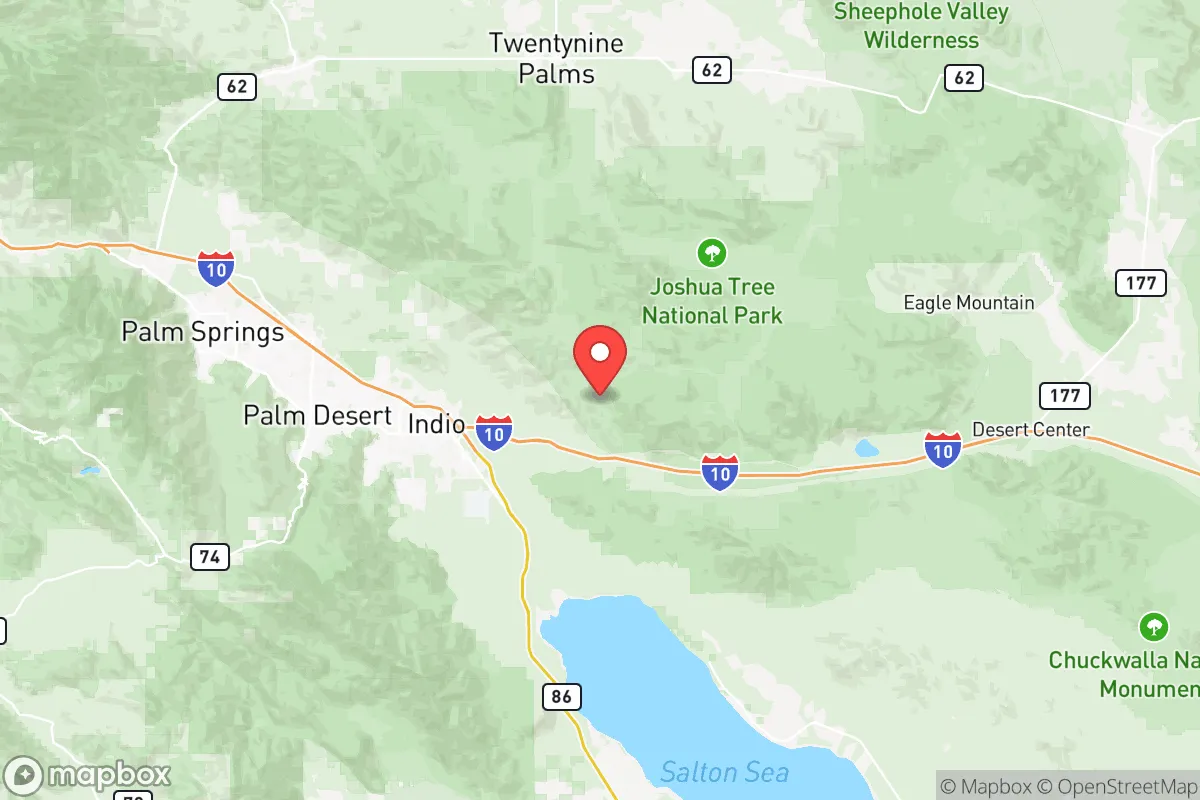
Photo: Wikipedia
Personal Sovereignty in Riverside County
Moderate friction. Expect trade-offs in some aspect of personal liberty and independence.
What does Personal Sovereignty tell us?
Personal Sovereignty measures your capacity for self-reliance and independence with minimal government friction. Higher scores mean fewer barriers between you and the way you want to live... but it assumes you have the space you need and good neighbors.
What does this tell us?
Personal Sovereignty measures your capacity for self-reliance and independence with minimal government friction. Higher scores mean fewer barriers between you and the way you want to live... but it assumes you have the space you need and good neighbors.
State Policy
Energy independence: Importer (33% of energy produced in-state)
Personal Liberty
Homesteading

Personal Liberty Analysis
Riverside County presents a deeply mixed personal sovereignty environment, where the state of California’s heavy regulatory hand collides with a vast, geographically diverse county that still harbors pockets of genuine self-reliance. While no part of the county escapes California’s high taxes, strict gun laws, and powerful state preemption on local control, the lived experience of autonomy varies dramatically between the dense, coastal-influenced western cities and the sprawling, desert-oriented eastern communities. For a conservative-leaning individual or family, the key is understanding that personal sovereignty here is less about total freedom and more about strategic location within a county that spans over 7,200 square miles.
Tax burden and regulatory posture across Riverside County
California’s statewide tax burden is among the highest in the nation, and Riverside County is no exception. The state income tax tops out at 13.3%, and the sales tax rate in most of the county, including cities like Riverside and Murrieta, is 8.75% due to local add-ons. Property taxes are effectively capped at 1% of the purchase price under Proposition 13, but the real estate prices in desirable areas like Temecula and Corona mean a $700,000 home still carries a $7,000 annual tax bill. Regulatory posture is uniformly heavy: California’s California Environmental Quality Act (CEQA) can delay or kill development projects, and the state’s energy commission mandates strict building codes that raise construction costs. However, the county’s Board of Supervisors has a conservative majority (4-1 as of 2026), which has pushed back on some state mandates, particularly around housing density and short-term rental restrictions. In practice, this means a homeowner in Blythe or Desert Center faces far less local interference than one in Palm Springs, where city-level ordinances on noise, landscaping, and vacation rentals are more aggressive. The overall regulatory posture is best described as "state-heavy, county-moderate, city-variable."
Self-defense and gun law specifics in Riverside County
California’s gun laws are among the strictest in the nation, and Riverside County residents must navigate them carefully. The state bans "assault weapons" by feature, requires a 10-day waiting period for all firearm purchases, mandates a Firearm Safety Certificate, and prohibits carrying concealed weapons without a permit (CCW). However, the county itself is a relative bright spot: the Riverside County Sheriff’s Department, under Sheriff Chad Bianco (a vocal Second Amendment supporter), has historically issued CCW permits on a "shall-issue" basis, even before the Supreme Court’s Bruen decision in 2022. As of 2026, the county processes CCW applications efficiently, with typical turnaround times of 60-90 days. Gun culture is strongest in the eastern and southern parts of the county. In Hemet and San Jacinto, gun shops and shooting ranges are common, and open carry of long guns (while legally restricted in most places) is more tolerated in rural settings. Conversely, in Palm Springs and La Quinta, local ordinances restrict firearms in city parks and public buildings, and the cultural attitude is less permissive. For self-defense, the key takeaway is that while state law is restrictive, the county’s enforcement and permitting are as friendly as California allows. Stand-your-ground laws do not exist in California; a person has a duty to retreat if safe to do so before using deadly force, a fact that surprises many relocating from Texas or Florida.
Self-reliance and homesteading viability: lot sizes, zoning, and off-grid feasibility
Homesteading viability in Riverside County is a tale of two landscapes. In the western, more populated corridor—cities like Corona, Norco, and Lake Elsinore—zoning is suburban, lot sizes average 6,000-10,000 square feet, and HOAs are common, often prohibiting chickens, goats, or vegetable gardens visible from the street. Norco, famously known as "Horsetown USA," is a notable exception: it allows horses on residential lots as small as 10,000 square feet, and many properties have barns and corrals. But for serious off-grid living, the eastern desert regions are the only realistic option. In Blythe (near the Arizona border) and Desert Center, unincorporated county land can be purchased for as little as $5,000-$15,000 per acre, with minimal zoning restrictions. Off-grid feasibility is mixed: solar is viable year-round, but water is the critical constraint. Most desert parcels lack well water, and drilling a well can cost $20,000-$40,000 with no guarantee of yield. Rainwater catchment is legal but limited by state water rights laws. Septic systems are permitted, but the county requires a percolation test and permits that can take months. The county’s building department enforces California’s Title 24 energy code even in remote areas, meaning a tiny home or shipping container dwelling must meet insulation and window standards that raise costs. For a family wanting true self-reliance—growing food, harvesting water, generating power—the eastern county offers the best chance, but it requires significant capital and patience with state bureaucracy.
Personal liberties: parental rights, medical autonomy, speech, and property
On personal liberties, Riverside County reflects California’s progressive state laws but with local conservative pushback. Parental rights are a flashpoint: California law prohibits schools from notifying parents if a child changes their gender identity or pronouns, a policy that the Riverside County Board of Supervisors voted to formally oppose in a 2023 resolution (non-binding). In practice, school districts vary: Temecula Valley Unified and Murrieta Valley Unified have conservative boards that have adopted parental notification policies, while Palm Springs Unified follows state guidance closely. Medical autonomy is heavily restricted by state law: California mandates vaccines for school attendance (with narrow medical exemptions), and the state’s health department tightly controls access to alternative treatments. Ivermectin and hydroxychloroquine prescriptions are legal but face pharmacy-level hurdles. Speech is broadly protected under the First Amendment, but California’s "hate speech" laws and workplace harassment statutes create a chillier environment for controversial expression than in less regulated states. Property rights are the most constrained liberty: California’s Coastal Commission has jurisdiction over development in western Riverside County, and the state’s housing laws (like SB 9 and SB 10) allow lot splits and duplexes in single-family zones without local approval, overriding local zoning control. For a property owner in Rancho Mirage or Indian Wells, this means the city cannot stop a neighbor from building a duplex next door, a significant erosion of traditional property rights that frustrates many conservative homeowners.
Overall, personal sovereignty in Riverside County is a compromise: you get a conservative-leaning local government that fights state overreach, but you cannot escape California’s high taxes, strict gun laws, and progressive mandates on education and healthcare. Compared to a state like Texas or Arizona, the autonomy environment is significantly more constrained. However, within California, Riverside County is one of the better options for those prioritizing self-reliance, particularly in its eastern desert and southern rural areas. For a family willing to navigate state bureaucracy and pay a premium for land and taxes, the county offers genuine homesteading potential and a community that values personal freedom—but it is not a libertarian haven. The smartest move is to target a specific city or unincorporated area that aligns with your priorities, rather than expecting county-wide consistency.

* Values derived from national, state, county, city and local statistics and may differ in a specific area. Last updated: 2026-06-16T00:32:27.000Z
Narrative content on this page is AI-generated and may contain mistakes. Verify any details that matter before acting on them.
ReloMaps may earn a commission from affiliate links at no extra cost to you.

