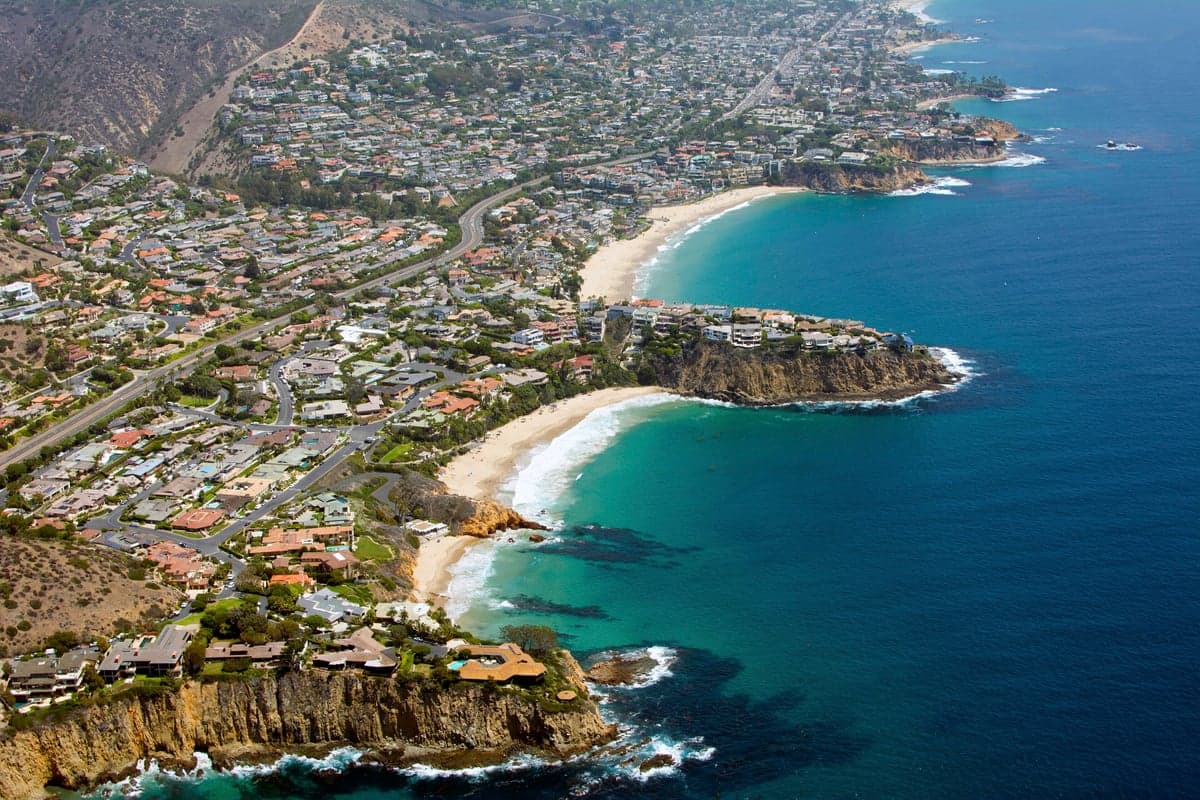
Photo: Wikipedia
Political ClimatePolitical Climate in Orange County
Showing district-level results — no local-only data available.
Local Political AnalysisPolitical Analysis of Orange County
Orange County, California, has undergone a dramatic political transformation over the past decade, shifting from a reliable Republican stronghold to a competitive, Democratic-leaning region with a Cook Partisan Voting Index (PVI) of D+3. This is a far cry from the county that helped launch Richard Nixon and Ronald Reagan, and it reflects deep demographic and cultural changes. While the county as a whole now leans blue, it is far from a monolith—pockets of deep red, deep blue, and critical swing territory create a nuanced political landscape that feels very different from the solidly Democratic state of California (PVI D+12).
How it compares
The difference between Orange County’s D+3 and California’s D+12 is not just a number—it represents a fundamentally different political reality. In statewide races, Orange County is often the only major population center that can keep a Republican candidate competitive. For example, in the 2022 gubernatorial election, Orange County voted for Republican Brian Dahle by a narrow margin, while the state as a whole gave Gavin Newsom a 20-point victory. This split is visible at the local level too. The northern and coastal cities—Huntington Beach, Newport Beach, and San Juan Capistrano—remain reliably red, with Huntington Beach earning a reputation as the "most conservative city in California" for its fights over mask mandates and library book policies. In contrast, Santa Ana, Irvine, and Anaheim’s central core are solidly blue, driven by younger voters and a growing Asian American and Latino electorate. The real action is in the swing precincts of Laguna Niguel, Mission Viejo, and parts of Westminster, where ticket-splitting is common—these areas voted for Joe Biden in 2020 but also for Republican congressional candidates like Michelle Steel in 2022. That kind of split-ticket behavior is almost unheard of in the rest of California, where straight-ticket voting is the norm.
What this means for residents
For conservative residents, Orange County offers a rare refuge in California where their votes still matter. A Republican running for Congress or the state assembly can win here, especially in the 40th, 45th, and 48th districts. Local policy fights—like the push for a voter-ID law in Huntington Beach or resistance to high-density housing in Newport Beach—have real traction. For liberal residents, the county’s shift means they no longer feel like a permanent minority. Progressive policies on rent control, sanctuary city status, and climate action have passed in Santa Ana and Irvine, and the county board of supervisors flipped to a Democratic majority in 2020 for the first time in decades. However, the D+3 lean means nothing is guaranteed. A single bad election cycle could flip the board back, and statewide ballot measures like Proposition 47 (criminal justice reform) or Proposition 15 (property tax reform) often see Orange County vote against them even when they pass statewide. This creates a constant, low-grade political tension that keeps both sides engaged and active.
Culturally, Orange County’s political split manifests in everyday life. In Huntington Beach, you’ll still see "Trump 2024" flags flying alongside surf shops, and the city council regularly makes national news for its culture-war battles. Drive 15 minutes inland to Santa Ana, and you’ll find murals of Cesar Chavez, bilingual city council meetings, and a thriving arts scene that leans heavily progressive. The county’s large Vietnamese American community in Westminster and Garden Grove adds another layer—historically conservative on foreign policy and small government, but increasingly split on social issues as younger generations move left. What unites the county, oddly enough, is a shared frustration with Sacramento. Whether you’re a conservative angry about gas taxes or a liberal frustrated by housing costs, there’s a bipartisan consensus that the state government doesn’t always understand Orange County’s specific needs. That shared grievance, more than any party label, defines the local political culture.

State Political ClimatePolitical Climate in California
State Political AnalysisPolitical Environment in the State
California is a solidly Democratic state with a Cook PVI of D+12, meaning it votes about 12 points more Democratic than the national average in presidential elections. Over the past 20 years, the state has shifted from a competitive purple state—George W. Bush lost it by only 10 points in 2004—to a deep blue stronghold, driven largely by the massive population and political weight of the coastal metros. The dominant coalition is a mix of urban progressives, Latino voters, and suburban moderates, but the state’s size means there are significant pockets of conservative strength, particularly in the Central Valley and inland rural areas. For a conservative-leaning relocator, the reality is that state-level politics are overwhelmingly controlled by Democrats, but local governance varies dramatically depending on where you land.
Urban vs. rural divide
The political map of California is a tale of two states. The coastal metros—Los Angeles, San Francisco, San Diego, and San Jose—are the engine of the Democratic majority, with San Francisco County routinely voting 85% Democratic in presidential races. These areas drive the state’s policy direction on everything from housing to environmental regulation. In contrast, the Central Valley and inland regions are reliably red: Bakersfield (Kern County) voted +22 for Trump in 2020, and Redding (Shasta County) is a conservative stronghold where the county GOP is often more libertarian than the state party. The Inland Empire—Riverside and San Bernardino counties—has been a fascinating battleground: once reliably red, it has shifted purple as suburban voters, particularly in areas like Temecula and Murrieta, have moved left on cultural issues while remaining fiscally conservative. The 2022 midterms saw several Central Valley House seats flip to Democrats, but the region’s rural core remains deeply Republican.
Policy environment
California’s policy environment is defined by high taxes, heavy regulation, and a progressive social agenda. The state has a progressive income tax with a top marginal rate of 13.3% (the highest in the nation), a state sales tax that can exceed 10% in some cities, and some of the highest gas taxes in the country. Property taxes are capped at 1% of assessed value under Proposition 13, but reassessments upon sale can still hit newcomers hard. Regulatory costs are high: housing construction is notoriously slow and expensive due to CEQA (California Environmental Quality Act) lawsuits, and the state’s energy policies have driven electricity rates to among the highest in the nation. On education, California spends over $20,000 per pupil, but outcomes are middling, and the state has a strong teachers’ union that often blocks reform. Healthcare is heavily regulated, with a state-run exchange (Covered California) and a push toward single-payer that has stalled. Election laws are among the most liberal: universal mail-in voting, same-day registration, and no-excuse absentee ballots are standard. For a conservative, the state-level policy environment is a challenge, but local governments in conservative counties often push back—for example, Orange County has a history of resisting state housing mandates.
Recent policy direction
Recent legislation in California has moved decisively left on a broad range of issues. On gun rights, the state has some of the strictest laws in the nation: a 2023 law (SB 2) effectively bans concealed carry in most public places, and a 2024 measure (AB 28) imposes an 11% excise tax on firearms and ammunition. Self-defense law is narrow, with no “stand your ground” statute and a duty to retreat in most situations. On parental and education rights, the state passed AB 1955 in 2024, which prohibits school districts from requiring parental notification when a child changes their gender identity—a flashpoint for conservative families. Speech is broadly protected under the state constitution, but a 2022 law (AB 587) requires social media platforms to report their content moderation policies, which critics see as a chilling effect. Privacy and surveillance: the California Consumer Privacy Act (CCPA) is one of the strongest in the nation, but law enforcement access to data remains broad. Medical and bodily autonomy: California is a sanctuary for abortion access, with a 2022 constitutional amendment (Prop 1) enshrining reproductive rights, and it has legalized assisted suicide (End of Life Option Act). Property rights are weak: rent control is widespread, and a 2024 law (SB 4) allows churches to build affordable housing on their land without local zoning approval. Voting access is extremely easy, but ballot harvesting and universal mail-in voting have been a source of election integrity concerns among conservatives. The overall direction is toward more regulation and more state preemption of local control.
Civil unrest & political movements
California has a long history of political activism, and recent years have seen both left and right movements flare up. The 2020 George Floyd protests in Los Angeles and Oakland were among the largest in the nation, with significant property damage and a subsequent push for police reform that led to the 2023 passage of SB 2 (use-of-force standards). On the right, the 2021 recall election of Governor Gavin Newsom—which he survived by a 62-38 margin—was driven by frustration with COVID-19 lockdowns, business closures, and school closures. The “Freedom Convoy” movement had a smaller echo in California, with truckers protesting vaccine mandates in 2022. Immigration politics are a constant flashpoint: California is a “sanctuary state” under SB 54 (2017), which limits local law enforcement cooperation with federal immigration authorities. This has led to tensions between state officials and conservative counties like El Dorado and Placer, which have passed resolutions opposing the policy. Secession rhetoric is mostly fringe, but the “Calexit” movement has periodically surfaced, though it has no serious political traction. Election integrity controversies have been muted compared to other states, but conservative activists have raised concerns about ballot harvesting and the state’s universal mail-in system, particularly in close House races like the 2022 CA-27 contest in Lancaster.
Projection
Over the next 5-10 years, California is likely to remain solidly Democratic at the state level, but the margin may narrow slightly due to demographic shifts. The state’s population has been declining since 2020, driven by out-migration to Texas, Arizona, and Nevada—much of it from conservative-leaning households and middle-class families priced out of coastal housing. The remaining population is increasingly diverse, with Latino and Asian voters growing as a share of the electorate, and these groups have shown some movement toward the GOP in recent cycles (e.g., Latino voters in the Central Valley swung right in 2022). However, the state’s Democratic lean is reinforced by the fact that many of the out-migrants are Republicans, while new arrivals from abroad tend to lean left. Housing costs will remain a central political issue, and the state may see more aggressive pro-housing legislation (like SB 4 and the 2024 “builder’s remedy” laws) that could slowly shift the political geography by densifying suburbs. For a conservative moving in now, expect the state-level policy environment to remain hostile to gun rights, parental rights, and tax cuts, but local control in conservative counties will continue to provide a buffer. The biggest wildcard is the state’s fiscal health: a projected $73 billion deficit in 2024-25 could force spending cuts or tax increases, which may accelerate out-migration and shift the political calculus.
For a new resident—especially one with conservative leanings—the bottom line is that California offers a high-cost, high-regulation environment where your political voice at the state level will be muted, but your local community may align more closely with your values. If you choose a conservative county like Kern or Shasta, you’ll find like-minded neighbors and local officials who push back against state mandates. If you land in a purple suburb like Temecula or Simi Valley, you’ll experience the cultural tensions of a state in flux. The practical takeaway: do your homework on local governance, budget for high taxes and energy costs, and be prepared for a political landscape where your vote for president or governor will be a drop in a blue ocean, but your vote for city council or school board can still shape your daily life.
* Values derived from national, state, county, city and local statistics and may differ in a specific area. Last updated: 2026-07-15T04:49:20.000Z
Narrative content on this page is AI-generated and may contain mistakes. Verify any details that matter before acting on them.
ReloMaps may earn a commission from affiliate links at no extra cost to you.

