
Photo: Wikipedia
Political ClimatePolitical Climate in El Dorado County
Showing district-level results — no local-only data available.
Local Political AnalysisPolitical Analysis of El Dorado County
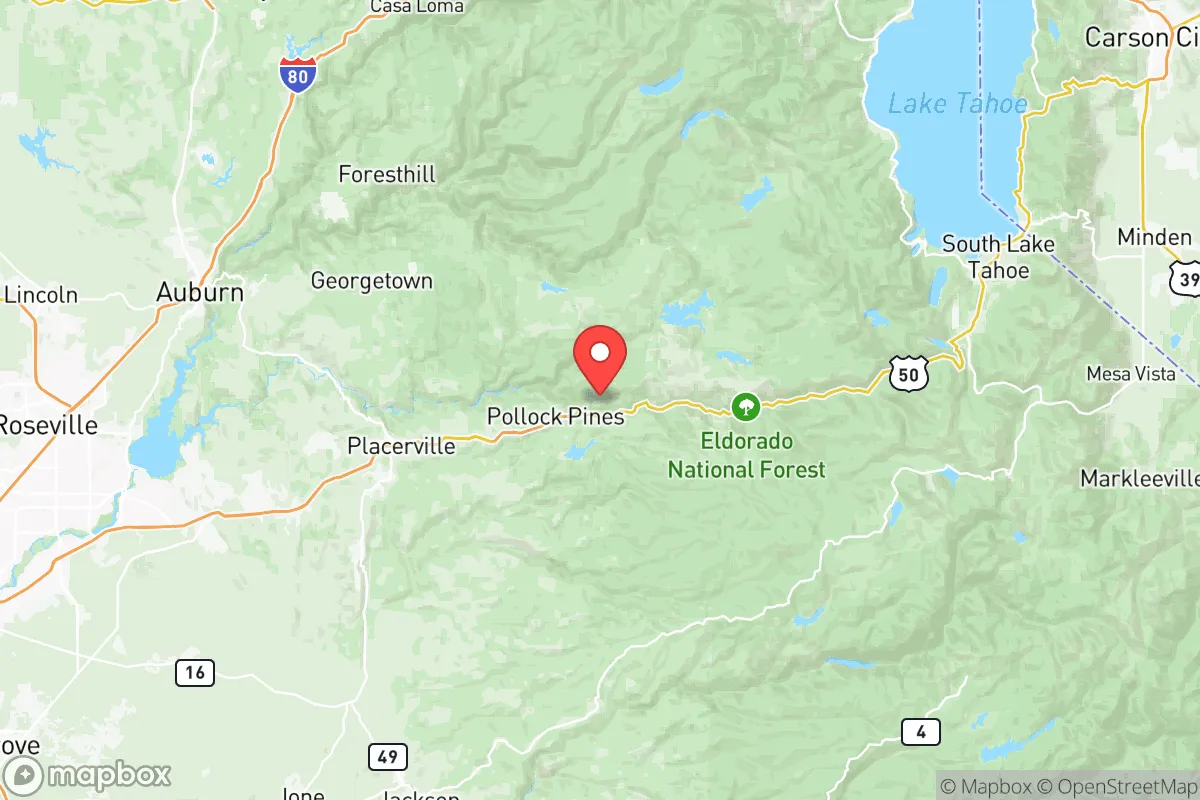
El Dorado County has long been a reliably Republican stronghold in California, with a Cook Partisan Voting Index (PVI) of R+2, meaning it votes about two points more Republican than the national average. However, the county is not a monolith; its political landscape is shifting, particularly as more residents move from the Bay Area and Sacramento into communities like El Dorado Hills and Cameron Park, bringing more moderate or even liberal leanings. Meanwhile, the rural eastern parts of the county, including towns like Placerville, Pollock Pines, and South Lake Tahoe, remain deeply conservative, creating a clear urban-rural divide that defines local elections.
How it compares
Compared to California as a whole, El Dorado County is a distinct outlier. While the state's PVI is unknown in the provided data, California is widely recognized as a solidly Democratic state, with a PVI of D+13 based on recent election results. In contrast, El Dorado County's R+2 PVI places it among the more Republican-leaning counties in the state, alongside places like Sutter and Placer counties. This means that while California voters overwhelmingly support Democratic candidates for statewide office (e.g., Gavin Newsom won the state by over 20 points in 2022), El Dorado County voters typically favor Republicans by a narrower margin. For instance, in the 2020 presidential election, Donald Trump won the county by about 5 points, while Joe Biden won California by over 29 points. The county's political trajectory is also notable: it has been trending slightly more Democratic in recent years, particularly in the fast-growing El Dorado Hills area, where new housing developments have attracted a more diverse and politically mixed population. This shift is not yet enough to flip the county blue, but it has made local races more competitive, especially in school board and city council elections.
What this means for residents
For conservative residents, El Dorado County offers a political environment where their views are the majority, making it easier to find like-minded neighbors and local officials who share their priorities on issues like property rights, gun ownership, and limited government. They can expect local government to generally resist state-level mandates on housing density or environmental regulations, though they must still contend with California's overarching laws. For liberal residents, the county can feel like a political island, but there are growing pockets of blue in El Dorado Hills and, to a lesser extent, in Placerville's historic downtown. These areas often have active Democratic clubs and progressive groups that organize around issues like climate change, affordable housing, and public education. The practical impact is that residents on both sides need to be engaged in local politics to see their values reflected, as the county's swing precincts—like those in the El Dorado Hills Business Park area—can decide close races.
Culturally, this political divide manifests in everyday life. In the western part of the county, you'll find more chain stores, newer schools, and a suburban feel that attracts families and commuters, while the eastern side retains a gold-rush-era character with small-town charm and a strong libertarian streak. Policy-wise, the county has been a battleground over issues like cannabis regulation (with some areas banning dispensaries) and wildfire prevention funding, reflecting the tension between local control and state oversight. For anyone moving here, understanding this political reality is key: you can find your tribe, but you'll also need to navigate a community that is proud of its independence and wary of Sacramento's influence.

State Political ClimatePolitical Climate in California
State Political AnalysisPolitical Environment in the State
California is a deeply blue state, with Democrats holding every statewide office and supermajorities in both legislative chambers, but that label hides a far more complex reality. The state hasn't voted Republican in a presidential race since 1988, and in 2024, Kamala Harris carried it by roughly 20 points. But that statewide number is pulled hard by the massive, reliably Democratic metros of Los Angeles, the San Francisco Bay Area, and Sacramento. Over the last 20 years, the state has shifted left on social and cultural issues, but a significant and vocal conservative minority remains, concentrated in the Central Valley, the Inland Empire, and the far northern counties. For a relocator, the practical takeaway is that your experience of California's politics will depend almost entirely on which of its wildly different regions you choose to live in.
Urban vs. rural divide
The political map of California is a study in extremes. The coastal metros—San Francisco, Los Angeles, Oakland, San Jose, and San Diego—are among the most liberal jurisdictions in the country, routinely voting 70-85% Democratic. These cities drive the state's overall leftward tilt. In contrast, the Central Valley cities of Bakersfield, Fresno, and Visalia are reliably Republican, often voting 55-65% for GOP candidates. The far northern counties, like Shasta and Siskiyou, are even more conservative, with Redding serving as a notable conservative hub. The Inland Empire—Riverside and San Bernardino—is a true battleground; it has been trending blue in presidential years but still elects Republican local officials. A fascinating microcosm is Orange County, once a GOP stronghold, which flipped to Biden in 2020 and has since elected a Democratic House majority, though its suburbs like Huntington Beach remain fiercely conservative on local issues like mask mandates and library book content.
Policy environment
California's policy environment is defined by high taxes, heavy regulation, and a strong social safety net. The state has a progressive income tax with a top marginal rate of 13.3%, the highest in the nation, and a state sales tax that can exceed 10% in some cities. Property taxes are capped by Proposition 13 at roughly 1% of purchase price, which is a major boon for long-term homeowners but creates a two-tiered system. The regulatory posture is aggressive: California has its own environmental agency (CARB) that sets vehicle emissions standards stricter than federal ones, and its own workplace safety and labor laws that go far beyond federal minimums. On education, the state spends heavily per pupil but ranks in the middle of the pack on outcomes; school choice is limited, with no broad voucher program. Healthcare is heavily regulated, with a state-run insurance exchange (Covered California) and a recent push toward a single-payer system that has stalled. Election laws are among the most liberal: universal mail-in voting, same-day registration, and no-excuse absentee voting are standard. For a conservative relocator, this means a higher tax burden and a regulatory environment that can feel stifling, especially for small business owners.
Recent policy direction
The last five years have seen California accelerate its leftward trajectory on nearly every front. On gun and self-defense law, the state passed SB 2 in 2023, which effectively bans carrying a concealed firearm in most public places, and it has a roster of approved handguns that shrinks annually. Parental and education rights have become a flashpoint: AB 1955 (2024) prohibits school districts from requiring parental notification when a child changes their gender identity, and the state has mandated ethnic studies and LGBTQ+ inclusive curricula. Speech and privacy are protected by a strong state constitution, but new laws like AB 587 (2023) require social media platforms to report their content moderation policies, which critics see as a chilling effect. On medical and bodily autonomy, California is a sanctuary for abortion access, with laws protecting providers and patients from out-of-state prosecution, and it has legalized physician-assisted suicide. Property rights are under pressure: rent control was expanded by AB 1482 (2019), and a 2024 ballot measure (Prop 33) that would have allowed even stricter local rent control failed narrowly. Taxation remains high, with no sign of a rollback. Voting and ballot access continues to expand: the state now automatically registers eligible voters when they get a driver's license. For a relocator weighing liberties, the state offers broad personal freedoms on lifestyle and medical choices but imposes significant restrictions on gun ownership, parental rights in schools, and property use.
Civil unrest & political movements
California has been a hotbed of political activism on both sides. The 2020 George Floyd protests were among the largest and most destructive in the state, particularly in Los Angeles and Oakland, where looting and arson caused billions in damage. Since then, organized left-wing activism has focused on homelessness, rent control, and police reform. On the right, the state has seen a surge in grassroots conservative movements, including the "Recall Gavin Newsom" effort in 2021, which gathered over 1.7 million signatures and forced a special election (Newsom survived with 61.8% of the vote). Immigration politics are a constant flashpoint: California is a "sanctuary state" under SB 54 (2017), which limits local law enforcement cooperation with federal immigration authorities. This has led to tensions with the Trump administration and periodic protests in border-adjacent cities like San Diego and Calexico. Secession rhetoric, while not mainstream, persists in the form of the "Calexit" movement, which has failed to gain ballot access. Election integrity controversies are less pronounced than in swing states, but conservative activists have raised concerns about the state's universal mail-in voting system, particularly after the 2020 election. A new resident would notice the visible homelessness crisis in major cities, which is often a political flashpoint, and the frequent presence of protest encampments on public property.
Projection
Over the next 5-10 years, California's political trajectory is likely to remain solidly blue, but with growing internal friction. Demographic trends favor the left: the state's Latino and Asian American populations, which lean Democratic, are growing, while the white, more conservative population is aging and shrinking. In-migration from other states is net negative, with many leaving for Texas, Arizona, and Nevada, but those who move in tend to be younger and more liberal. The biggest wildcard is housing affordability: if the state fails to build enough housing, it could drive out moderate and working-class families, further concentrating the electorate among the wealthy and the very poor, both of whom lean left. The Central Valley and Inland Empire may continue to trend blue as suburban voters shift away from the GOP on cultural issues. For a conservative relocator, the realistic expectation is that the state will not flip red, but the intensity of blue policies may moderate slightly if the state's budget crises (driven by high spending and volatile tax revenue from capital gains) force fiscal restraint. A new resident moving in now should expect to live in a state where Democratic dominance is the norm, but where local elections in conservative strongholds like Bakersfield or Huntington Beach can still produce Republican governance on the ground.
For a conservative-leaning individual or family considering a move to California, the bottom line is this: you can find a community that matches your values, but you will be living under a state government that is actively hostile to many of them. Your property taxes will be high, your gun rights severely restricted, and your children's education will follow a curriculum you may disagree with. On the other hand, if you choose a city like Bakersfield or Redding, you will find like-minded neighbors, conservative local officials, and a slower pace of life. The key is to pick your county and city carefully—California is not a monolith, and your daily experience will be shaped far more by your local government than by Sacramento. Just know that the state-level policies on taxes, regulation, and social issues are not going to change anytime soon, and you will be paying for them regardless of where you live.
* Values derived from national, state, county, city and local statistics and may differ in a specific area. Last updated: 2026-10-04T11:19:19.000Z
Narrative content on this page is AI-generated and may contain mistakes. Verify any details that matter before acting on them.
ReloMaps may earn a commission from affiliate links at no extra cost to you.

