
Photo: Wikipedia
Personal Sovereignty in California, MD
Viable for self-reliance. Generally workable, though some barriers may limit total independence.
What does Personal Sovereignty tell us?
Personal Sovereignty measures your capacity for self-reliance and independence with minimal government friction. Higher scores mean fewer barriers between you and the way you want to live... but it assumes you have the space you need and good neighbors.
What does this tell us?
Personal Sovereignty measures your capacity for self-reliance and independence with minimal government friction. Higher scores mean fewer barriers between you and the way you want to live... but it assumes you have the space you need and good neighbors.
State Policy
Energy independence: Importer (18% of energy produced in-state)
Personal Liberty
Homesteading

Personal Liberty Analysis
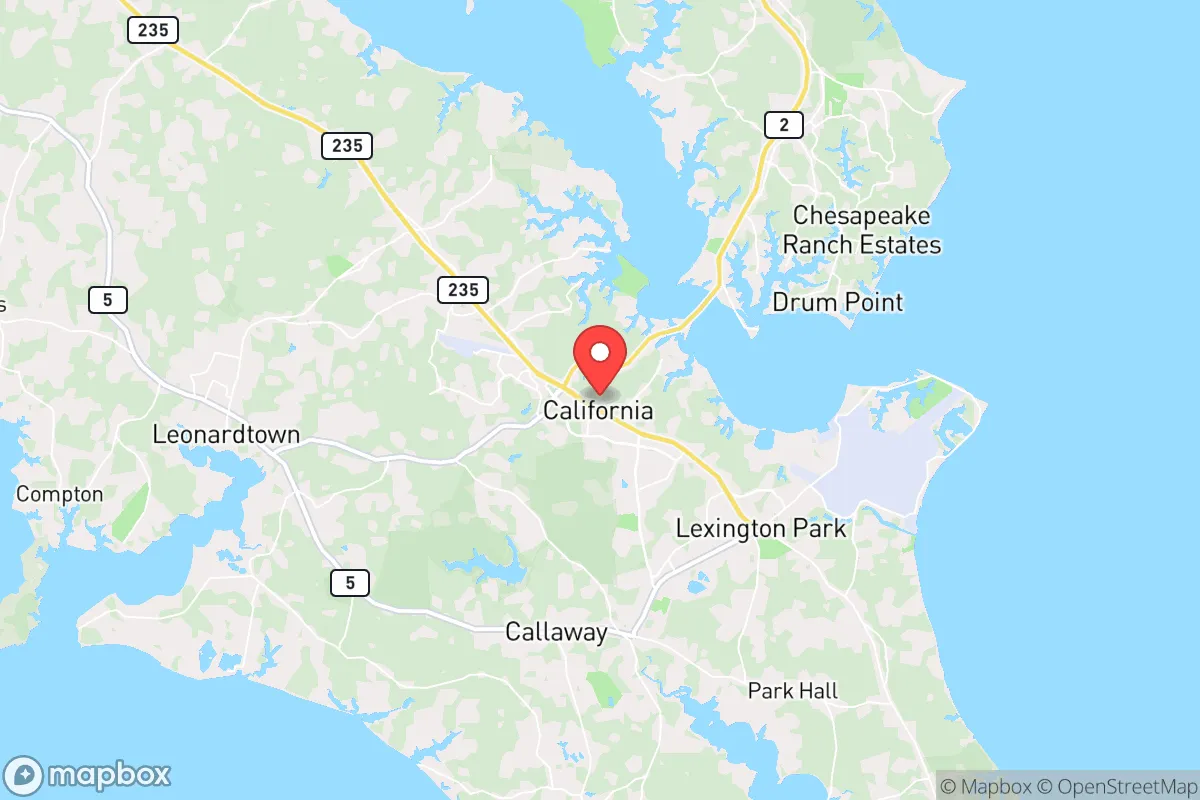
California, Maryland, offers a notably different personal sovereignty landscape than its namesake state, largely because it sits in St. Mary’s County, a jurisdiction with a more conservative, rural character that pushes back against some of Annapolis’s more restrictive policies. While Maryland as a whole imposes significant state-level constraints on gun ownership, taxation, and regulatory autonomy, the local environment in California provides meaningful practical relief through lower property taxes, more permissive zoning, and a community culture that values self-reliance. For a relocation-minded individual or family weighing personal freedom, the key trade-off is clear: you get the Chesapeake Bay lifestyle and proximity to D.C. defense jobs, but you must navigate a state that ranks in the top 10 nationally for tax burden and has some of the strictest gun laws in the country.
Tax burden and regulatory posture: How Maryland compares to its neighbors
Maryland’s overall tax burden is the 6th highest in the nation according to the Tax Foundation, and St. Mary’s County is not exempt. The state income tax rate ranges from 2% to 5.75%, and the county adds its own local income tax of 3.1% (the state maximum for counties), meaning a combined marginal rate of 8.85% for top earners. Property taxes are more moderate: the county rate is $0.933 per $100 of assessed value, and the town of California adds a small municipal tax of roughly $0.10, keeping the total around $1.03 — well below the Maryland average of $1.11. Sales tax is a flat 6%, with no local add-ons. The regulatory environment is mixed: St. Mary’s County has a reputation for being business-friendly relative to the D.C. suburbs, with a streamlined permitting process for new construction and fewer zoning hurdles than Montgomery or Prince George’s counties. However, state-level regulations on environmental compliance (Chesapeake Bay critical area laws) and building codes add layers of cost and delay. For a self-reliant individual, the property tax burden is manageable, but the income tax bite is real — especially compared to Virginia or Delaware, which have no local income tax.
Self-defense and gun law specifics: What you can and cannot do in St. Mary’s County
Maryland is a “may issue” state for concealed carry, but a 2022 Supreme Court ruling (NYSRPA v. Bruen) forced the state to adopt a “shall issue” standard. As of 2024, the Maryland State Police must issue a wear-and-carry permit if the applicant meets objective criteria — no longer requiring a “good and substantial reason.” However, the process remains onerous: applicants must complete a 16-hour training course, pass a live-fire qualification, submit fingerprints, and undergo a background check. The state also bans “assault weapons” (defined by a list of specific models and features) and limits magazine capacity to 10 rounds. St. Mary’s County Sheriff’s Office is known for being relatively pro-2A in its administration of permits, and local gun ranges like the St. Mary’s County Rifle Club are active. Open carry is legal but practically discouraged; most permit holders carry concealed. For a family, the key takeaway is that lawful self-defense with a handgun is possible, but the state imposes a higher barrier to entry than Virginia or Pennsylvania. Stand-your-ground laws do not exist in Maryland; the state follows a “duty to retreat” standard outside the home, which limits defensive options in public spaces.
Self-reliance and homesteading viability: Lot sizes, zoning, and off-grid feasibility
California, MD, is not a dense suburb — it’s a rural census-designated place with a mix of large-lot subdivisions and agricultural land. Zoning in St. Mary’s County allows for residential lots as small as 1 acre in the Rural Residential zone, but many properties in the California area sit on 2-5 acres, providing room for gardens, small livestock, and workshops. The county’s Agricultural Preservation District program protects farmland from development, keeping large tracts available for serious homesteading. Off-grid living is legally challenging: Maryland requires connection to the electrical grid for new construction, and the county health department mandates septic systems that meet strict nitrogen-reduction standards (the “Bay-Wise” program). Rainwater collection is allowed for non-potable uses (irrigation, livestock) but not for drinking without a permit. Solar panels are permitted and net metering is available, but the permitting process involves county and state review. For a family wanting to raise chickens, keep bees, or grow a substantial garden, St. Mary’s County is one of the more permissive jurisdictions in Maryland — no county-level bans on backyard chickens exist, and beekeeping is allowed with registration. However, anyone seeking full off-grid autonomy will find the regulatory framework a significant obstacle, particularly around water and waste.
Personal liberties: Parental rights, medical autonomy, speech, and property
Maryland’s political leanings affect several personal liberty areas. On parental rights, the state has a relatively strong record: parents can opt their children out of sex education and certain health curricula, and the state does not mandate COVID-19 vaccines for school attendance (as of 2024). However, Maryland has universal background checks for firearm transfers, which some parents view as an infringement on their ability to pass firearms to adult children. Medical autonomy is mixed: the state has legalized recreational marijuana (effective July 2023) and protects abortion access, but it also maintains a vaccine mandate for school entry (standard childhood vaccines) and has a prescription drug monitoring program that some view as intrusive. Free speech protections are robust under the First Amendment, but Maryland has a “hate crime” statute that enhances penalties for speech deemed threatening or harassing — a point of concern for some conservatives. Property rights are generally strong in St. Mary’s County: the county does not have rent control, and property taxes are capped at a 10% annual increase for owner-occupied homes (the “Homestead Tax Credit”). The county’s comprehensive plan emphasizes preserving rural character, which limits high-density development but also protects landowners from spot zoning changes. For a family, the most tangible liberty is the ability to use your property without excessive interference — something St. Mary’s County delivers better than most Maryland jurisdictions.
Overall, California, MD, sits in a unique sovereignty niche: it’s a conservative-leaning enclave within a blue state, offering a lighter regulatory touch on property and land use than the D.C. suburbs, while still operating under Maryland’s heavy state-level tax and gun regimes. Compared to Virginia’s Northern Neck (which has lower taxes and looser gun laws), California loses on fiscal and 2A freedom. Compared to rural Pennsylvania, it loses on off-grid feasibility and duty-to-retreat rules. But for someone who needs to be within commuting distance of Patuxent River Naval Air Station or D.C. defense contractors, and who values a rural lifestyle with decent property rights, California represents a pragmatic middle ground — not a libertarian paradise, but a place where personal sovereignty is more attainable than in most of the Mid-Atlantic’s densely regulated corridors.

* Values derived from national, state, county, city and local statistics and may differ in a specific area. Last updated: 2026-11-18T00:35:20.000Z
Narrative content on this page is AI-generated and may contain mistakes. Verify any details that matter before acting on them.
ReloMaps may earn a commission from affiliate links at no extra cost to you.

