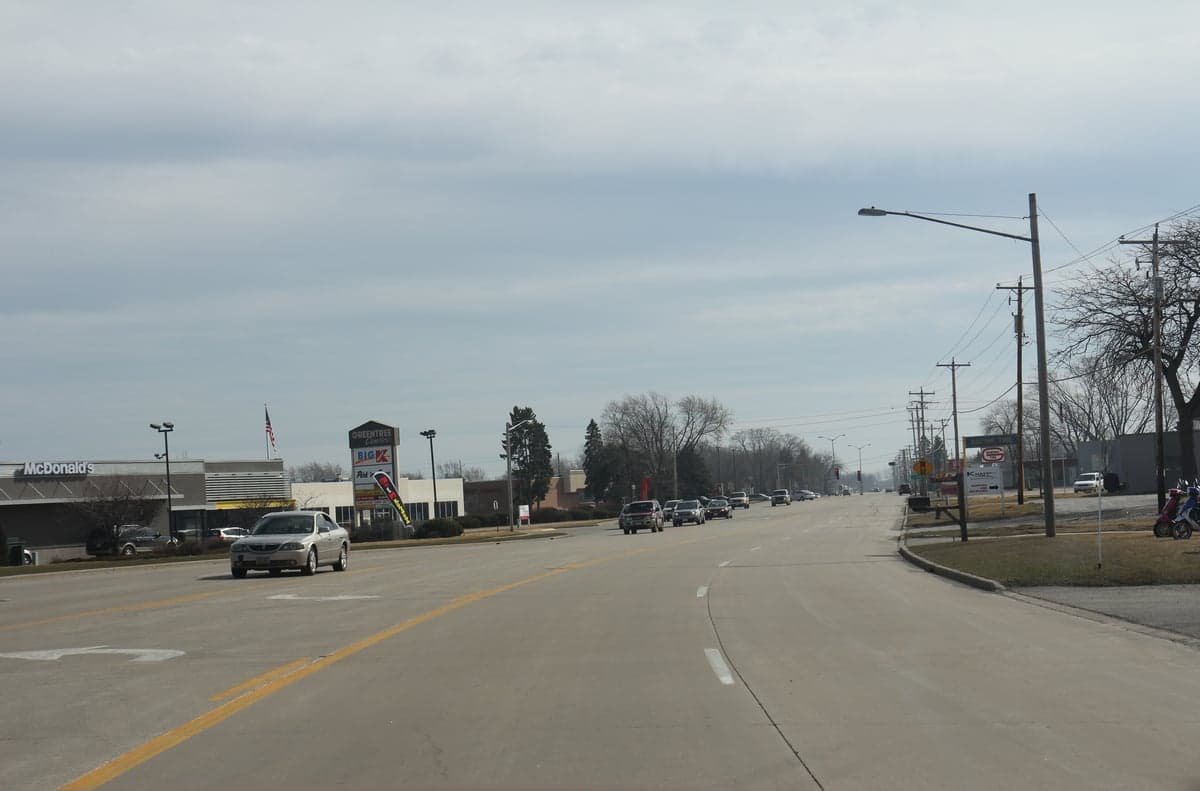
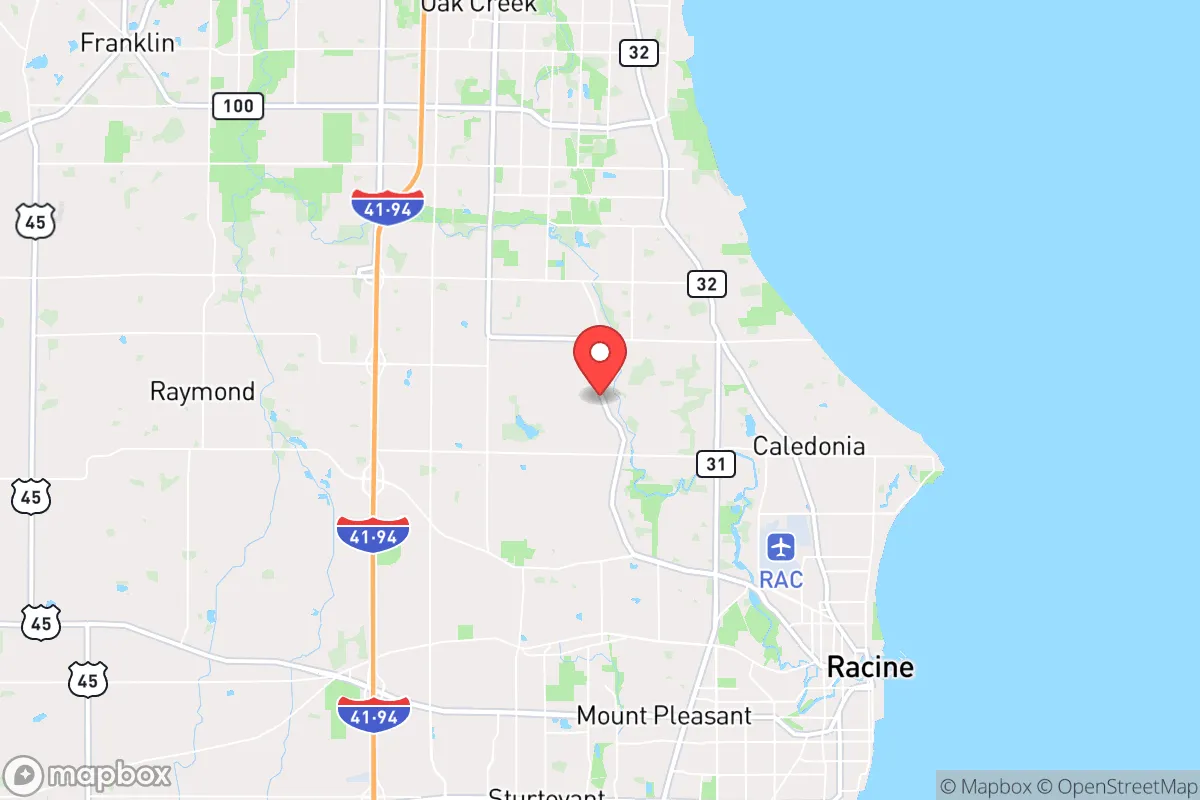
Photo: Wikipedia
Strategic Assessment of Caledonia, WI
Meaningful friction. Expect exposure to either population pressure, blast zones, or natural disaster risk. Consider buying a retreat property.
What does the Strategic Assessment tell us?
Our Strategic Assessment grades tactical survivability of an area. Major population centers, military targets, fallout zones, natural disasters, and border exposure all drive risk — lower exposure means a more defensible position in a crisis.
This is heavily inspired by Joel Skousen's Strategic Relocation book. Highly recommended you checkout the book ($)What does this tell us?
Our Strategic Assessment grades tactical survivability of an area. Major population centers, military targets, fallout zones, natural disasters, and border exposure all drive risk — lower exposure means a more defensible position in a crisis.
This is heavily inspired by Joel Skousen's Strategic Relocation book. Highly recommended you checkout the book ($)Strategic Pillars

Key Distances
Regional Safe Places
Below is our recommended "safe zones" in Wisconsin and the surrounding area based on our strategic heuristics. For most people, it's unrealistic to live in a “safe zone” full-time due to work, family or other personal reasons. They tend to be more rural. However, many of these areas are perfect for second homes and retreat properties that double as a vacation home or even a short-term rental.
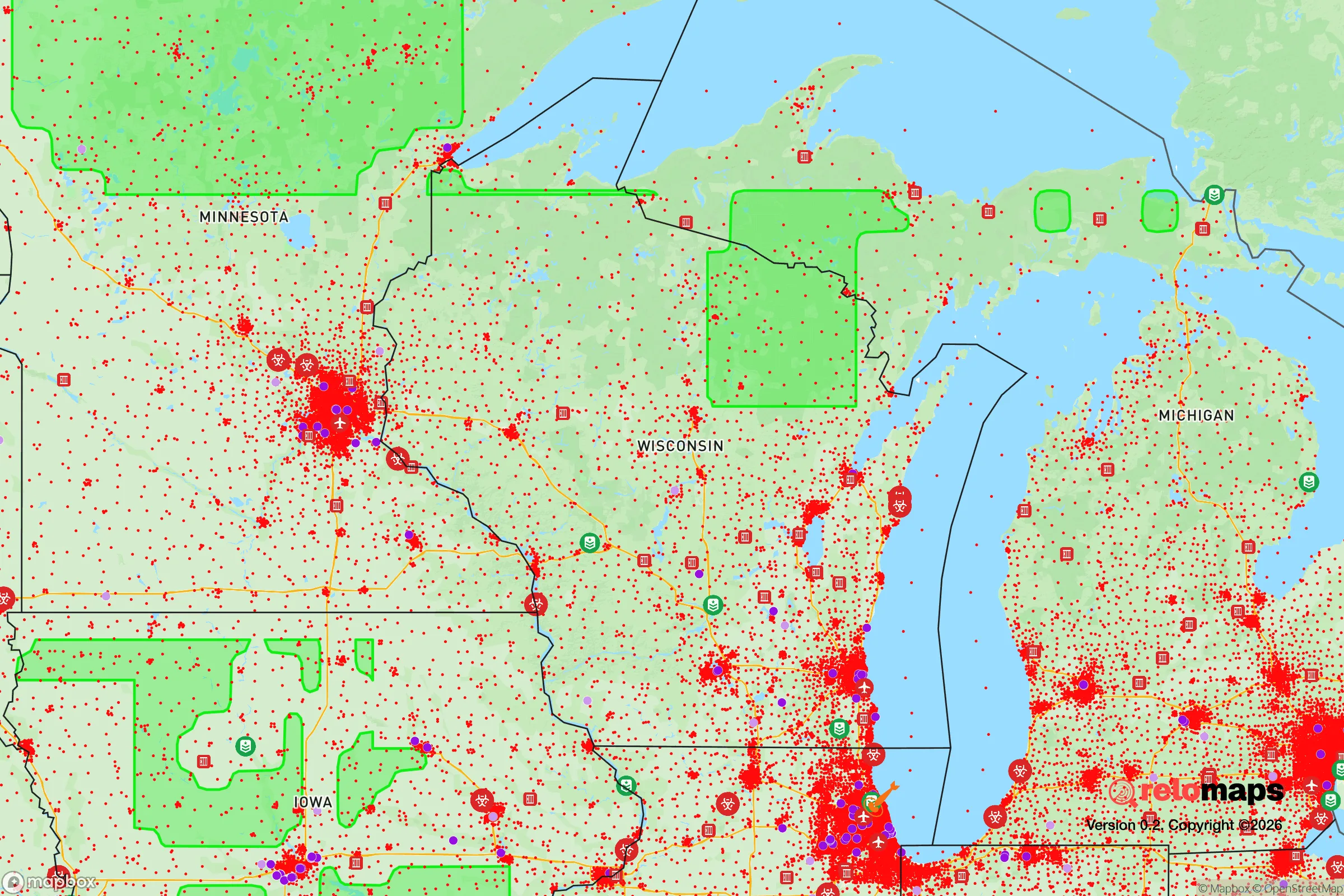
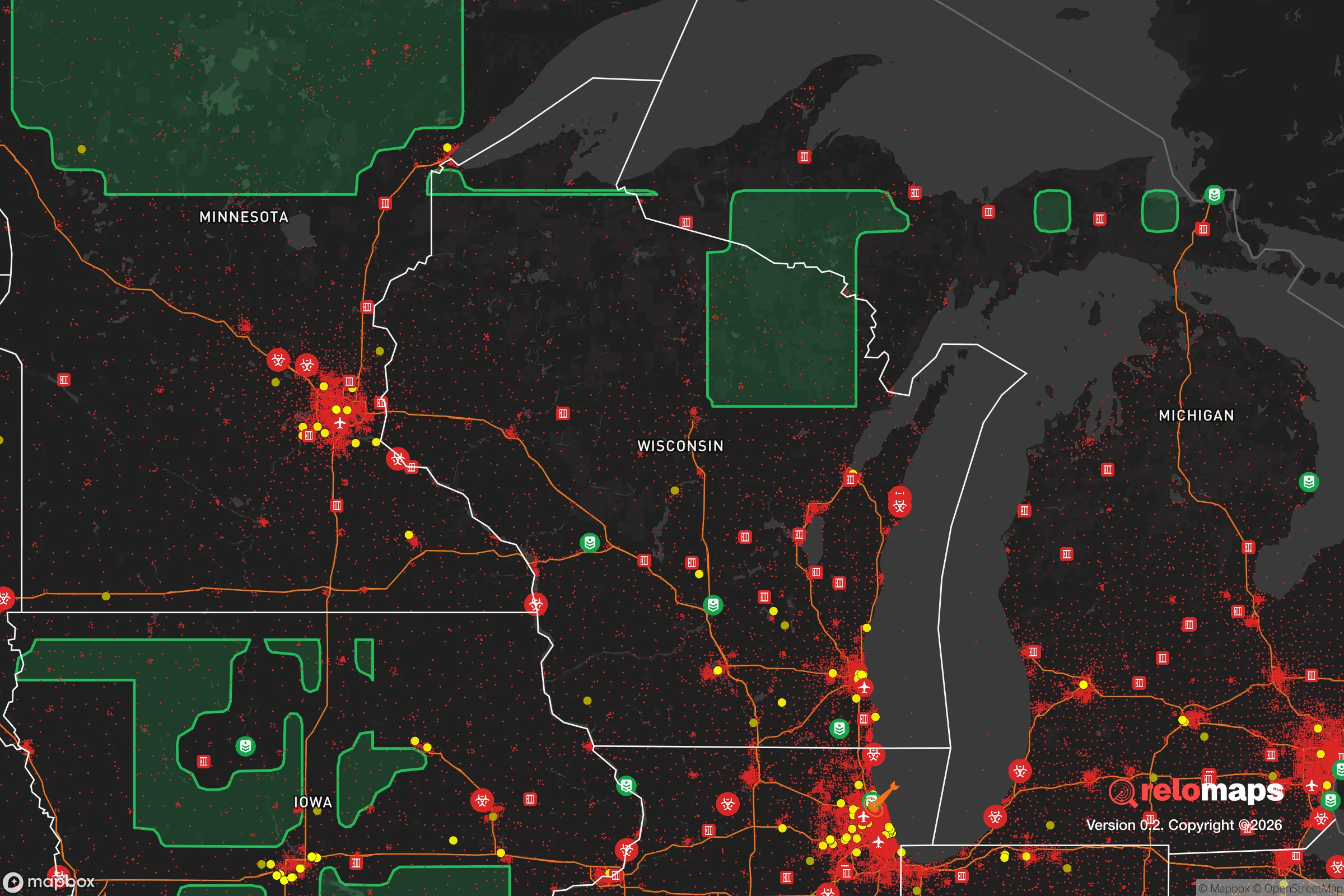


Important Note: For informational purposes only. This does not mean nothing bad ever happens in the green zones. Please use common sense. This is based on public data and modeled with AI. We tried to take a conservative approach but mistakes happen. We update this regularly as new information becomes available.
Solar Generator Recommendations
Backup power matters more here than in safer locations. We've picked three solar generators across budgets and capacity tiers — start with the budget unit if you only need a few essentials, or step up if you want to run a fridge and HVAC for days at a time.

Jackery Portable Power Station Explorer 300
Budget OptionPower on the Go: Weighing only 11 lbs, it's convenient to set up and store with book-sized foldable solar panels

BLUETTI Portable Power Station AC180
Designed for both indoor and outdoor scenarios, AC180 is highly capable as it has a robost capacity and continuous output power.

EF ECOFLOW DELTA Pro Ultra Power Station
Upgraded PickEcoFlow DELTA Pro Ultra is a whole-home energy system designed to grow with your family. Integrated with the Smart Home Panel 2, it scales to meet your evolving energy needs — keeping your home powered, intelligent, and secure through every stage of life.
We earn a commission, at no additional cost to you.
Strategic Assessment Analysis
Caledonia, Wisconsin, offers a surprisingly resilient strategic position for those prioritizing preparedness and long-term stability. Located in Racine County along the Lake Michigan shoreline, this village of roughly 11,000 residents sits about 20 miles south of Milwaukee and 70 miles north of Chicago. Its location provides a buffer from the immediate fallout zones of major metropolitan areas while still offering access to critical supply chains and transportation corridors. The area's agricultural base, access to fresh water, and relatively low population density make it a viable option for individuals and families seeking a balance between rural self-sufficiency and proximity to essential infrastructure.
Geographic position and natural advantages for long-term stability
Caledonia's geography is its primary strategic asset. The village sits on a bluff overlooking Lake Michigan, providing a virtually inexhaustible source of fresh water—a critical resource in any prolonged disruption scenario. The surrounding Racine County is dominated by farmland, with over 60% of the land area dedicated to agriculture, meaning local food production is not a theoretical exercise but a current reality. The terrain is gently rolling, offering natural drainage and defensible high ground in several neighborhoods. The proximity to the lake also moderates temperatures, reducing the severity of both summer heat and winter cold compared to inland areas. For a relocator, this means lower heating and cooling costs and a more predictable growing season for gardens or small-scale farming. The area is also outside the primary tornado alley that cuts through central Wisconsin, though severe weather is still possible. The combination of lake-effect moderation and agricultural abundance gives Caledonia a tangible edge over purely suburban or exurban locations that depend entirely on distant supply chains.
Risks, exposures, and proximity to fallout-relevant landmarks
No location is without vulnerabilities, and Caledonia has several that a strategic relocator must weigh. The most significant risk is its proximity to the I-94 corridor, a major north-south artery connecting Chicago to Milwaukee. In a mass evacuation event, this highway would become a choke point, and the village lies within 10 miles of it. The nearby Mitchell International Airport in Milwaukee (about 15 miles north) and the Port of Milwaukee are potential targets or secondary fallout zones in a major conflict or terrorist event. The village is also within 50 miles of the Zion Nuclear Power Station in Illinois, which, while decommissioned, still contains spent fuel on site. Any incident there could affect air and water quality downwind. Additionally, Caledonia is not far from the urban centers of Kenosha and Racine, which have experienced civil unrest in recent years. While the village itself is predominantly residential and agricultural, its location between two larger cities means it could see spillover from urban disruptions. The key is that these risks are manageable with proper planning—unlike being directly in Milwaukee or Chicago, where escape routes are limited and population density creates immediate competition for resources.
Practical resilience for a relocator: food, water, energy, and defensibility
For the serious prepper, Caledonia offers a workable foundation for self-sufficiency. Water access is excellent: most homes are on municipal water drawn from Lake Michigan, but private wells are common in rural pockets, and the lake itself is a backup source with proper filtration. The village has multiple parks and natural areas with streams and ponds that can serve as supplementary water sources. Food production is viable: the surrounding farmland means local farmers' markets, CSAs, and direct-from-farm purchases are readily available. Many residential lots are large enough for substantial gardens, and the growing season runs from late April to early October. Energy resilience is mixed: the grid is reliable but not hardened against major EMP or cyber attacks. However, the prevalence of rural properties means solar panels and backup generators are common and socially accepted. The village's building codes are not restrictive enough to prevent installing off-grid systems. Defensibility is moderate: the village is spread out, with no single chokepoint that would be easy to control. The bluff areas provide natural observation points, and the many dead-end roads and cul-de-sacs in newer subdivisions create natural barriers to mass movement. The local law enforcement presence is adequate for a community this size, but in a prolonged crisis, residents would largely be on their own—which is exactly the mindset a strategic relocator should have.
Community character and cultural alignment for conservative-leaning families
Caledonia's demographic and cultural profile aligns well with a conservative, self-reliant worldview. The village has a strong tradition of volunteer fire departments, active churches, and community organizations that emphasize mutual aid rather than government dependency. The school district, Racine Unified, has mixed reviews, but several private and parochial schools operate in the area, and homeschooling is legal and relatively common in Wisconsin. The local economy is anchored by manufacturing, agriculture, and small businesses, not government or tech sectors, which means the workforce is accustomed to hands-on skills and practical problem-solving. Gun ownership is common, and the county sheriff's office is known for a pro-Second Amendment stance. The nearest major city, Milwaukee, is a Democratic stronghold, but Racine County has trended more conservative in recent elections, reflecting a rural and exurban backlash against urban policies. For a family looking to raise children with traditional values and practical skills, Caledonia offers a community where neighbors still know each other and where self-sufficiency is respected, not viewed as eccentric.
The overall strategic picture for Caledonia is one of calculated viability. It is not a remote bunker location—it is a working-class exurb with real assets and real liabilities. The lake provides water and moderation, the farmland provides food, and the distance from major cities provides a buffer. But the proximity to Milwaukee, Chicago, and the I-94 corridor means that any major event in those cities will ripple outward. The wise relocator will treat Caledonia as a base camp, not a fortress: stock supplies, develop local networks, learn the back roads, and maintain the ability to move further north or west if conditions deteriorate. For a conservative-leaning individual or family who wants to be part of a functioning community while maintaining the capacity to weather disruption, Caledonia is a solid, unglamorous choice that deserves serious consideration. It won't make headlines, but it might just keep you safe when the headlines turn bad.

* Values derived from national, state, county, city and local statistics and may differ in a specific area. Last updated: 2026-04-21T10:21:38.000Z
Narrative content on this page is AI-generated and may contain mistakes. Verify any details that matter before acting on them.
ReloMaps may earn a commission from affiliate links at no extra cost to you.

