Photo: Wikipedia
Demographics of Caledonia, WI
Affluence Level in Caledonia, WI
A middle-class area roughly in line with national averages across income, home values, education, and employment.
People of Caledonia, WI
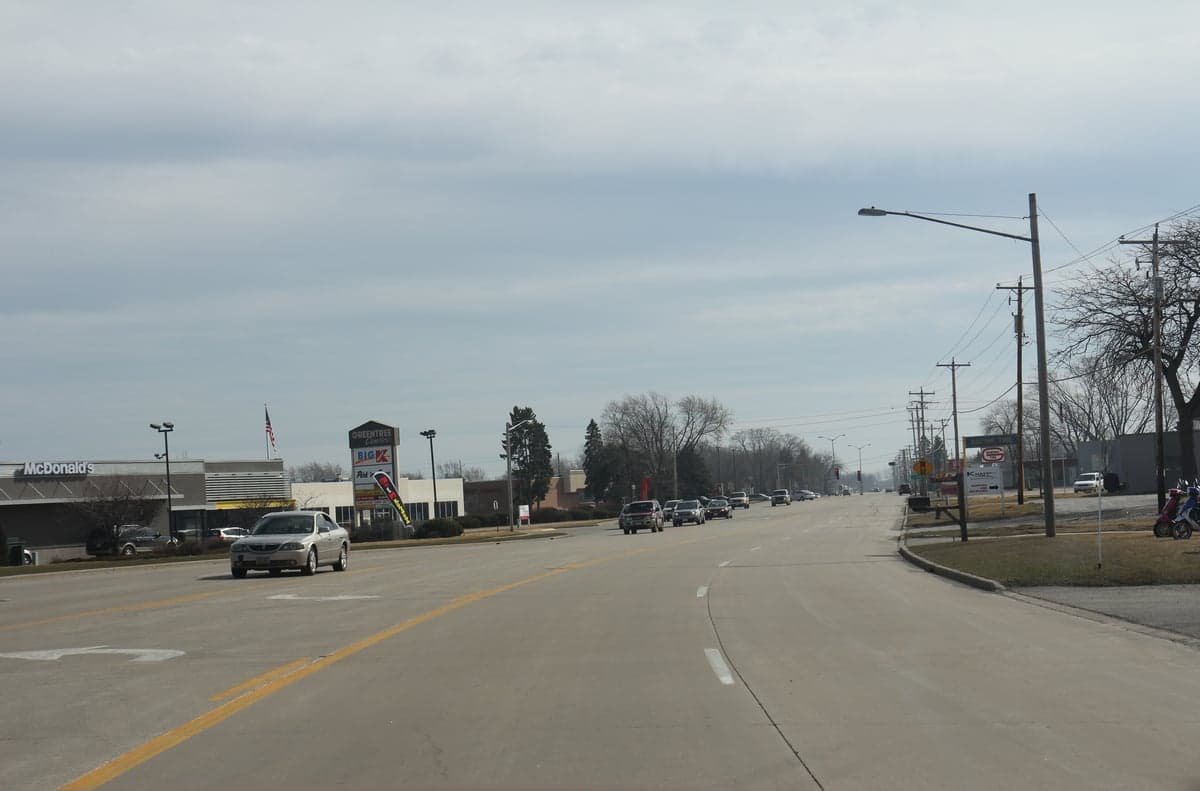
The people of Caledonia, Wisconsin, today number 25,292 and form a predominantly white, family-oriented community with a growing Hispanic presence and small but established Asian and Indian populations. The city’s character is shaped by its roots as a rural farming township that transformed into a suburban bedroom community for Racine and Milwaukee, retaining a lower density than neighboring suburbs. With a foreign-born rate of just 2.6%, Caledonia remains less diverse than Racine County as a whole, but its demographic shifts over the past two decades signal a gradual diversification, particularly in its newer subdivisions.
How the city was settled and grew
Caledonia’s original population arrived in the 1830s and 1840s, drawn by the federal government’s land sales following the Black Hawk War. The first settlers were Yankees from New England and New York, who established farms along the Root River and built the area’s earliest roads. By the 1850s, German and Irish immigrants began arriving in significant numbers, taking up agricultural land in what are now the West Caledonia and North Caledonia neighborhoods. These groups built the area’s first churches and schools, with St. Louis Catholic Church (founded 1854) serving the Irish, and several Lutheran congregations serving the Germans. The village of Franksville, in the northwestern corner of modern Caledonia, became a small commercial hub for these farming families. A second wave of German and Polish immigrants arrived between 1880 and 1910, settling in the Eagle Lake area and along Highway 38, where they established dairy farms that supplied the Racine creameries. Caledonia remained a rural township with fewer than 3,000 residents through the 1950s, its population almost entirely white and native-born.
Modern era (post-1965)
The post-1965 period brought suburbanization, not immigration. The Immigration and Nationality Act of 1965 had little immediate effect on Caledonia, which remained overwhelmingly white. Instead, the major demographic change was domestic: families from Racine and Milwaukee moved outward seeking larger lots and lower taxes. The Meadowbrook and Green Ridge subdivisions, built in the 1970s and 1980s, absorbed most of this white, middle-class outflow. By 1990, Caledonia’s population had grown to 11,000, still 98% white. The first non-white residents arrived in small numbers during the 1990s, primarily as professionals working at Racine’s SC Johnson and Case New Holland. The Hickory Hills neighborhood, developed in the early 2000s, saw the first notable cluster of East/Southeast Asian families (now 1.0% of the city) and Indian-subcontinent families (0.9%), drawn by the area’s good schools and proximity to I-94. The Hispanic population began growing more visibly after 2010, rising from 4.5% to 11.2% by 2024. These families, largely of Mexican heritage, have concentrated in the Franksville area and along the Highway 38 corridor, where older, more affordable housing stock exists. The Black population, at 3.0%, is small but has grown steadily since 2000, with most households settling in the Eagle Lake and West Caledonia neighborhoods.
The future
Caledonia’s population is likely to continue its slow diversification, but the pace will depend on housing development. The city has limited undeveloped land, and new construction is concentrated in a few large-lot subdivisions that appeal primarily to white families from Racine and Milwaukee. The Hispanic population is the fastest-growing segment, projected to reach 14-16% by 2035, driven by natural increase and continued migration from Racine’s existing Hispanic neighborhoods. The East/Southeast Asian and Indian populations are expected to remain small but stable, as the city lacks the professional job base that attracts larger Asian communities to suburbs like Brookfield or Mequon. The white population, while still dominant at 79.6%, is aging and declining slightly as younger families move to newer subdivisions in neighboring Mount Pleasant and Sturtevant. Caledonia is not tribalizing into distinct ethnic enclaves; rather, its non-white residents are dispersing across the city, with no single neighborhood exceeding 20% minority. This pattern suggests assimilation rather than segregation, but it also means that ethnic institutions—churches, grocery stores, cultural centers—are unlikely to develop, which may limit the city’s appeal to immigrant families seeking co-ethnic community.
Caledonia is becoming a more diverse, but still predominantly white, suburban community where demographic change is gradual and geographically diffuse. For a conservative-leaning family moving in now, the city offers stability, good schools, and a low crime rate, with the understanding that the population will be slightly less white and slightly more Hispanic in a decade. The city’s future is one of slow, steady diversification without dramatic cultural or political shifts—a place where newcomers of any background can expect to be a small minority in most neighborhoods, but not an isolated one.

* Values derived from national, state, county, city and local statistics and may differ in a specific area. Last updated: 2026-04-21T10:21:38.000Z
Narrative content on this page is AI-generated and may contain mistakes. Verify any details that matter before acting on them.
ReloMaps may earn a commission from affiliate links at no extra cost to you.

